Torah for now

Archive for January, 2021

Measure our Dreams for Tetzaveh

I originally wrote this exactly four years ago, for DLTI but never published. A favorite kid’s book of mine is the Big Orange Splot, (Daniel Pinkwater), in which a sea gull spills a can of orange paint on the owner, Mr. Plumbean’s roof. Instead of repainting or erasing, the owner leaves the blemish, turns it into a sun image, and remakes his whole home to reflect his dreams. “My house is me and I am it. My house is where I like to be and it looks like all my dreams.” And the neighborhood responds, until all the homes reflect their owner’s dreams and soul. According to Rav Kook, the loving details of the mishkan show us the various ways to connect to G-d. Could Mishkan be a map of our hopes and dreams and very soul. But what about the “splots” – the disappointments, challenges, faults, shame. Maybe they are important too, like Mr. Plumbean’s splot, can become the sun in our scene!  

Mansion dreams in giant sizes filled me when I was younger

in center was a room made and star dust and light

E                      F#m7                                 G#m7         F#m7   B7

Today a tent will do, a canopy where together we can become whole

D                     F#m7                                 G#m7

I think there’s sublime design to my very soul

E                                 F#m7                                 G#m7                                     B7

Taking God with us, it’s how WE Carry  our Dreams through the journey of years

D                                              F#m7                                  G#m7          F#m7

How can our dreams survive intact through the all the fears?

Cut the cloth from love, Measure out the seams with care

cast jewels of joy on the breast plate and light that flame, eternal flame

Mansion dreams in giant sizes filled me when I was younger

What Remains in the center is a room made and star dust and light

E                      F#m7                                 G#m7         F#m7                           B7

Today a tent will do, a canopy where together we can become whole

D                                 A                                  F#m                 G#m

I think there’s sublime design to my very soul

But off on the side is a dark fearful room

D                      A

Hurt, anguish doubt emptiness and gloom

is this all sublime design too or simply my chains?

If I can embrace that place too,

a soft gentle breeze blows right through

to fan my ner tamid to blazing blue and yellow and purple and scarlet hues.

Points the way You Helps me see way through

Chorus
Be Like a Tree: Live Righteously

Why bother? What is the Reward for living a good life: is it during one’s lifetime, or is it in olam haba’a, the world to come? And what exactly is the world to come? And what does this all have to do with trees, and the Holiday of Tu B’Shevat, the Jewish Arbor day?

I have recently watched the wonderful new Pixar movie Soul. One thing the movie creates is an adorable version of the spiritual realms beyond earth, for souls waiting to make the journey to earth, and also hints at a “hereafter” for departed souls.  Is this the world to come, or is it our own future, the world which our children will inherit? The answer matters a lot, for the environmental crisis is nearing a crucial point. If we can envision a changed world, we can enable a beautiful planet rich in life that can support future souls waiting to be born. If we cannot, we have just plain failed. Now is the time!

All this year I’ve been studying Pirke Avot with Dr. Joseph Rosenstein. These paragraphs reflect wisdom and advice for folks in all walks of life during Mishnaic times, when Judiasm was reeling and recreating itself following the destruction of the second Temple.   In these Chapters are, evolving ideas of how the Rabbis of this period answer this question of the reward for living a good life, and it begins by defining “good” as a life of learning, spiritual service and acts of loving kindness. In Chapter1: 2, Shimon Hatzadik famously answers that the entire world stands on those three pillars!

Chapter 1:14 ends in teaching  im lo achshav eimatai. If I am not for myself, who will be for me, if I am only for myself, what am I, and If not now, when? The reward of righteous living is creating a good world, it’s up to us.

But in Chapter two, which is written later, we see a very different answer: In teaching 20-21 Rabbi Tarfon teaches “The day is short, the task is great, the workmen are sluggish, the reward is great, and the Boss (G!d) is insistent. Then in verse 21, which begins “It is not up to you to complete the work (G!d’s work), but you are not free to desist,…and Know that the reward of the righteous is in the world to come.

Whoa, what happened since chapter one?

The task of living a life of the mind and spirit, rich with acts of loving kindness, it seems has grown overwhelming. For me this often seems true in our days too!  The idea of a ‘hereafter’ where justice reigns had taken a foothold in our imaginations, in order to persist with righteous living in the face of discouraging times.

But we return to our roots in Chapter three, verse 22 where Elazar ben Azaria teaches that the reward is in this world:  that wisdom and loving deeds afford the person a sort of “soul protection” in the face of life’s storms. And he does it by comparing a human to a tree! There are a couple of other sources that say a human being is like a tree. In psalm 92  – tzaddik katamar,  the Righteous person is like the date palm – bearing fruit into old age. Here in Pirke Avot, chapter three, Ben Azaria says there are two kinds of people:

  1. The one whose wisdom is greater than their deeds is like a tree with many branches butfew roots, a strong wind uproots it and flips it onto its face. Further this person shall be like a lonely one in the wasteland, and shall not see when good comes; they shall dwell on the parched soil in the wilderness, a salt-saturated land which is uninhabitable. Eretz m’lacha v’ lo teshev.
  2. The other type of person whose deeds are greater than their wisdom is like a tree whose branches are few but has many roots. Even if all the winds of the world come and blow upon it, they cannot move it from its place. Of such a one it is said they shall be like a tree planted by the waters, which spreads out its roots to the stream of water. Their leaves will remain fresh, they will not be troubled in the year of drought, and they will not cease to bear fruit.

Are there any other texts that liken a human being to a tree? Funny you should ask! In Deuteronomy chapter 20:19, is an amazing verse from where we get the command not to destroy food bearing trees (and all trees have some sort of food: acorns, for example). Never, even if you are besieging a city in times of war. The reason: because is a tree of the field a man coming before you? Fascinatingly, this verse can also be read: the human is a tree of the field!

Finally in Ecclesiastes Rabbah 7:13 G!d says to the human to look at how beautiful My world is. I made it all for you. If you corrupt it no one will be left to repair it.

 I’ve mashed up these texts for the holiday of TuB’shevat (a sort of Jewish Arbor day) into a song and an imperative.

Be like a tree,

Live righteously

who will remain after

 you to repair this wondrous world

Ki ha-ADAM

 EITZ HASADEH

A tree of the field is like

you or me

it’s fruit is sweet  

Ki ha-ADAM

 EITZ HASADEH

A tree of the field is like you or me

Be  someone

whose love is beyond wisdom,

With so many roots..

That Even if all the winds of the world come

to blow you down,

they cannot fool you

you shall be a tree planted by the waters

Be like a tree,

Live righteously

who will remain after

 you to repair this wondrous world

you will bear  sweet fruit

Ki ha-ADAM

EITZ HASADEH

A tree of the field is like you or me

More powerful than 80 million Locusts: Bo

Bo – Come to Pharoah Commands G!d! But Moses and Pharoah fail time and again in their mission to liberate their people And so the final three plagues will descend in ever increasing darkness. The first of these is locusts. According to National Geographic, there are 80 million locusts in a swarm. 80 million buzzing, moving bits of darkness, that devour your food and create another type of darkness: hunger and poverty.

Then the ninth plague, actual darkness, but no ordinary darkness, as we’ll explore. And darkest of all – plague of the slaying of the first born, is courtesy of the Angel of Death.

I have a confession. I hate the darkness, perhaps you do too? I know we need the darkness to appreciate the light, and that death is a part of life. But the idea that G!d is in charge of it – an Angel of Death, is deeply troubling. I have only recently in my (not so young) life come to (sort of) embrace sadness. In part to  R’ Jay Michaelson’s amazing book The Gate of Tears.  It is liberating, and necessary to be able to emerge into the light and joy. I have written before of the animated movie Inside Out and its ode to sadness and ultimately, joy.

I remember lying in bed in total darkness following the aftermath of Hurricane Sandy at 7:00 in the evening, thinking, I get it, G!d’s still here, even in the darkness. But I didn’t get it – I still meant the good and the light. Somewhere in my struggle, a friend recommended R’ Rami Shapiro’s book Amazing Chesed. He likens God to the sun, and G!d’s love to sunlight. The sun shines on us all, and very impressively, I might add, from 93 million miles away bestowing life through photosynthesis and warmth. But the sunshine can blind and burn – the impact or effect is part of the package, of the reality at the core of existence. He writes: Chesed (G!d’s loving kindness) isn’t a reward, it’s reality… You cannot control existence; all you can do is learn to work with it, to navigate God’s grace in such a way as to live graciously with a sense of radical acceptance, abounding compassion and deep tranquility.  

So the awareness of G!d’s grace can be a profound gift, even with the darkness. I add my own spin to this understanding: that G!d is the creative power that comes into play when components of the universe are in supportive relationship with one another: the relationship of chesed.   

Now, back to the plagues. Exodus 10:21

Then YHVH said to Moses, “Hold out your arm toward the sky that there may be darkness upon the land of Egypt, a darkness that can be touched.”  When’s the last time you could touch the dark? This is no ordinary darkness! Moses held out his arm toward the sky and thick darkness descended upon all the land of Egypt for three days.(Sefaria’s translation)  The next verse is telling,  How dark was it? It does not say “so dark you couldn’t see your hand in front of your face.” I transate it: (so dark that..) A person could not see his sibling and a person could not rise off their behinds for three days! And to all the children of Israel, there was light in their settlements.

Nachmanides comments that it’s a magical mist-like darkness. Maybe.  To me it’s clearly a darkness of the spirit. One that doesn’t allow you to see that the human being sitting next to you is your brother or sister. Perhaps further,  the loneliness that results becomes a depression – that doesn’t allow you to get off your bottom.

But the dwellings of the Israelites – well, they were painting their doors to look like wombs. (Thanks R’ Arthur Waskow) They were about to get birthed into a relationship with one another, with the land, and with G!d – to become a new free people. From the darkness they would emerge into the light, redeemed together.

Take away: we can be agents of chesed in the world, channeling that sunlight if we act together in love. And that’s more powerful than 80 million buzzing locusts!

Healer of the Broken Hearted, Va-era

Fred Rogers is a hero of mine. I watched Mr. Roger’s Neighborhood with my daughters as they grew. A wonderful movie from 2019 A Beautiful Day in the Neighborhood is based on the friendship between Fred Rogers and a journalist, and an actual episode of the television show. The journalist, Lloyd in the movie, had heart had been broken as a child by the death of his mother and his Dad’s abandonment of the family in his inability to handle the loss. Lloyd never healed, and cannot deal with his father, with his childhood in any way. I don’t want to give too much away, but Fred Rogers, in Moses-like humility, sees Lloyd’s hurting and becomes a messenger of caring, a messenger of the Most High, and of healing for Lloyd. I won’t say more, except to urge you to see the movie if you have not yet, or view it again before next High Holy days

I suspect none of us escapes life without a broken heart. What do you do with the broken heart is the real question. Although my wounds were not as deep as Lloyd’s, I tried the same tactic as he, building a wall around my heart, believing in the fairy tales, that you can leave home and live happily ever after, never having to look back. I did not even realize how broken I was, until having to try to care for a very sick parent, I could not handle it, and had an emotional break. I will every be grateful for my family, and my spiritual counselor, my mashpiya ,who helped me look back honestly, to let them, and to the power of Love in this universe Healer of the Broken hearted. It took me a lifetime to heal, but man, did it feel liberating. I still struggle, but also remember the redemption and how great it felt. I should have wondered why I could cry buckets at a sad movie, but not when a loved one died – just feeling empty loss. I have done some rear-view crying. I feel more alive now than ever.

Perhaps all of this is why I resonate so strongly with Shir Yaakov’s beautiful interpretation Healer of the Broken Hearted. It is such a powerful name for G!d, I think of it each morning when I awake and listen to my heartbeat, and remember. Yet this week’s parashah seems to challenge this view with the words “ I will harden Paroah’s heart”. How can these be reconciled?

A new name for the Holy One is  introduced in parashat Va-era, spelled  YHVH, it  is unpronounceable, interbreathing of all life which, means existence. This  new name according to Rashi, and Talmud, and more, is associated with Chesed, loving kindness,. it is this name, YHVH, associated with love and compassion, that we invoke for compassion for our lives on the High Holy days, -this name -inter-breathing of existence (thanks R’ Arthur Waskow) who has heard our cry and will be our redeemer. So  our “fearless” leader, Moshe, when asked to go to Egypt and go to Pharoah so the Israelites may be set free, says in his vulnerability “I am  inadequate” The Israelites would not listen to me; how then should Pharaoh heed me, a man of uncircumcised lips (aral s’fatayim) say Moses in Exodus 6: 12. in his humility before G!d, and gets the promise that both God, be with him and his brother Aaron too. And that’s when YHVY tells Moshes “I will harden Paroah’s heart” Eventually Moshe is convinced he goes to Egypt with Aharon to be our salvation.

What of Pharoah’s heart?  If you look closely  7:13 when Aaron’s staff swallowed Egyptians,  in verse 22 after the plague of blood Paroah –  y‘chazek–strengthens his  own heart – to follow his own urges of anger and to be cruel. After frogs in 8: 11, and insects in 8: 28 and animal disease in 9:7 Pharoah weighs down his heart. Finally God, in  the plague of boils y’chazek, strengthen’s Pharoah’s heart.  Now fearless, Pharoah’s reveals his true self, the one that kills baby boys born to the wrong ethnic background as a show of strength.  

Torah teaches us: true strength is given us by a heart cracked open by awareness of the brokenness, In vulnerability, in letting God in, we let healing in, we can not only be redeemed,  we can feel each other’s pain.

Maybe the   tension between Moshe and Pharoah – humility and ego/ arrogance is also within us. The liberator and the enslaver are both within us. And that the wisdom that is empathy, born  of the healed heart is our Torah and it glows in our eyes. And is our strength

Times are heartbreaking now, beyond our understanding.  But we have all of this wisdom to lean on.  I’ll end with a song: based on Proverbs 3 by Ira and Julia Levin. Here it is on Spotify

When you need more than your own understanding, lean on the power of love

The wisdom you’ll hold is worth ten times the gold Some sell their souls for in vain

And a peace that surpasses every thrill on this plain. 

Is heard when your soul calls your name

And my roads all lead to peace    Let go of your hold and your sorrow will cease

Wisdom will shine through you like a light the trees

Wisdom will shine and you’ll be free and happy

Wonder, Shemot

I was going to talk about wonder today. And so much has happened since I began to write this drash. We’ve been shaken to our very core. In a prayer vigil on Wednesday night in response to the attack on the Capitol, R’ David Ingbur recalled the Midrash in which Avraham sees palace on fire,  a birah doleket, and Avraham was able to see wonder, and know G!d was there. But that fire was destructive. There’s a different kind of fire in the parashah, Shemot. Moses is shepherding his father in law’s flock in the wilderness, and he comes to the mountain of G!d. (Aren’t all mountains in the wilderness God’s?) Then These amazing words Vayera malach Adonai alav b’labat eish mitoch ha-sneh. And an angel of G!d was seen by him (Moshe) in the heart of fire in the midst of the thorn bush. And he saw –the word for vision Ra-ah is repeated so many times, a humble thorn bush, not an impressive sight, as a wonder! It’s leaves were burning, but not being eaten up. As our capital, our democracy were burning, they were not destroyed.  And Moshe said “I must turn aside asurah na, v’ereh AND SEE et ha-mareh hagadol hazeh,  and see this great VISION.  Rabbi David ended Wednesday night’s service with Esa einai, I will lift my eyes to the mountains.

And I imagine someone gently with lifting my chin in their hand so my eyes can be lifted to hope and wonder

I lost a friend to cancer this week. I heard those same words at her funeral.

How can we, in these circumstances, lift our eyes, turn aside, and see wonder?

For me, words and music of praise help me wake up each morning adding layers of meaning, helps me to re-cognize the wonder.

In an interview in On Being this week, In answer of what it means to be human, Mary Katherine Bateson (daughter of Margaret Mead) answered “We live in a time of real urgency where we have to mine the rich words of our tradition.. We have to learn to use the word “we” to include all life on earth, and shape everything we do to protect it”  All life. All people, able and disabled, brown and white, male and female, and the more than human world as well.

As Moshe lived in a time of urgency.  He was a runaway dis-graced Prince of Egypt, reduced to shepherding for a Midanite Priest. And he would wander into the wilderness, and open his eyes because of a sense of wonder, would experience God, perhaps for the first time in his life, and find his life’s mission and purpose, and save us all. “And in his heart their burned a flame”  Wonder can ignite a flame in our hearts,  wake us up to our purpose, and lift our eyes. How can we jibe the wonder with the brokenness?

The kabbalists of the sixteenth century were refugees of the Spanish Inquisition, and knew well of brokenness. They had a brilliant answer. It’s all about creation, they said, where in a universe filled with G!d’s light, G!d contracted to make room for creation, storing the light in vessels. But the light was too powerful for the vessels and creation shattered into tiny shards, fragments that became corporeal existence. A residue of G!d’s light remains in each fragment Our mission is to re-gognize the holiness in the fragments, and reconnect the fragments as puzzle pieces, into wholeness, sh’lemut, peace. I share this poem of peace by student Rabbi Heather Paul that I have put to melody, and speaks so powerfully. (I hope to add a recording soon.)

God, You scattered the divine sparks 

so that we may find them in each other,

but sometimes, we forget to look. 

We are Your glistening fragments,

Your shards, Your stars. 

We stand here before you, 

ready to gather the sparks, 

ready to illuminate the world

(like One holy campfire.) 

Sim Shalom tovah u’vrachah, Peace, blessed and lovely, when will we be ready?,

We may be scattered, shattered

but we will glow together, grow together,

we will see each other’s shine

and maybe then, dear God,

we will finally be ready

for peace. 

Barukh Atah Adonai, ha-mevarech et kol ha’olam b’shalom 
Blessed are You, God, who illuminates the world with peace.

Ending Genesis and 2020 Vayechi

December 31st, 2020

I wish to start by thanking R’ Elizabeth Goldstein, whose study of this parashah began my week with tears. The parashah Vayechi, meaning And he lived, opens with Jacob’s approaching death and will end the death of Joseph and close the book of Beginnings, of Genesis. It begins as the “days of Yaakov’s death drew near”.  He recognizes this and calls his favorite son Joseph to him, to arrange burial in Canaan. We will say goodbye not just to Jacob and Joseph but to all the richly flawed, and brave and deeply human icons of this first book of Torah. And our tradition says it will make us strong, we will say chazak, be strong! as we complete the book.

And Elizabeth asked us “what have each of us personally lost, and are bidding farewell to” and many of us who have experienced fear and loss and vulnerability. Thus the tears. By allowing vulnerability we honored these feelings, and so somehow made it possible to move on.

As we say goodbye to this year, on New Year’s eve.

The old year, with all it’s drama and pathos.

The old seasons. The days are longer, sap will flow, spring is coming.

And to too many souls lost.

What do we do? How can we move on with mortality so near?

Well what does Israel do?

He first invokes his father and grandfather and then calls his grandchildren near, calls them his own, invoking time and generations. Verse 10 chapter 47 – Israel’s eyes were dim with age, he could not see. And Joseph brought them close and he kissed and embraced them in gratitude. I didn’t think I’d ever see you, and G!d has let me see your children.  Gratitude is an enormous part of the answer. Then he makes a small tikkun,  a correction that will endure. All through Torah, where the first born child traditionally had the right to twice the inheritance of others, and to be the leader of the clan, G!d had other plans, and this has led to strife between brothers. Jacob crosses his hands in blessing Ephraim and Menasseh, the younger on the right before the older, in the order we still do things, though Menasseh was first born. Perhaps we can make sme tikkun too.

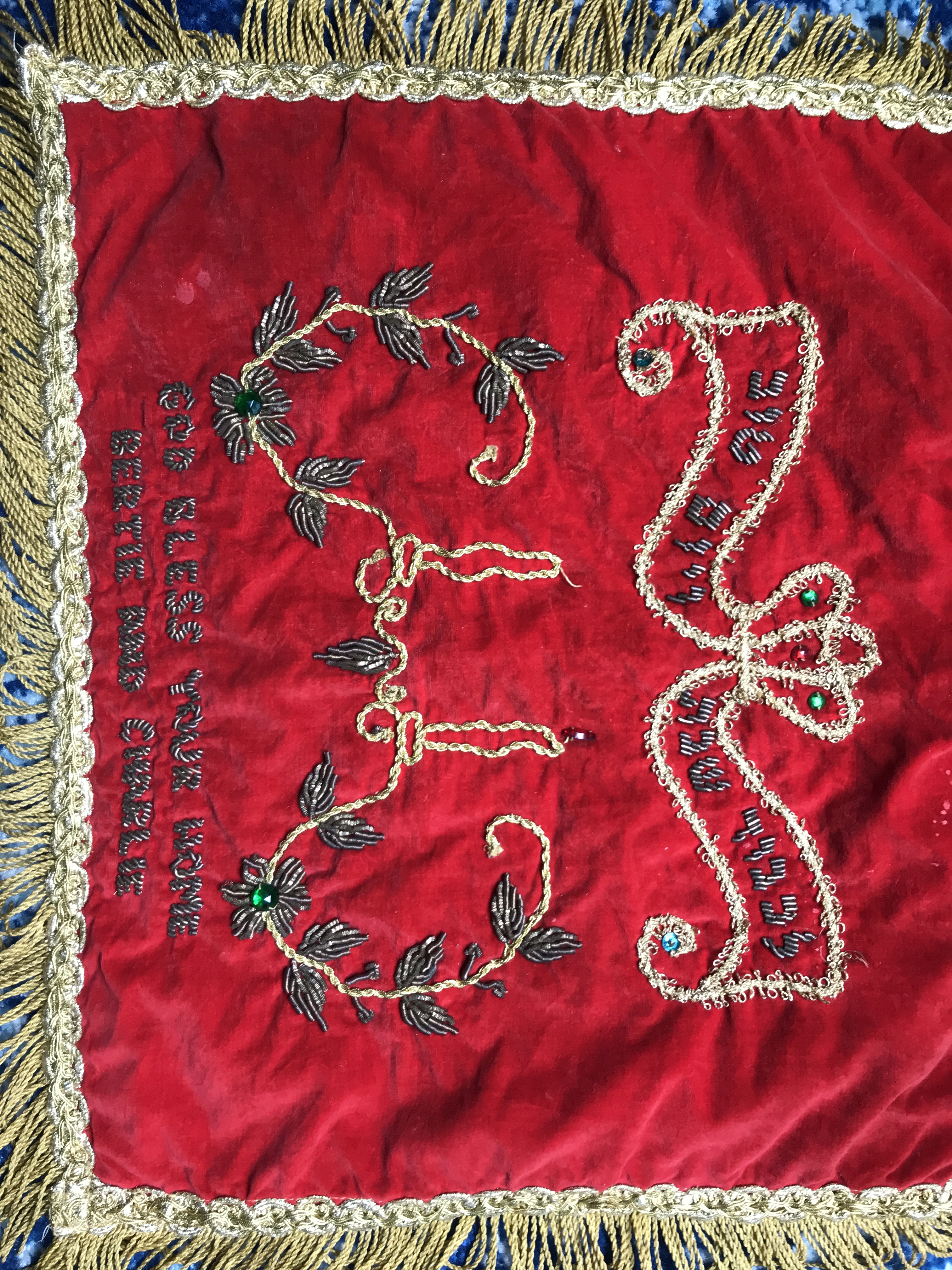
Then he gives the boys his Angel: may the Angel who has redeemed me from harm bless the lads. Ha-malach ha-goel oti m’kol rah y’varech et ha-naarim. My grandparents were my angels in childhood and have become again. I have a few things from my grandparents, including a challah cover with their names embroidered on it. Who have been your angels

May those angels who have helped us through this past year be with our children, with those who will carry forward beyond us.