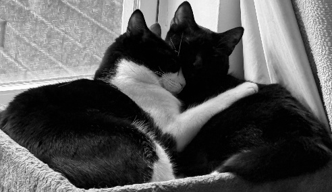
Last year I adopted two rescue kittens. We only wanted one, but they were bonded litter mates. They were really terrified of me, and still are a bit skittish. Why do animals fear us? Genesis 9:2 explains that after the flood, awe and terror of animals against humans would be the reality in a world in which humans are carnivores, which happens after the flood. Noach (Noah) is a righteous man during horribly violent times, and by walking after G8d’s ways ends up becoming life’s salvation. Within the ark there is light and trust, Afterwards, animals are in awe of humans, and terrified. Our part in the brit -covenant, is to be like Noach. Once again, as in the first reading in Genesis (B’reisheet), human connections to the other animals are featured. Our part of the new covenant is to be like Noach, a comfort, a salvation from the slaughter we are imposing. His name actually means comfort! Sources here
The iconic images of spaceship earth teaches us that the entire planet is an ark. Times are violent once again, and we are in need of brave souls who can bring us back into positive relationship to other creatures. Biologists call the era we live in now the Anthropocene – the era of humans changing the planet, and it also is an era of mass extinction. The rate of species disappearing has not been equaled since that asteroid pummeled the Gulf of Mexico, carving out the Yucatan peninsula and raising a firestorm so intense that 75% of species, including the non-bird dinosaurs became extinct (Cretaceous extinction event)
It has been heartbreaking to live through. Perhaps there is hope in an ancient mythical arc and skylight. And a quote by Margaret Mead “Never underestimate the ability of a small group of committed individuals to change the world.” (Mythical meaning larger than life, a culturally essential narrative.)
One of the most interesting parts of the Teva (ark) is the skylight, or Tzohar in the roof, or it might be a jewel which emits light. This light foreshadows the rainbow, a sign of the new covenant where G8d promises not to destroy all life again. White light contains all the colors of the rainbow – they simply must be separated to be seen, but are there all along. A covenant is a mutual deal. What is the human part of this deal? It must be to guard and protect planetary life as Noach did, in parallel to the mitzvah (commandment) given of “Ovda v’shomrah” to serve and to guard the Garden in Genesis, chapter two.
In comparing the blessings of Adam to that given to Noach (Noah) upon leaving the arc, notice the connection of creatures coming of their own accord by the command of the Holy One to Adam and to Noach. There are many more connections, showing this is a second creation. Both are blessed to be fruitful multiply and fill the earth. In addition Adam is commanded to “kivsuah” -conquer her (the earth). But after the violence of Noach’s generation, permission is not given to conquer the earth. Interestingly, however, permission is given to slaughter animals for meat. According to Cassuto and Rav Kook, this is a temporary situation, a compromise until our empathy turns, to one another, and to other creatures. Factory farms of today are not only steeped in unethical treatment of animals, and generation of harmful gut bacteria that get into the irrigation water, they are a key driver of deforestation and climate change. It treats animal life as if they were not creatures, rather as factory parts. Eco-kosher takes ethics into consideration. Factory farms are clearly unethical and should never be kosher.
Returning to my kittens and their fear of me – Kedushat Levi explains: (as it says in Genesis 9:2), “And the fear of you and the dread of you shall be upon every beast of the earth.” Works of Mussar (ethical teachings) explain that when Yisrael– which I’ll translate as G8d-wrestlers after teachings of Arthur Waskow, perform the will of the Almighty, all creatures receive their sustenance through them—as the Sages stated (*Leviticus Rabbah* 36), (it is they who) channel abundance to all the worlds. Consequently, all creatures stand in awe of them;
One of the most profound phrases of Torah, is that “it is not good to be alone”. We live during a time of a loneliness epidemic, which impacts our health, our sanity, our ethical character – without empathy there can be no morality. (Vivek Murtha: Our epidemic of Lonelness and Isolation) I believe the source of human loneliness is hinted at in Genesis chapters 1 and 2. Archeology further reveals about earthlings standing upright as the first step toward evolution of humanity. To be human is to toggle between being upright and lonely, and to being humble and in relationship. In Kaballah, even the Holy One humbly withdraws (tzimtzum) to make room for relationship with others. Furthermore I think this toggling reflects the current disconnect in humanity between those who wish to dominate in aquest for more and more power and those who wish to be humbly in relationship with one another, with the land and her creatures. Sources here
In Genesis, chapter One, earthlings (adam in Hebrew) is/are created from the mud of the earth (adamah), and Divine breath. The midrash (Avot DeRabbi Natan on Gen 3:15) sites “standing up” qum in Hebrew as one of the major steps of human creation (sixth hour) Standing is one of the ways we’re like the Angels. Furthermore the primordial human, was really like G8d – stretching and seeing the universe! After the earthlings ate from the tree of knowledge of Good and Bad, The Holy One squished humans down to size. They could not longer stand before G8d, and no longer had standing in Gan Aden – the Garden of Eden. And of course Cayin (Cain) “rose up” to kill his brother, whose bloods cry out to the Holy One from the ground. Then Cayin had to wander, could not stand.
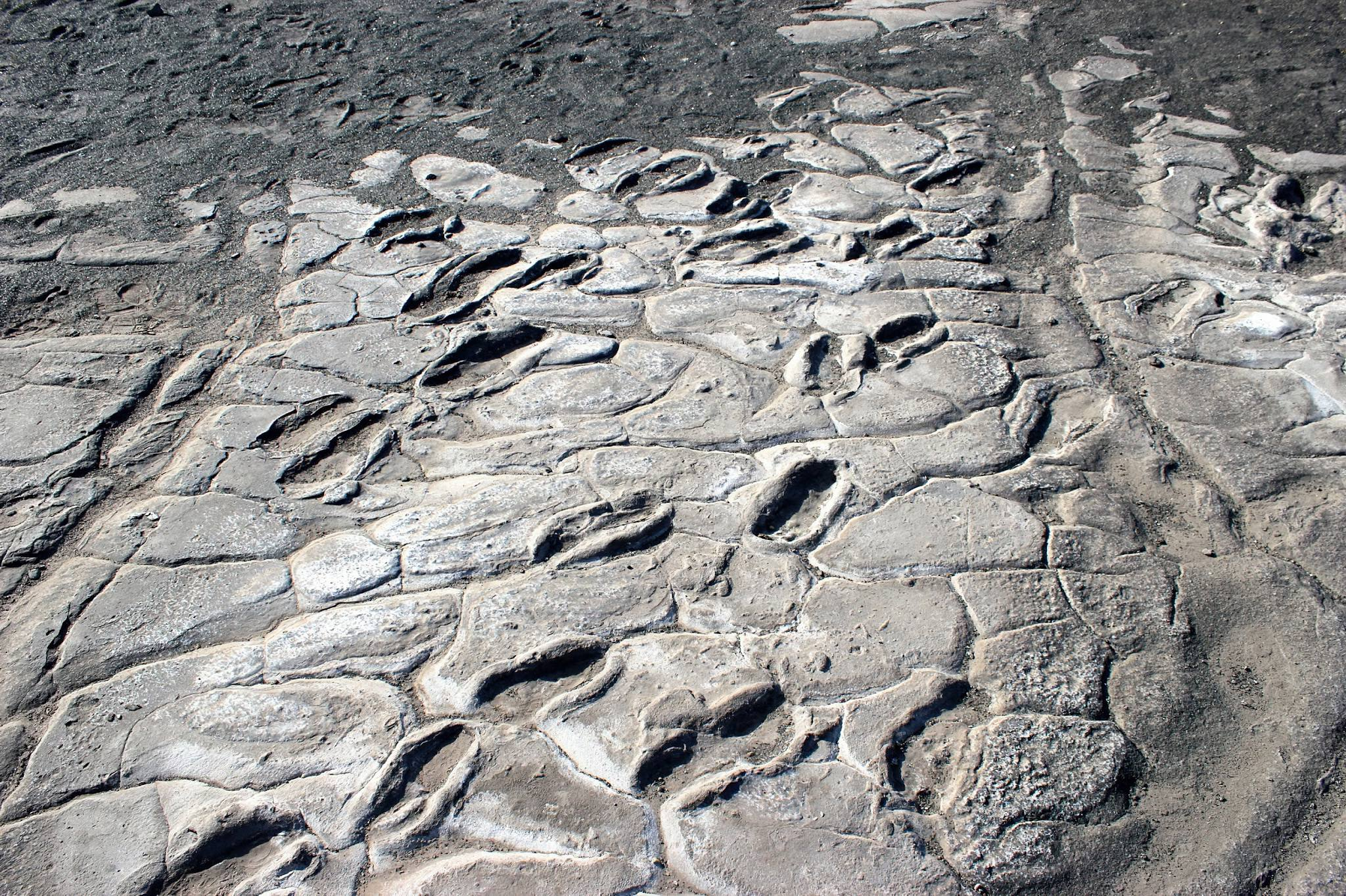
It turns out that in the evolution of ancient humans in Africa, the very first anatomical feature on the road to humanity was… No, not a large brain-case, but an upright stance. More basket-like hips, and the big toe in line with the other toes. There are footprints going back 3.7 million years ago, in which humans walked upon powdery volcanic ash, which then became moistened and hardened by a fine rain, and then covered with more ash to preserve it. Upright stature has advantages in surviving on a plain – of being able to see predators from afar, and freeing hands for carrying and tool use.
What does rising up have to to with being alone? As we tower over other creatures, we are in a position to dominate. In the book of Numbers, to describe how small we felt, when scouting the promised land, the scouts described a land of Giants, in comparison to which we felt like grasshoppers. In fact one of the most derided verses by environmentalists is the apparent permission to “rule over” the animals, in Hebrew “yirdu” Rashi cites the midrash that the word can be read in two ways – to dominate, or to fall. If we are ethical we can dominate, if not we fall. I have translated it as “look down” to capture both meanings. But if we dominate we cannot be in relationship with creatures. Lest you think Adam has no relationship with other creatures – check this out – after The Holy One declares “it is not good for earthling to be alone” G8d brings…each type of animal to see what the earthling will call it. Adam had to go through a period of relating to all other creatures, recognizing a unique loneliness before the separation/creation of mates. And the mate is “kinegdo” opposite the earthling, not lower. Only then does loneliness end,(and of course more trouble begins).
We are like Jacob’s ladder when we stand upright, with our feet on the ground and our heads in the sky. Our very first mitzvah, command from G8d is to “be fruitful, become many, to fill the earth and to conquer “her” It was not lost on the commentators that men conquer earth, and may also rule unkindly over women. Height and might do not make right! In Genesis chapter two, the androgynous earthling will lie down, asleep when his mate “life-giver” Chava comes into relationship with him. And we will always be a toggler between standing and lying down.
~Inspired by Aviva Gottlieb Zornberg’s Reflections on Genesis, “Standing Upright” page 20!
This sermon was given the morning of Erev Yom Kippur at the Universalist Unitarian congregation at Davie, Florida, who were kind enough to let us use their space for Yom Kippur Services.
Everything is connected. When we try to pick out any one thread by itself, it is hitched to everything else. ~John Muir
Jake was a twin, born second, when his mom delivered them, literally grabbing at his brother’s heel. By the time the boys were grown It seemed Jake spent his whole life reaching for light in the shadow of his brother. Although older by only minutes, his big brother was everything he was not – tall, strong, and did I mention, Dad’s favorite. Things got out of hand, and before you know it, Jake was running for his life, chased by the voice of his brother vowing to kill him after their dad died.
Do you recognize this story? This vignette is the story from Genesis, the death threat in chapter 27:41 The brothers are Jacob and Esav,or maybe you recognized it from a family you know -the story is as new as today, and as old as humanity. The brothers are in competition & the parents play favorites, and the family falls apart its center cannot hold.
We need each other in four worlds. The four worlds, in Jewish mystical tradition, exist simultaneously in different levels. They sort of correspond to Abram Maslow’s levels of human needs. The first level is physical. A story that I read a couple of weeks ago in the NY Times, was of a journalist who went on vacation to spend time with her elderly mother. The two of them went snorkling together. At first it was wonderful, but then her mom got into trouble. Getting water into her snorkel, she began to flounder. At first the journalist tried to rescue her mother, swimming toward shore with her mother in tow, but there was a current, and she wasn’t getting anywhere. She was quickly becoming exhausted. She suddenly realized that if instead of swimming, she use one hand to hold her mother, and the other to wave for help, someone would see them who would be much more able than her to help! Her mother lived –and is in her 90s now. The article was entitled: What all successful people have in common. It turns out the “thing” is the ability to round up help, not to tough it out alone! We need one another on a physical level.
The next level of existence and of needs is emotional – we need to feel safety and a sense of belonging. Dr. Naomi Remen (of blessed memory) tells the story of a college student named George, in her wonderful book, “Kitchen Table Stories”. Remen counseled George when his father had suffered from cancer and his housemate Michael had been a tremendous help and support. They became roommates the following year as Michael continued as a grad. student. But this year Michael was getting into trouble using a lot of cocaine and such, hiding it so that nobody else seemed to notice. George was a practitioner of Buddhism. The core of his teaching was to be non-judgemental, and not to interfere. This was not easy for George –in his family folks were always telling the kids what to do. Their friendship reached a crisis point one evening when George brought Liz, a girl he was fond of to the apartment to find Michael shirtless, dazed and covered in his own vomit. When he looked at Liz’s shocked face, he just “lost it”. He picked his friend up, put him in the shower, and told him all the criticisms he’d tried so hard not to say. “It’s too hard watching you throw yourself away” -and then an ultimatum: clean up or get out. Next morning George felt awful –contrite, scared, ashamed of having lost the discipline of ten years of Buddhist practice. He’d responded just as his dad would. Would Mike even be there, he wondered.
He was –pale and looking ill, but straight. Sitting on the sofa and waiting for his friend. They talked. George heard things he hadn’t known about Michael. He was the only child of a wealthy family, raised by “paid strangers” and sent away to boarding school and camp. He’s been given anything he ever wanted, except for the time and attention children/people need so much. In the shower, Michael knew his life mattered to George, and knew he was causing his friend pain. “I knew I was in trouble, but I didn’t know anyone enough to help. Will you help me, George?” George and Michael went to addiction counseling together and stayed friends. George’s honest, authentic self was just what Michael needed! We need one another on this second, emotional level.
On a third level we are connected to all living things. In the natural world interdependence is simply a fact –Life is a magnificent web and we are a part of it. it’s how ecosystems, habitats and the creatures in them survive .Perhaps you know about the teeth cleaning fish and the sharks – or the clown-fish and the anemone. Competition, as we saw with Jacob and Esav does exist – the clashing of antelope horns, the pounding of the silverback male gorilla’s chest, but they are for show, very rarely resulting in death. Humans are the only animals to do that. All the creatures need one another, as we need other creatures for our oxygen, our food, for digestion and much more. Within our bodies, organs are interdependent, within our tissues cells are interdependent, and within our cells chemicals, which themselves are dead as a doornail interact and give rise to much more than the sum of their parts – to life itself. When we were children, we knew we were a part of nature. We disconnect ourself now to our detriment. This poem by the medieval Sufi poet Kabir expresses this poignantly.
I talk to my inner lover and say
why such a rush?
We sense there is some sort of spirit
that loves birds and animals and ants.
Perhaps the same One who gave you Radiance in your mother’s womb
Is it logical that you would be walking around entirely orphaned now?
The truth is you turned away yourself, and decided to go into the dark alone
…You have forgotten what you once knew
The One referenced in this beautiful poem can be God, who is also the connection who saves Biblical Jacob. Unable to ask his brother for help, he dreams of a ladder whose feet rest on the ground, and whose head is in the heavens, and awakens knowing “God is in this place but I, I didn’t know” This ladder to the heavens, connection to the Divine Sublime, is the fourth level of existence. For me (this was my capstone)
G8d is in the magic and the mystery in the spaces between parts of a system. G8d is In the love sparkling between a mother and child, lovers, or friends, as well as in the gravity that holds galaxies and planets and atoms together Those seem very different, – they are G8d immanent, and G8d transcendent. The interstices – the part you don’t see at first glance – in the Relationship between the parts, that’s where life is, that’s where love is, that’s where G8d is. In a Torah scroll, the letters are hand written in black ink. Each letter is limited. But the spaces between the letters are continuous, and unlimited. The Torah was given, say the mystics in black fire upon white fire . Here are the centuries of interpretations, the holiness that surpasses a generation’s limited understanding, the flexibility to evolve with the times. Here is where scripture comes alive. For example
Deuteronomy 30:19 G8d tells us: I have set before you this day, life and death, blessing and cruse, Uvacharta b’chayim choose to be In life so that you and your offspring may live. The medieval commentator Ibn Ezra explains what it means to choose life – to love is to live- for love surpases death. According to shir haShirim, the song of songs – only love is as fierce as death.
What story will our lives tell. If we choose rightly and often enough, to embrace inter -loving, the world we are building can be the world we envision in our dreams
To love God is to love creatures, your near ones, and the immigrant.
We prayed: Shema Yisrael, but it is no ordinary prayer – it does not even address G8d. Whom do you hear it addressing. Listen up you Yisrael – G8d wrestlers/ singer. V’ahavta.Love of God is one of the three loves commanded in Torah. But who or what is G8d, and how can we love G8d?
We are not capable of knowing what G8d is. According to Maimonides, born as Moshe be Maimon, known as the Rambam he was born in Cordova Spain in 1135-ish and died in December 1204. A brilliant physician, scientist, philosopher he taught:
to love G8d, one must contemplate God’s pure and holy CREATIONS! -& we must remember, the great principles of the Creator of the world. … miracles are found in the wisdom of nature and geometry.. Anyone who wants to know the miracles based on God’s words should strive to study… until they know the blessed Holy One through G8d’s creations
. Rambam knew from personal tragedy the power of knowledge of nature.. A person should not go on a voyage in dangerous seas, and expect divine providence to save them! So did his younger brother david, against his advice. His beloved brother perished, leaving a widow and child/ Rambam was devastated. Only devotion to his wisdom studies – Torah, science, philosophy could raise him from his sick bed, bring him back to life from heartbreak. How could Rambam love G8d after such tragedy?
Rambam’s words answer: learn about nature and you will learn to love G8d
In his most controversial work, Guide to the perplexed, written purposely as a mysterious letter to a confused young student, he writes that to interpret the Bible literally is, for the thinking person, the biggest obstacle to true love of G8d and is in effect – a form of idolatry!
Who is G8d for you?
For me G8d is the mysterious connecting and creating force in the universe, filling the interstices of the universe. This power emerges when things are in supportive relationships. And it gives rise to everything – from atoms to cells, from creatures to communities – everything. It is evident as the plus factor where and when the totality becomes greater than the sum of its parts. We are much more than a bag of organs. There are several such forces (ask me later) but most importantly for us, love.
A story to illustrate this love from our tradition
It was Friday morning, the eve of Shabbat that a group of hasidim set out to journey to the town of Lublin, in Poland, to spend Shabbos with their teacher, Rabbi Ya’akov Yitzkah, known as the “Seer of Lublin” Among those traveling was Reb Dovid of Lelov, who had a reputation as a great lover of animals. They set out early, and there should have been plenty of time, but there was a bridge out, so they had to take a detour and a boulder to be moved from the pathway, not to mention rush hour traffic jam (only kidding) and the students arrived just as the sun was about to set!
Not wanting to be late, and miss the teacher’s wisdom they quickly tied up their horse and carriage, and ran into the synagogue. All, except Reb Dovid.
Back at the synagogue, the Seer of Lublin noticed that Dovid was missing. He sent the others to look for him. They searched, and where do you think they found him? He was at the stable, feeding and watering the horses. “What are you doing here, Reb Dovid?”
He replied, the horses were tired from the long journey today, and hungry and thirsty as well. I stayed behind to care for them.” And his face shone from the joy of the mitzvah of baal tzarei chayim, preventing the suffering of animals. It was this joy that the Rabbi could see!
In Hasidic Jewish tradition God can be found in each creation and reached through each pure deed. And we must Be Torah, not just learn it
Jewish Renewal considers itself to be a new Hasidism
Torah has two more commands to love – your neighbor, and the immigrant or stranger – This latter is the most often repeated mitzvah – we should remember that we were oppressed immigrants, and remember Not do that oppression, but to reach out in love.
A story told by Dr. Rachel Naomi Remen z’l’ from her work with cancer patients at a retreat. One man, Yitzhak, an immigrant from poland was 2 years from diagnosis with pancreatic cancer. Brilliant and hard working, Yitzhak became a physicist, and came to the retreat to engage the power of his mind to help beat the cancer. A very loving man to his family, he was very uncomfortable with the touchy feely culture of the retreat. Vat is all dis “huggy huggy vit strangers” he would say. He let folks hug him anyway, relates Remen, After several days of silence and yoga, Remen says, sometimes folks uncover deep truths. Yitzhak related an experience of a beautiful and tender” pinkish light that felt like he was inside a rose. But then,, he realized this light surrounding him came mysteriously from his chest. He described it as a hemorrhage, It frightened him and made him feel vulnerable. It turns out Yitzhak was a child survivor of a concentration camp. He learned to protect himself from hurt by restricting relationships and love to his family only. This was borne of a fear, which he had become aware of only now. But as the end of the week approached , Yitzhak seemed to relax a bit more. Dr. Remen asked him on the last day how he was doing “Better!” Yitzhak replied. He explained that the day before he had a walk on the beach, in which he had talked to G8d. What did G8d say?, Remen Asked “Ah rachel-le, Yitzhak said, I asked the Holy one of Blessing is it ok to love strangers? And in his heart yitzhak hear this answer “yitzhak, vat is dis “strangers? You make strangers! I don’t make strangers! I don’t know how long Yitzhak survived. But i do know that at any age, the blooming of that inner rose is possible. teshuvah a return to the childhood G8d- spark, the one before the trauma is possible, And for Yitzhak this pathway to joy and inner healing happened after a lifetime
We began by singing Shema Yisrael and asking who is God and how can we love. We explored the The 3 loves commanded in Torah – G8d, which can happen even through tragedy, as Rambam discovered by a love of wisdom of nature. Including as Reb Dovid of Poland by loving creation. Loving family friend & by loving the immigrant. How do we love them – Bchol levavcha.. With all your hearts, soul and all! Will this cure your heartache, your cancer? I don’t know. But I know going through whatever life brings us with a heart filled with love is an amazing way to live and can ultimately redeem those sparks and heal a fractured world. I urge today. Open your hearts a bit past your comfort zone. Choose one way. Tell your loved ones you love them. In the words of the prophet Micah – Just do what’s right, love kindness and walk humbly with your G8d.
With honor to my teacher of Maimonides, Dr. Sarah Pessin, Reb Sarah Binah bat Miryam Batya
May I stay amazed! Some folks and all toddlers are amazed with life. But how do you maintain this sense of “radical amazement”, as Rabbi Abraham Joshua Heshcel says – how can you avoid the burnout.
I once saw a sign on a coffee house window, which I never forgot: middle age is a time when a narrow waist and a broad mind swap places!
Recently I began to wonder – what is the connection to cafe?
A bit of history of coffee from Britannica encyclopedia, just because it’s so interesting..
Wild coffee plants were native to a flat region in Ethiopia known as Kaffa. One legend of its discovery is that of a goat herd who was curious – his goats were performing strange antics! He followed that curiosity and sampled the berries the goats had been munching on. He felt exhilarated. And viola! This is the year 850 or so of the common era. From ethiopia, the beans crossed the red sea to Yemen where they were grown.Sufi monks brewed the bean, and used the resulting beverage to stay up all night and praise through the night. Making its way to the Muslim world, coffee houses began, even though the beverage was outlawed, with stiff penalties. From Turkey to Europe. In London in 1600s a cup cost a penny, Coffee houses became nicknamed penny universities –folks would stay up half the night engaged in philosophic, scientific and political discussion. Make no mistake, I am not pushing coffee drinking, I drink it rarely, and only decaf. I find natural ways to boost curiosity
There is mystery – a deep unknown at the heart of the universe, at the core of life itself.
How do we respond to things we just don’t understand? With fear, or with curiosity – is central to the story of our life!
Someone whom I love dearly is transgender. Just a week ago, A friend who has met them asked me what makes them that way? She was curious of something she did not understand. I sort of dismissed it, I responded “that’s a mystery.The important thing is to love and accept them. She agreed- perhaps her curiosity, and open mind is a reason why?
The dark is mysterious. It contains things imagined and real. On October 29 8:00 Pm a category 1 hurricane reached the shores of NJ, where I lived. It collided with a cold air mass which pulled it up the Jersey coast, turning it into a 900 mile wide super-storm named Sandy The damage was tremendous. 8.5 million people were blacked out, including my home. That’s when I first felt that G8d was present even, perhaps especially in the darkness.
The interplay of light and dark is mysterious, Where were you on August 12th of this year/thousands flocked to Spain to see the Total eclipse of the sun. This twilight darkness during daytime – it fills us with awe. It was very moving, emotional, said my daughter. She could not describe the emotion – it was not joy, no ordinary emotion. She is a person of words, a voracious reader. For the second time in her life she was speechless. The first time was at her wedding. The stars fill us with one kind -Awe of G8d transcendent, and love is the signature of G8d imminent. Unfortunately At about the same time, fires, heat waves and drought raged in Spain,later that month catastrophic mudslides devastated Nepal-Tibet border, as retreating glaciers destabilized mountains, The cause of these disasters is not mysterious, the sad consequences of a world that will not stop burning fossil fuels, for some mysterious reason…btw climate change threatens the future of coffee crops.
The word “yirah” in Hebrew, is super important to understanding G8d and Jewish spirituality. But Yirah has two related meanings: it means both fear and awe. Both were in full play this summer. But fear tends to close the heart, and awe to open it – how could one word mean both?
What fills You with Yirah? fear? With Awe? Perhaps these things are not so separate. A year ago I got to hold my first & possibly only grandchild, I gave to him his Hebrew name, Shalom, from my dad, who died many years ago. In January of this year I was at my mother’s side when she passed away. Birth and death, the reminders of time and mortality fill us with awe and fear – there is the unknown- darkness mystery, danger and in each. And in that darkness G8d is with us: Every beat of that baby’s heart, a complex dance of proteins in split second timing -every beat is a miracle, and so is the heart’s capacity for love that outlasts death.
The Awe of G8d can be found – by being amazed by creation, by creatures,
Hummingbirds hearts can beat up to 20 times per second during flight
A seed – contains a plant embryo, and enough food to start a redwood tree.
But plants that heal can also poison – all parts of the foxglove plants are deadly, yet from these can be extracted the potent heart medication digitalis.
A story from our tradition.
Medicine
Rabbi Baruch was Tzaddik in Poland, leader of his community, He had a beloved daughter, Rayzel
. His daughter was ill, and though he prayed, she had gotten worse so Rabbi Barukh went to the city and bought medicine.Rabbi Barukh stared at the bottle, realizing that some of the herbs in the remedy were poisons! He experienced yirah was scared, amazed, curious – how could it be? And why didn’t G8d just heal his daughter from his prayers
If it is Your will Holy One that my daughter, Raizel recover, she would need no medicine. But if You make your miracles visible to all eyes then no one would need faith. So You cloak your doings in the processes of nature. That is why You created healing herbs. Baruch began pacing again. But why are they poisonouos, and why do we give them to the sick? An answer came to him. A little background into Lurianic Kabbalah
AT the beginning of time there was only G8d. G8d longed to be in relationship, and so withdrew and placed some of G8d’s light into vessels. The vessels weren’t strong enough and so they shattered, and the shards, containing sparks of the light formed the material world. So the answer came to him. Aha – the sparks of plants yearn to return to you.
But how can the sparks that fell into poisonous herbs be redeemed? G8d intended them for the sick: and when used with holy intent, the patient redeems the poisonous plant – it too can be reunited with its source.
We are here tonight connect to the Creative Power of the Universe, and the only way to do that is to always be curious,, to always learn -to allow the Awe to grow in you, until says Rambam, the love of the this power fills you,
Maimonides the great medieval philosopher, physician and Rabbi talks about Yirah from his Mishneh Torah
Yirah h is divided into…two parts the first of these parts is fear – fear of consequences, of punishment. Some fear can be helpful, keeping us from getting in trouble, giving us wisdom
The second is the “end of fear” which is awe, which is attained after fulfilling the commandments according to Rambam, the very reason for the mitzvot is for humans to cultivate, or attain Awe of G8d! And following the awe is love of God, which we will return to tomorrow.
So we asked how can Yirah mean both fear and awe? One answer we’ve explored – is the things that provoke them are not so different – but our reaction – do we close in fear or open in love?
Another possiblity
Rabbi Shai Held in the name of his teacher Bernard Steinberg, “Awe is what happens to fear when it stops being about me” – I stop thinking of the consequences to my body, my ego. I can think about G8d. When my mind travels beyond my personal concerns to the wonder of being alive. Life itself, a miracle of the highest order, every second of our existence a complex world, Our own consciousness, an order beyond that. We are here to be grateful for our lives, but beyond gratitude is praise,
This gratitude awe and love commands us to choose and protect life. Especially in the darkness, especially if we don’t understand.
Our tradition has a pathway to live a life of gratitude and awe – says the Talmud, each person is to recite 100 blessings each day. 100 time each day we are to say “wow” – and bravo to the composer! To see each sunset and twilight as a total eclipse of the sun. To be wise to the dangers our actions evoke, consequences such as superstorms and glaciers melting and to have a healthy fear of them. To know in our hearts that G8d is present especially in the darkness. To know that a cup of coffee is amazing, you would not be able thank all the i people that helped bring it to your doorstep, but you can thank the source of seeds and rain and the human mind. To thank the Creator for making us beautiful just as we are, and to remain curious about and grateful for, life.
The traditional blessing begins Baruch ata Ad*nai, You are the source of blessings oh Holy one. Think it’s difficult? Come to our morning services – for a gratitude and awareness – a yirah bath. It’s much easier with friends, One prayer alone contains 19 blessings. I challenge you this year – 100 wow and bravos per day. It has the power to change you and the world.
This is the time of year to “Return”–to do Teshuvah,in Hebrew, as we lead up to standing before God on the High Holy Days. We search our souls, identify our faults, offer apologies, and offer apologies to the Source, perhaps for not keeping G8d before us always (psalm 16) The meaning of teshuvah is clearly “to return” though it is sometimes translated as “repentance” — But return to what? Shlomo Carlebach’s song “Return Again” sung here by his daughter, Neshama, explains that we are to return to the “land of the soul” and “to who you are…born and reborn again” Hashiveinu, from lamentations, offers: “if you return us, we will return”. In other words Teshuvah, which we are told in Deuteronomy 30 is “not too hard or too far for us, but in our mouths and in our hearts to do it” is actually hard -we need the help of the Holy one of Blessing! In the same way, where in Deuteronomy 10 we are commanded to circumcise our own hearts, in Dueteronomy 30 we are assured to have G8d’s help with this task as well. Sources here.
The word Teshuva, is from the Hebrew root Shin, vav, vet, and is repeated over and over again in chapter 30 of Deuteronomy (archive source) In verse 3 alone it’s repeated three times (!), and in a puzzling way. I have added verse 4 for its poetry and beauty.
And YHWH your God will return your “sh’vut’cha“, and have compassion on you: G8d will return to collect you from all the peoples, If you be led away to the ends of the heavens, from there YHWH your God will collect you, from there he will take you,
But wait – How can G8d return? Is the Holy One in exile, and why is it repeated so often?
Many sources – Rashi, Zohar, all make a case, that when we are exiled – spiritually or physically- that G8d or Shechinah is with is in our exile! And that G8d takes us each by the hand to return us to who we are. The repetition of shuv so many times can refer to: spiritual or physical, G8d and the People of Yisrael. It can refer to the good parts of us with the parts that stray. The third repetition is from the word “sh’vutcha” – your returnings. Tanya says that when we do teshuvah, the letter “hey” will be returned to us, making us complete – as Avram and Sarai received the letter “hey” added to their names.
Tomer Devorah, an ancient mystical work often read during this time claims the world was birthed with the letter “hey” and where the baal teshuvah – the returnee stands, not even the tzaddik can stand – it’s a greater route around the outside of the “hey” then up through to the open window. G8d’s forgiveness is greater than ours, and even allows those who have really missed the mark to rise higher – their own love traversing a longer distance as well as G8d’s love. This is the gist of Jonah.
Maimonides allows there are three levels of “Yirah” – the lowest is fear of G8d, the second is awe, gotten by means of awe of creation, and the highest is love of the Holy One.
Chapter 30 contains the exhortation to choose life that we and our children may live. Ibn Ezra’s comment is my favorite – to live is to love.
I propose that return means to return to loving – ourselves, in spite of our flaws, one another, and the Creator of life and love
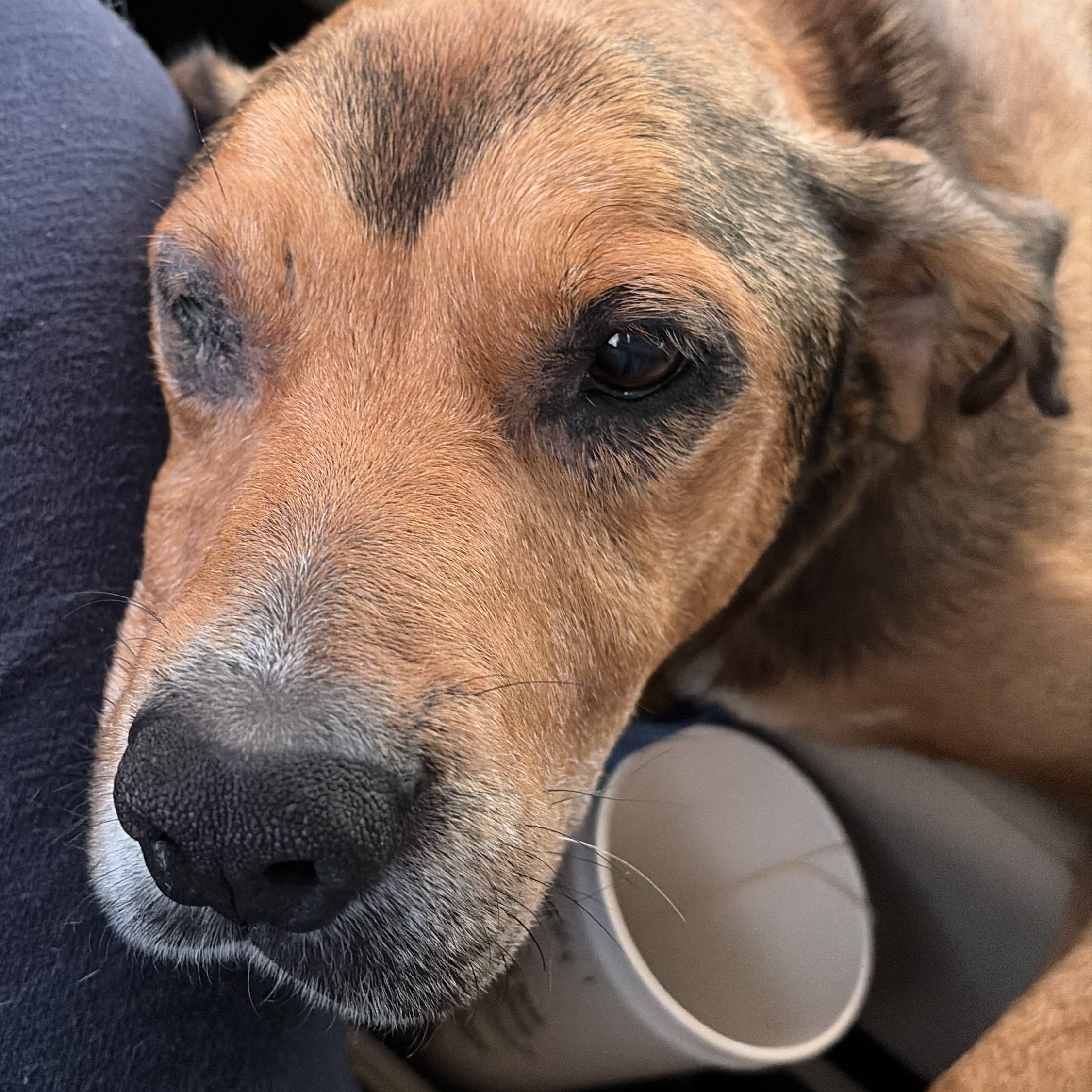
Shofar, a hound dog, was stumbling around at night, as the car nearly hit him in rural Georgia. Luckily an angel appeared, picked him up and took him home. It was almost midnight. He was considered a hospice dog — dehydrated, feverish with infection, blind from an eye condition, he would have been euthanized. That was three weeks ago. Nourished and treated for his infections, Shofar is healthy enough and can see, and be adopted. Today he got neutered. Anne Gregory Teicher and her husband Zach Teicher, administrators and angels for Congregation Shaarei Simchah have an interesting calling – they have established animal rescue agencies in their homes and foster them and prepare them for adoption. They especially care for older or special veterinary needs animals. To find out more, check out the Rescue society Here, or follow the story on social media Here.This week’s reading from Deuteronomy includes the following instructions about caring for lost animals! (synchronicity!)
Deuteronomy 22:1 Do not see the ox of your kinsman or his sheep running off and hide yourself from them;
Why would anyone hide themselves from an ox or sheep that belongs to someone else, I wondered. The Hebrew root for hidiing oneself is Ayin, Lamed, Mem. It also means forever, like in “olam” which also means the world. Also piquing my interest was the sheep running off – it reminded me of the midrash of Moshe (Moses) following a runaway lamb, and finding the burning bush which called him to his life’s journey! Reading further, it becomes clear that the “hiding” refers to hiding from the responsibility to help. What if you should hear the lamb bleating or the ox, and turn your head so you don’t see it – would you be absolved? No, says Rashi, turning your head is the very essence of hiding!
During the month of Elul, it is said “The master is in the field” – the Holy One of blessing is immanent, palpable. Playing a game of hide and seek with us perhaps? We must do the seeking, and then we will be found.
Psalm 27, recited each day during Elul, often refers to this game of hide and seek:
(4)One thing I ask of GOD,only this do I seek:to live in GOD’s house all the days of my life,to gaze upon GOD’s beauty,to frequent the temple.(5)I will be hidden in God’s pavilionon an evil day,granted the protection of God’s tent,and raised up high upon a rock(7)Hear, O ETERNAL One, when I cry aloud;have mercy on me, answer me.(8)In Your behalf my heart says:“Seek My face!”O ETERNAL One, I seek Your face.(9)Do not hide Your face from me;do not thrust aside Your servant in anger;
We seek (darash in Hebrew) with the hope of being Found (matza) One of my favorite songs is “You will be Found” from the musical “Dear Evan Hansen” The version I fell in love with is linked here, from the Brooklyn Youth chorus, recorded during COVID, when loneliness was rampant (which it still is) I love the emotion the composers, Benj Pasak and Justin Paul, give to the contrast between lonliness, and the joy of being found. In Jewish tradition, redemption only can happen in community, with others having our back -for example returning something we’ve lost, or helping with burdens
Verse Two continues׃
And if your kinsman/countryman is not near to you, and you do not know him, you are to bring it into the midst of your house; it is to be with you until your brother makes seeks it, and then you are to return it to him.
What? I have to bring the sheep home, and into my house? or an ox? OK, perhaps I could keep it with my other animals, but what if I don’t have any? (a Levite, for example). I noticed a hyperlink to a verse in Exodus – we are to bring the lamb for the first Passover into our homes. And the Hebrew word for returning is is based upon the root Shin Vav Vet – “shuv” which is a theme word for this season and the m onth of Elul – Teshuvah – returning to “the land of the soul” to your true essence, to your relationship with the Blessed Holy one. Now the text had my full attention.
I wondered if the lost sheep or ox could be a lost person, so I reached for one of my favorite commentators, Or HaChayim (Chayim Ibn Attar, Morocco 1700’s) and my hunch was validated. Sources here. Ibn Attar argues that the ox or sheep is one who has lost their way morally or is ignorant of Torah, and the person “returning” them is one who sees it as their responsibility to teach them. He says: the commandment to restore lost Jewish souls applies, i.e. to the righteous, the Torah scholars. Ibn Attar sees the scholars as responsible arguing that the word “achim” literally meaning “brothers” which I have translated as kinsman or countryman, means they view all kinsmen as brothers, making them righteous.
Verse 3 continues:
Thus you are to do with his donkey, thus you are to do with his garment, thus you are to do with anything lost of your brother, that is lost by him, and you find it: you are not allowed to hide yourself.
There is was again, the prohibition from hiding, from melting into the rest of “olam” the world, pretending we don’t see. The word for “lost” in this verse, however, was different from verse one, and is repeated for emphasis. The root “aleph” “bet” dalet” often means to perish, to be destroyed. Emphasizing, that these are living assets, they could mean survival or lack of it for one who thinks it’s lost! Imagine the relief if you can restore such a valuable loss after thinking it was dead.
The last verse in the cluster of four, verse four relates to that magical creature in Torah (see Balak) we often overburden-the donkey
You are not to see the donkey of your brother, or his ox, fallen by the wayside, and hide yourself from them; you are to raise, yes, raise it up [together] with him.
Ramban connects this verse to the hyperlink to raise even your enemy’s donkey, the one who “hates you” when the poor thing has fallen because they often carry such great burdens. Imagine a world built on this commandment! Ibn Ezra notes: the same applies to all beasts. Including Shofar, the hound, who was FOUND!
As I write this, 300,000 are evacuated from Spain and France due to climate fueled fires. The whole earth is filled with G8d’s Kavod/Presence. Soon Spain will experience a total solar eclipse. People today experience a sense of the majesty of the solar system in viewing things so grand. In ancient days, it was a fearful portent, to see the sun’s power dimmed. The beginning of wisdom is fear of G8d – the Big picture of the Universe, (Proverbs 9:10) The dual meaning of the Hebrew yirah is fear and awe. We need tears, the thickening of our hearts to be cut open (Deuteronomy 10:16) We have just emerged from Tisha B’av, soon to be immersed in TuB’Av, the Biblical Holiday of Love, and comfort as the refugees returned from Babylonian Exile. More than ever we need hearts broken by awe and fear to fill with love.
It would take a couple of hard smacks from life before my heart could heal.
The theme of opening our hearts to bring tikkun repair to ourselves and the world runs through this amazing parashah in three parallel ways!
https://soundcloud.com/user-30824119/vakhalta1. Gratitude: Birkat Hamazon, the blessing after a meal, is partly here. We are always yearning, hungry, But each item on your plate is grown from the earth, watered, harvested, delivered, prepared – a miracle. To stop, and really enjoy the food, is another miracle, and to really allow yourself a moment to say – wow I am satisfied! (It is easier without distractions, electronic or otherwise) I have found that even a brief blessing said with focus, or Kavannah can be transformative. Here’s a quick one based on words from Deuteronomy 8:10 V’achalta, v’savata, uverachta,et Adonai Elohecha(It is written that you shall eat, you shall be satisfied and you shall bless!)Blessed are you G8d for goodness, and holiness, for the land and for this food. Here’s a lovely version from Hannah Tiferet Siegel
2. Open our hearts to the vulnerable, the immigrant: because it is how G8d acts: 18)G8d upholds the cause of the orphan and the widow, and loves the stranger, giving them food and clothing.—(19)You too must love the stranger, for you were strangers in the land of Egypt.
3. What if the rain were G8d’s tears? In Eikev Rain is clearly dependent upon our ability to act in justice and to love. Unlike Egypt where slave labor irrigated farms from the Nile, The promised land drinks water gifted by the Holy one. These passages are the second paragraph of the Shema, but here the command to love G8d has moved from singular to plural, communal. The shema itself is a progression of love rippling outward from the center: beginning between your eyes and upon the heart of a person to your family/children, to the borderlines of your home, across your gates, and into the outside world, where, earlier we learn to love the stranger. It is parallel to the journey from Mitzrayim, the narrow straits, to the wide skies of freedom.
All depends on water, water is life. What if the rain were G8d’s tears, and they being withheld because of our heartlessness? What if this were the spiritual source of climate change?
I wrote the song Water planet inspired by the text and associated meditations from Rabbi Jill Hammer’s Return to the Place:The Magic, Meditation, and Mystery of Sefer Yetzirah
If you had to list your three most important values, the guides of your neshamah/ soul, what would they be? My cousin asked me this at dinner recently. What do you dream and spend time and effort pursuing? And for what aim? Sources here, and to see my own
In our Torah drama tale, the Freedom project begun in Egypt has led us to the brink of the Jordan River. This double portion, Matot-Masei begins with a section of the three types of vows: the neder, assur, and shevua –the vow, the “I’m going to abstain” and the oath. (For more on women vs. men’s oaths Sources here) Words that you swear in a vow or oath must be fulfilled! Is your word your bond? Interestingly these opening words of Matot, meaning tribes, are directed to the leaders of the Israelites. According to Ibn Ezra, the words are directed to the Leaders because the Israelites have just been through a war together. (One of the most troubling, violent passages in Torah. Check out the bottom of source page) In this Freedom Project the leaders of the tribes, under direction of Moses, have certainly vowed to have each others’ backs. Could some temptation cause them to abandon these vows? Apparently, after this war, two of the tribes, Reuben and Gad have accumulated riches in the form of herds of cattle. How did this happen? One can imagine by grabbing rather than equal distribution. And on the shores of the Jordan they say to Moshe, we’re good here, can we please be excused? Their reason? This is great cattle country, a great place for our possessions (how can we protect our stuff if we go?)
Moshe (Moses) is a bit upset at this abandonment of their obligations to their “brothers” In fact the same words of “doing what comes out of your mouth” is repeated in Moshe’s argument. (Ibn Ezra) The Reuvenites and Gaddites have a compromise. They will build enclosures for their flocks, shelters for their families, and then come join the other tribes in the conquest of the land. Moses corrects them in their word order and accepts the deal. “You may build homes for your families and enclosures for their flocks, and then join us” Rashi says they have their priorities backwards.
The second of this double reading is Masei meaning Journeys. “These are the journeys of the children of Yisrael through the wilderness. There were forty two times when the Israelites camped, and then traveled, guided by a pillar of cloud to camp, and of fire to journey. Why this naming and travel-log? Priorities are great. But to focus only on priorities can be problematic. What about the every day? R. Ingber’s podcast “Detours and Destination” asks all guests about their plans, and then what actually happened in their lives. Sometimes the most important things are what happens on your way to the priority! Zohar says each of the forty two stops were opportunities to see and uncover the holy sparks within the ordinary. Perhaps after the catastrophes of the calf and the spies, these wanderings were the healing. The Barbara Streisand Song On My Way to You jumps to my mind. “if I had changed a single day, what went amiss or went astray, I never would have found my way to you. I wouldn’t change a thing that happened on my way to You. I wouldn’t change a thing that happened on my way to You”
Rashi asks “why name all the stops if the destination is the promised land? he answers with a parable And Rabbi Tanhuma explained it with a different drasha: This can be compared to a king who had a sick child and he brought him someplace very far to be healed. And once they return home, his father recounts all of the journeys and says, “here we slept, here we were cold, here you had a headache.” [Bamidbar Rabbah].
Chazak Chazak, v’nitchazek. As we close the book of Numbers until next year, may we be strengthened together, drawn close by dancing with the words of Torah.
In our Torah reading we are nearing the end of our wilderness journey. Sources Here. As I write this post, it is the 17th of Tammuz, a day to remember the sadness in our history and honor the the fear we face in a challenging world. As I write this post it is also 103 Degrees Fahrenheit- deadly hot, as are tempers round the world. The powers that be in this world, both human leaders, and technological challenges seem overwhelming. We in the older generations are living a lifestyle that is destroying our nest – we take natural gifts, and really most of our gifts for granted in the quest for “getting and spending, we lay waste our power” ~William Wordsworth. In our wilderness journey, a census is taken, “lifting up the heads of those who are counted” It is about half of what it was at the outset of the freedom project that began 40 years ago. An entire generation has died. Miriam and Aaron have died, and Moshe (Moses) knows he will not enter the land. It is a time of transition. As if to dramatize that the “times they are a’changing” the Five Daughters rise up, and draw near. I’ve written about them before (2021 post) Have you heard of these women, the daughters of Tzeloph’chad? In an all male genealogy, where women had no rights of inheritance, they bravely and brilliantly “wrote themselves into the narrative” to paraphrase Hamilton. Song below. There is brilliant timing and Torah spoken by the Sisters, and even a bit of gender bending (Chizkuni).
Immediately after this wonderful scene, as if to emphasize this crossing over, Moshe is called by G8d to travel to Mount Eivarim – which is elsewhere called Mount Nebo. Eivarim, with the Hebrew root Ayin, Vet, Reish means to cross over, as Ramban reminds us. Ramban opines that it’s because the folks are about to cross the Jordan. But an entire generation has crossed over, and Moshe himself is about to cross over. Nostalgia can be sweet or toxic. We are in a world where nostalgia of returning people to a former powerful era is being used as an excuse to harass and deport refugees and immigrants. As I write this, ICE is intensifying its efforts. And in Israel and Iran to continue warring. When will they ever learn? Let’s be in it for the long haul, with a vision that extends from generation to the next: l’dor va’dor.
The Daughters and the Promise. Miryam Wolfson, 2016, final form 2021, Sound track
“Who are we that have the courage to be freely
Standing tall before the powers that be?
We are Machla, Noa, Hogla Milka and Tirtza,
daughters of Tzelophechad
Five strong sisters, each her sister’s keeper
On the journey to our land“
Now our father’s gone,
what will come of our name?
Who will tell our family’s story?
We believe in the Kingdom
a land milk and honey
Where justice and wisdom
will sing of G8d’s glory.
Chorus
Hand in hand we stand,
talking justice to the Man
“Moses, Our father was a good man,
even though he had no sons
his name should not be banned.
Please take our case to the Holy One
for the sake of the orphan,
the powerless, and all women”
Chorus
Moses says
“Listen up oh Children of Israel,
The law of these five sisters is true, G8d tells”
And in their love for each other and their strength,
They bring down the justice of the Holy One
Machlah, Noa, Hogla, Mika and Tirtza
They put themselves back in the narrative (Machlah, Noa, Hogla, Milka and Tirtza)