Torah for now

Gladiator (Matot)

Rage, anger: we call it being “mad” for it takes our sanity from us.

There are some passages in Matot, this week’s parashah about rage, that I struggle strongly with,  including one where an enraged Moses has women and children captives killed. When I write or speak about Torah, I often just focus on my favorite verses, and ignore the hard ones, but given the week’s violent and disturbing news in Israel, I cannot.

“I believe that it’s my job to find myself..” in Torah, sings Julie Silver. “I struggle and I question, I criticize and doubt, but surely that is what our tradition’s all about!  Where am I, in the midst of this commandment?.Where am I, I am not between the lines…how can I turn aside, where am I?”

Choral director and composer, Eleanor Epstein taught me something eye-opening last year. “You know how we say about Torah that “all its paths are peace?” Well, that means if you don’t find peace in the words, you are simply not interpreting it correctly, because ALL it’s paths are peace!” So with that in mind, the lesson on rage- that it makes us “mad” even for best of us, even our heroes.

A story (from R. Ed Feinstein’s Capture the Moon): Did you ever meet someone who just turned everything around, set you on a better path?  (or perhaps you been that person?). There once was a Jewish boy named Simon, who lived in Israel during the time of the Roman Empire around the 200CE . Kidnapped to serve Rome, he would become among its fiercest gladiators. His reputation?:  nobody could withstand his rage and might. One day he was traveling in a hurry to get to his next contest when he came to a narrow bridge which crossed a rushing stream. Weighted down by weapons and armor he stopped about half way across, his way blocked by another man traveling in the opposite direction. This man was a very different kind of hero. His name was Rabbi Yochanan, and he was small, had tender eyes and was armed only with scrolls of ancient wisdom.
“MOVE OUT OF MY WAY” ordered Simon. Rabbi Yochanon would not. So Simon unsheathed his sword. “MOVE OR I WILL CUT YOU INTO A HUNDRED PIECES AND FEED YOU TO THE FISH”. But Yochanon would not budge. So the gladiator raised his sword. But just as he would lower it, his eyes met the Rabbi’s eyes, and he saw something he’d never seen before. Always in his rival’s eyes was terror,  enabling him always to prevail. But there was none in Yochanon, only a deep serenity. Here was a man who knew his purpose, and had more inner strength than anyone he knew from the Roman arenas. This meeting of eyes  shook Simon deeply. He stared long at the gentle rabbi, and then  trembled and dropped his sword. And what was the Rabbi seeing? As Yochanon was staring into the eyes of the gladiator, he saw a spark – beyond all the rage and violence, the Rabbi saw an enormous heart, an aching to love and be loved. A soul waiting to be touched.
Softly the Rabbi spoke to Simon: “My brother, talk with me awhile. Don’t be in such a hurry to kill, or to be killed!. Perhaps I can show you a greater path”
“I serve only the Glory of Rome and Ceasar,” replied the gladiator, repeating the oath he’d sworn. “There is no greater glory!”
“Ah, sighed the Rabbi”,  One day soon Rome and its Caesars will be gone and forgotten. Instead there are truths and Ideals that are eternal. You, my brother, have a spark, are in God’s very image! and you can shine the light of Torah, of truth and love. Come, my brother, devote yourself to the study and mastery of God’s Torah!”
“But…Simon’s voice trembled “I know nothing except the arts of war and killing.. I could never study with a scholar like you…!”
“But your heart, it’s much stronger than your sword, and that’s all God requires of you, Come my brother…” the Rabbi gently urged.
Maybe it was the light in the words and eyes of the Rabbi, Maybe it was because no-one had ever before called him “brother”, but Simon’s soul was reached that day on the bridge. He dropped to his knees and cried. He threw away his weapons, turned direction and followed Rabbi Yochanon. Simon became a truly devoted student. and in time the gladiator become one of the most brilliant Rabbis and teachers of our tradition: the great Reish Lakish. He also became Yochanon’s brother in law. And it is this gladiator Rabbi whose teaching enlightened me this week.

From Torah, God gives Moses the following instruction. You may avenge the Midianites, and then you will die, be gathered to your kin.  You see the Midianites had not let the Israelites pass through on their way to the promised land, and instead had tried to curse them, when that didn’t work they tried to seduce the men, and a plague resulted killing thousands.  But here’s the thing: the Torah actually forbids vengence! (Lev 19:18)  Torah goes on to say Moses is furious -perhaps understandably:  he’s lost his family, has been condemned, will not see the promised land,… and these damned Midianites…! Reish Lakish then comments “When a man becomes angry, if he is a sage, his wisdom departs from him, if he is a prophet, his prophecy departs from him. That his wisdom departs… we learn from Moses, for after Torah says Moshe was furious with his commanders (for letting women and children live)… Reish tells us that Eleazar has to remind the troops of legal instruction (how to purify their swords  in fire), because MOSES FORGOT!

Poet Roger Kamenetz comments “In the atmosphere of war and violence, anger spreads and contaminates like a virus….Vengeance, even in a righteous cause, leaves a permanent stain, an impurity that cannot easily be washed out. Anger leads us to forget our deepest wisdom…Fire is fine for purifying metal, but how does a human soul cleanse itself from anger?”

So Moses was angry, and he messed up, and that’s a lesson. But doesn’t Torah say God was vengeful?  For ME, I know that although Torah is our Divine inspiration, its words have had to go through the lens of the folks understanding it at that time, in this case a despairing Moses, and it is our SACRED TASK to interpret it more truly.  Maimonides, in  Guide for Perplexed says

“whenever an act of God is perceived by us, we put our own emotion and attach it…. but God’s actions cannot be the cause of human emotions – God is beyond this defect”

It takes a reformed gladiator to criticize Moses, but he understands the rage of war. If Moses cannot handle anger, how much more careful should you or I be?

I was so ashamed of the angry Israeli mobs, and that our rage helped fan flames of war.  I despair that there is so much hatred for Jews on the Palestinian side of the border. Martin Luther King said “Hate cannot defeat hate, only love can do that”  Like the love of a small, wimpy Rabbi to reach the soul of a great gladiator, and turn him around on a narrow bridge.  Shalom, peace, comes from the root meaning “wholeness” and I think love can make us gladiators whole

Roman Gladiator

There once was an Ogre who set out on a quest –to keep his little world safe. He found much more than he set out to find, with the help of a donkey who could talk. Instead of keeping his life the same, he was transformed, as was his lady, but maybe not the ways we expected! I love Shrek, it celebrates childhood rhymes, and journeys, and happy endings! But that Donkey: Is it animal or human? Donkey and Shrek and Fiona and the Dragon: Is it love or hate? Shrek’s world: Is it fantasy or reality?
Sanity means, it part, being able to tell the differences between things: L’havdil: we must separate. When a baby looks at the world, all is one collage of color and light, of line. Then an object moves, and all its colors with it – aha!– that is a separate object, we learn. But in one-ness, in connections, in ambiguities is also a truth.We know that, as Adonai Echad (God is One), therefore all is one.

I have always seen the Biblical tale of Bilaam and his talking she-ass as poetic comedy all leading up to the beautiful blessing: Mah Tovu – how full of goodness are your tents of Jacob, your dwellings oh Israel. The renowned seer and prophet/speaker who can neither see the messenger with the flaming sword, nor speak, as his donkey does, saving his life. Rather than speaking, Bilaam acts in violence, beating his ass three times. (as he will bless Israel three times). When Bilaam opens his mouth to curse, he will bless Israel/Jacob instead.
But it is this emphasis on ambiguity, being both a thing and its opposite that I’m able to see this time ‘round reading about Bilaam

shrek and donkey
Ambiguity:
1. Who is the prophet, who is the beast? Perhaps we are wisest are we then listening to the instinctive parts of us. Who are we at our core? Animal and spirit and emotion all rolled up into one. We fight against our inner nature often, depriving ourselves of its wisdom. As we “civilize” chidren do we sometimes subdue their playfulness, and grow up unable to play? I know we sometimes put weapons in the hands of teens, and teach them hate and fear. Similarly we beat down the Natural world with an agenda to subdue. We say we are superior to nature, when the reality is we have no existence apart from her at all. We beat her as Bilaam beats his ass. There is powerful force blocking his way that only she can see. And only when she speaks are his eyes open
2. Who is the Israelite and who the foreigner/ enemy. Bilaam is a foreigner, hired by the Moabite King, and yet he hears the wisdom of Israel’s God, and blesses them. He becomes the pathway for their survival. The Moablites are called our enemy. As the parashah finishes, they are seducing the Israelite men, and a zealot, Pinchas will slay a couple engaging in sex at the opening of the Mishkan. Yet Moses’ wife is daughter of a Midianite (Midianites and Moabites are interchanged) and Ruth, the Moabite is great grandmother of the great king David.
3. How can the messenger be both an angel and a Satan/ an adversary? Yes the messenger in Bilaam’s way is a “satan”, an adversary. Both an angel and a Satan, at the same time? Can the adversaries in our live be our saviors? The tough customer, or boss? The rebellious teen? The sports adversary that hones us to be our best certainly is. Meet and be open to the adversary with sword drawn.

4. How can we be both Israel and Jacob?  Israel struggles with Angels and prevails, gaining a new name. Jacob is a heel. The names symbolize male and female aspects of ourselves as well. Just as the first earthling in genesis was both male and female.

5. How can we set out for evil/ for cursing, and it be for blessing? I know the reverse well: we attempt to do some good, and it ends up hurting someone by accident. This is much better. Hired by kings to curse, only what is divinely put in Bilaam’s mouth is allowed to come out: of course that will be blessings, from the Source is blessing! If we are open, perhaps the same can happen with our lives.
6. Shacharit, comes from the word shachor: black, yet it means dawn. You know: it’s alway blackest before…The blessing: Mah Tovu, which opens morning services comes from this passage – what a cool coincidence: the transformational blessing at dawn. The time of day which turns darkness into light. As Bilaam turns darkness to light.

Israel this week is in darkness as she mourns the loss of three children. Seeking vengence,  settler mobs  kill a fifteen year old Arab boy. We struggle with demons and angels.  We cannot see the face of the divine in our adversaries nor can they in our face. I prefer the full vision of ambiguity. To send condolences to all four grieving families click here.  I pray somehow that this curse of senseless violence can find some happier ending. I suspect, though, that it will take ambiguous vision to really see “the other”.

Lesson from the Mah tovu: what is NOT ambiguous is goodness. In the Mah tovu, what is good is our tents, our dwellings, not our impressive army or beautiful Mishkan.  Perhaps there were no homeless, perhaps the boundaries between the tribes were soft, perhaps the love from within the tents shone through.  It’s the goodness that transcends the ambivalence of the new day dawning.

I’ve just returned from Wisconsin, my second Hava Nishirah, a songleader’s Jam and inspiration and teaching. (Last year’s first was revelation, post here) My sound recorder died, first night, so I’m writing as I remember. Firstly, returning was like finding Brigadoon: connections made last year were as solid as though it were yesterday,  in an idyllic campground and perfect weather. It is also the end of Shavuot as I write,  celebrating the first harvest, and the Harvest of inspiration from Sinai. The theme of the Hava week was light, they told us, but it was light through sound: music and silence!  And it all seems to be converging: light and sound, Hava and Holiday.
What’s cool about mixing light and sound is that sound and light are very different energy waves, yet all connected, just like all 250 of us were totally on the same wavelength as we sang!   Also, in the Ten Commandments, read on Shavuot, the intensity of revelation is such that we saw the thunder: radical! and what a coincidence/connection.  They remind me of waves that rocked the aluminum dock on the lake as we sang in harmony in the sunlight.

Worship service highlights for me: I will begin with mornings. On our first morning shacharit service, we sang Or Zarua la Tzaddik: light is  planted for the righteous, we sang in three part harmony in the early sunshine, with scroll unrolled.

10439459_10152491498539839_1903649802664242715_nphoto by Susan Shane Linder

And Rabbi Ken Chasen told us Maya Angelou’s passing by reading from her poem, When Great Trees Fall 

….And when great souls die,
after a period peace blooms,
slowly and always
irregularly.  Spaces fill
with a kind of
soothing electric vibration.
Our senses, restored, never
to be the same, whisper to us.
They existed.  They existed.
We can be.  Be and be
better.  For they existed.

This was the first time I was moved to tears during this weekend, and it would happen at every service afterwards.

On the second morning, Friday, “Don’t forget the miracle of the morning, says God…how I drench my mountains in gold, pink, purple and orange,..” There was an index card on everyone’s chair to put our deepest wish or blessing, and these were incorporated into the morning blessings, while Craig Taubman sang Elohai neshamah (the soul You have given me is pure…) Later he asked us to give our card away. I gave mine to the lovely woman sitting next to me, whose prayer had been to help heal a sick little boy. She hugged me for the gift, and all four or our eyes were wet.

Shabbat morning services: Three Torah aliyot were chanted in English (!) and Hebrew by a Rabbi friend, Melody Davis. Two sweet teens sang That’s What Love’s About by Craig Taubman, to enhance the V’ahavta. Rick Lupert’s poem “Silence” was amazing and funny, he spoke of the silence in an elevator, or gazing into his wife’s eyes, and helped make all our silences ring with meaning. The pauses making the melodies much sweeter. Sound and silence… I wonder if silence has wavelengths too, because I thought I felt them.

Evening services: one evening I  “Laugh, Look, Listen. Leap, 4D family worship”. It was mind expanding. Did you know that with every step you take you bring G-d with you?”  asked Shira Kline? Yes, I’d read that, but tonight we’d pray that way. The yud in our faces, the hey  in our shoulders and arms, vav in our spin, and final  hey in our pelvis and legs, makes us walking breathing examples of b’tzelem Elohim,  and we, like Rav Heschel, got to pray with our feet, and arms and hearts as the Sun set, and sent our consciousness wandering and back under Billy’s guidance

Erev Shabbat was about doorways, the image kept appearing on our screens. And about LIght, of course “Let there be Light, Tonight, Tonight Tonight” we sang this beautiful song by Judith Silver, a wonderful lady, with whom I had spent time. We walked down to the dock on shifting platforms, to join in an impromtu song teaching session on the lake earlier that day. And Cantor Ellen Dreskin was a magical storyteller that night. Both of the stories she told made me cry. One was of the rescue of a momma sea turtle come to lay her eggs on the sand of a beach. But in the morning she’d not returned to the safety of the waves. The poet grabbed a park ranger to help, who hooked the enormous reptile onto his jeep, and she was terrifyingly dragged through the dunes until reaching the waves. This amazing prelude to Mi Chamocha made us all experience redemption as primally as a sea turtle freed.  Her second story was a prelude to Ba yom ha hu, (That day will come) of a mom and daughter walking home from synagogue. Mommy? queried the child. Didn’t Rabbi say G-d was all around us? Yes. But, mommy, didn’t the Rabbi also say G-d was  inside us.  Yes.  That’s what I don’t understand, if G-d is all around us and also inside us, then how can it help but shine right through us ?!  “On that day”, Ellen explained, “God will be One”

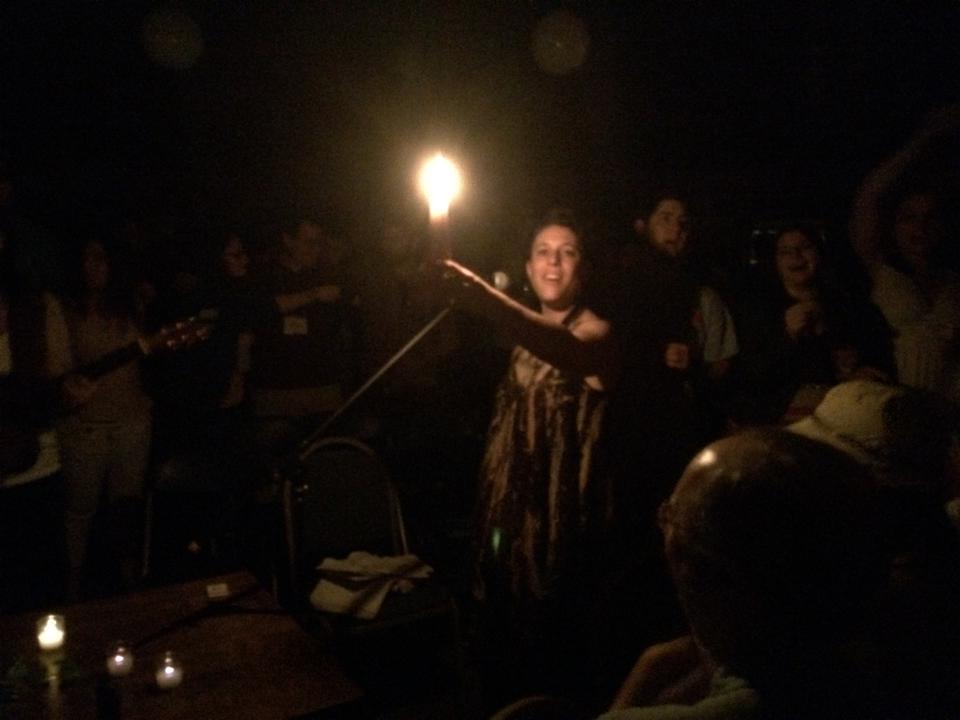
For me the most powerfully lovely evening service was our last, the most heart-expanding havdalah, beyond beautiful. Havdalah is usually bittersweet, marking the end of Shabbat, beginning a week of work, of stress, or obligations. This was even more so, for it marked the near end of Hava. We began in darkness, just candles in an enormous room. Shira told us a legend of danger, that Shabbat had opened some sort of door that must be carefully closed. Then Rosalie told a story I’d known.  Adam and Eve, who have struggled hard after being kicked out of Eden, endured trials, raised a family, eeked out a life together, and are now old. They decide to travel together, to see the wide world. They see gorgeous mountains, valleys, oceans, glaciers, rich forests, and then glimpse a place familiar, a garden guarded by a seraph with a flaming sword. God offers for them to return It’s been long enough in exile. There is no suffering here, and all is timeless. The earthlings choose instead a life of overcoming life’s hurdles and reaping joys. They turn their back on Eden, and walk off hand in hand together.  How brilliant to use it to here, as we return from Shabbat and Hava to the world, it was shattering! And then came the cello, whose sonorous tones filled the building and our hearts.  ….then we ate ice cream…

.10175008_10152471235254839_1211122048922492529_nphoto by Susan Shane Linder

Some of my classes at Hava were just as inspiring. My first, with Rosalie and Ellen, challenged us to find a worship vision. It began with text study to try to work out the meaning of prayer itself. Heschel describes prayer as having no adequate way to express what we long to express, but, a wave of a song carries the soul to heights which unutterable meanings can never reach. Such abandonment is not esape…for (this world) is the nursery of the soul, the cradle of all our ideas. It is…a return to one’s origins. What a JOY to study with my small group of partners.  We then were asked to record an inspiring prayer moment in our life, and to craft a metaphor for what it means to be a prayer leader. And by clearly defining the landscape, I felt my eyes really opened; light!  Another class with Merri gave insights in leading kids in a youth choir, and making it an organic part of a service, not a performance, by teaching, no, by demonstrating the kavannah, the intention of each moment in which they sing, by setting the background, helping the kids make connections with the lyric and melody. Similarly Alan Goodis’ workshop on connecting with teens and kids was from a kid’s eye view, with the life stories of real kids and their likely, or unlikely involvement in synagogue music. The kid on whom the Bar Mitzvah tutor gave up in frustration, but the rabbi took under his wing was a synagogue drop out, and electric guitar player. Alan reached out to him. persisted: we really could use you. Now the teen is a leader and teacher, irreplaceable. As they all are.  Shira Kline is a master song leader, and gave instruction on the most incredibly fun ways to experience/ teach music for young kids k-6. Use your body, and your feet! Just do it. Keep the beat while you are teaching. Be large and in charge. Use all your gifts. Tell stories: now I’m taking you back in time: A long time ago… The purpose of blessing is PAY ATTENTION. I have paid attention.

Torah Study with Jerry Kaye on Saturday morning was very small. Jerry asked why we were in the wilderness to receive Torah. He wondered if we were really exploring Torah here, or just Kumbaya Judaism. I reminded him we’d just sang Lechi Lach the night before. Lechi Lach, and you shall be a blessing… it’s from Genesis. He looked heavenward “Debbie stay out of this”, he implored.  Yeah it’s Torah all the way around. And the wilderness is Wisconsin.

A huge thanks to all my teachers and friends.  Let there be light, let there be music, let there be love (congrats Rob and Julie).


Teacher Recognition

My Grandparents have been among my most powerful teachers: of what it means to be a mensch (good person) and how to cook and lots more. I have had powerfully influential teachers during my life in school as well, such as my High School biology teacher Leonard Warner, inspiration to be a biology teacher and environmentalist myself. I’ve been lucky to study with Clergy who’ve inspired me to in that direction as well, beginning with Cantor Susan Caro many years ago. Who have those teachers been in your life?
I have also been a teacher almost all my life. At age five, I remember instructing my baby brother with a toy chalk board. At sixteen, I began teaching in my High School in an apprenticeship program. I briefly worked as a lab technician and my first year of teaching was impossibly hard, and there were times following the birth of my children when I did not teach. But otherwise, teaching has provided constant fulfillment for me: communicating; the joy of the fabulous question; opening doors in “teachable moments”; the catching of a spark from mind to mind, teaching a song and hearing it catch wing with young voices; inspiration; exploring ideas, helping someone overcome roadblocks and find a path to success…… I am as lucky as it gets: I love my work.

So I found the perfect song for Teacher recognition Shabbat at my Hebrew School. I’ve heard it before. I love that it talks of trees, and planting, and creating a future for those yet to come. I’m sure it’s taken from the legend of Honi, a magical rain maker, original Rip Van Winkle, who chided an old man for planting a carob tree, because he would never eat its fruit. Honi fell asleep under the tree, to wake seventy years later. The old man’s grandson was harvesting the tree. I love trees. Torah is also called our Tree of Life: it’s ideals and laws of kindness have kept us alive through the ages. Still somehow didn’t realize this song is really about teachers, until just yesterday. Now I actually feel even more lucky and blessed. It’s really been an honor and a priveledge. (I am choked up right now…)

Standing on the Shoulders, by Doug Cotler

In the Garden is a Tree
Planted by someone who only imagined me
What love, what vision
I marvel at this gift: no fruit could be sweeter than this!
I’m standing on the shoulders of the ones who came before me.
As our people roamed from land to land; something passed from hand to hand
And it isn’t just the words and stories
of Ancient laws and golden glories,
It’s the way we study, it’s the Book we study,
I’m standing on the shoulders of the ones who came before me
Now my life is full of choice, because a young man raised his voice,
Because a young girl took a chance, I am freedom’s inheritance
Long ago they crossed the sea; to make a life for you and me
Chorus
So today I’ll plant a seed, a book of life for you to read
It’s fruit will ripen in the sun, the words will sound when I am gone
These are the things I pass along:
The fruit
The book
The song.

tree life

Grecian urn

Beauty is truth and Truth beauty, that is all you know on earth and all you need to know. This penned by Coleridge in Ode to a Grecian Urn, because in ancient Greek philosophy, beauty reflected the divine ideals that the universe was built upon.  Physical Perfection: we are bombarded with images of the young, beautiful and perfect, at least on the outside. Teens starve themselves, their self image on the line for a “look”, and I have frustratingly met some of these children. But Nobody’s perfect, and more importantly: Perfection on the outside does not mirror the soul on the inside. This week’s parasha, Emor has a section which is a challenge to my very imperfect self, .In Lev. 21:19 It reads a flawed Cohen may not offer sacrifice, including the blind, lame, deformed nose or misshapen limb. This mirrors sacrificed animal requirements.  My thanks to Rabbi Lisa Malik, for inspiring this train of thought. She taught that since both the life of the priest and the animal are gifts, offerings to God, it is simply bad form to offer what is blemished.  Yet there is still value judgement that what we consider beautiful on the outside is better. And that is a problem, perhaps on three different levels:

1. Beauty depends upon how closely you look, and how well you see. In Gulliver’s travels, one journey is to the land of giants.  One of Gulliver’s insights was: in looking close up at skin pores and hairs, there are no beautiful women! The closer you look, what we consider beauty disappears. Now I LOVE to look close up at natural things, including the skin, blood, bone, anything. It reveals a world of intricate workings, supporting amazing processes. Truly beautiful! But, when I teach human biology, I usually have a different reaction to these close up looks: one of disgust.  Reality is better revealed with a microscope and fiber optics. What we see on the outside is truly illusory. Yet for anyone to be alive is miraculous and beautiful beyond compare.  Even if a nose is misshapen.

2. Ghandi famously said that our value as a society can be measured by how we treat those among us who weakest. Surely that includes those who are blind and lame, or misshapen. The ability to recognize God’s image, in these folk is most crucial of all. To cast them as intrinsically inferior, only worsens prejudice against them.

3. One of the most profound gifts of Genesis is the understanding that human beings are created B’tzelem Elohim, in the Divine Image. I explored these words for almost 2 decades with third graders in Hebrew school. Does this mean,  I ask them, that God looks like people, with a bellybutton and eyebrows and fingernails? This makes them pause & think, and most conclude: that’s silly! It is not our physical appearance which is divine, but our insides, our spark, our creativity, our capacity to love and decisions to care. That is divine.  Look deep into the eyes of a friend,  I direct. See it there, that spark? That’s what God looks like.  Not on the outside, but the goodness and love within. That’s the valuable part, though admittedly difficult to judge sometimes. It’s hard to judge because folks lie, or we don’t get to know them very well…. it’s so much easier to judge the outside!

Blindness: I know some very beautiful blind people. I myself was born with very poor vision in one eye. If not for modern eyewear I would certainly have “weak eyes” like Leah. Or perhaps I do: to maximize vision in my strong eye, the other turned in, giving me a less than”perfect” appearance. Dealing with a flawed appearance is a part of who I am. Consider this: true blindness is to look, but not understand. In fact Torah often warns us not to follow our eyes, and prostituting ourselves for what we see. We see suffering, but ignore it. We don’t use our eyes to weep for others.  Instead we are urged to LISTEN!

Yet, I’ve found 3 reasons to agree with the ban of  Cohanim.

1. How does that person feel about their deformity: are they angry, insecure, resentful? Do they blame God, or themselves, or their parents, or….? Perhaps that emotion is the true location of their flaw?

2. I needed to look deeper: what is the reason that someone is blind or lame or deformed? Sometimes it is a birth defect, sometimes it is due to accident, sometimes due to violence of human against another. Thalidamide, agent orange, radiation – all of these cause mutations, and therefore birth defects. Certainly not the child’s fault, but perhaps not things we should be messing around with! War takes limbs, and eyes. Violence distorts the human form divine. A lack of respect for these gifts, and a willingness to sacrifice the wholeness of our young men and women in battle, or ourselves or others, results in deformity and death. Or perhaps there are those who are broken, but nobody has cared enough, or there is poverty that’s prevented “fixing” them.  I read an incredibly moving account in Scientific American this past summer about an MIT Dr. named Pawan Sinha . Returning to India following the death of his mother, he reached for a handful of coins from his Mom’s charity box to honor her. On his busy way, his car stopped at a light. There he was beset by a mother with two blind children. The lives of blind kids in India is brutal and short. These young boys were blind from cataracts! Easily and cheaply corrected, these boys could be given vision. Yet he almost didn’t see them.  An MIT scientist, he applied for a grant to correct children’s vision to study how we learn to see. One teen’s vision was restored with a $20 pair of glasses. ( See blindness above.)  Perhaps this is the real shame, not fixing people.

3. What is inside eventually tells on the outside (although youth may hide it for awhile). And it’s true: people seem Physically uglier while being nasty to others! In the times I’ve spent entertaining in assisted living places, many of the elderly no longer think a check is needed on their behavior, and true selves come out, for ugliness or beauty.  I think it was watching Reading Rainbow,  with my daughters, that I saw four beautiful actresses demonstrate how the “ugliness” of the stepsisters was portrayed simply by giving reign to the emotions of the character. The beautiful actress transformed herself magically to an ugly stepsister!

After all this, I find myself with a radical conclusion: Perhaps this verse of Leviticus is a test – as Abraham was tested, to see if we would say to God: this eye-blinded person is insightful and therefore blessed with piercing vision, and this lame person’s kindness moves mountains, their weakness superficial, their strength enormous, so accept this beautiful person. 

Musical comment for this blog is Fix You by Cold Play


Hungry. Passover 2014

Appetites loom large each Passover. Feasting on fresh fruits and veggies, meats and eggs, cheeses and nuts and, of course, matzah, after a few days folks become obsessively hungry for what they don’t have: bread, pizza, bagels… As someone who cooks a lot during this week, this is frustrating and confusing! But spring is a time of awakened hunger. In another kind of hunger, Song of Songs, erotic poetry of the Bible is featured on Shabbat of Passover. Gorgeous, melodic, a stunning song. I first chanted from the Song 2 years ago, and again this Pesach. Intrigued at first because it was provocative, I soon learned it was beautiful. Eventually it completely captured me: Love is as strong as death, the poem proclaims, and love is what God is most about, and what is Godly in our relationships.
Also chanted on Shabbat of Pesach are Torah verses which follow the incident of the Golden calf in Exodus. What were the Israelites hungry for after Moses disappeared up that moApuntain? Did they revert to idolatry because they wanted bread? On the contrary, they were hungry for a relationship with the Divine. But they feared they had been abandoned by Moses, and by God. After all, they had not long ago recovered from a 400 year abandonment. So they built what they knew, an idol. But the point is they hungered for relationship with God. And Moses will echo this hunger as he climbs Sinai a second time. “Please, let me experience your Cavod (honor, glory, ways?)” Moses begs. He has dedicated .his life to God and is hungry to know the Divine more fully. And God’s Goodness will pass near Moses, and God will proclaim that the Divine nature is kindness and forgiveness and grace. Moses will restore those smashed tablets, and be forever changed, aglow from this encounter, his hunger fulfilled, a relationship of love with God a permanent part of his being. Around the dinner table this beautiful Spring, I hope that hunger will be for love, and kindness, and with the yearning to connect with one another and the Goodness in this Universe

April is the cruelest month, mixing memory and desire,  wrote Elliot. Passover mixes memory and desire! Also, during this first week of counting Omer, of numbering our days between Pesach and Shavuot, the theme is loving kindness! I love it when things converge!

Song.

It’s been awhile since I’ve traded childbirth stories with other women, my youngest is 15. But I remember, the intensity, the profound feeling of a new life with big blue eyes staring at you, but also the feeling like you might die because your body can’t possibly take that kind of pressure.

The Torah portion for this week opens with the rules for becoming “pure” for a Mom after conception and childbirth- able to return into relationship with the Divine.

I think it’s interesting that wording of Text begins with Tazria AND  Yalda:  Conception and Birth.
Conception is Life, but Labor and Delivery bring death incredibly close. That’s what it feels like, and for much of history was reality for a really large percentage of us.
And spring brings life from a dead land. TS Elliot wrote that April was the cruelest month, because he would rather remain dead inside, and unfeeling.
Yet interestingly, with the stresses of spring, death rates are high (spring is second only to winter) and we mark yom HaShoah in spring
Finally, the focus is on the Mom, not the Dad in this portion, and her ability to return to holiness, and to the Mikdash, which is kind of interesting, because it says she belongs there: comes from, and must return to holiness and the Mikdash.

Day before yesterday I cried for the first time for a boy who died almost twenty years ago. His name was Brandon, and he was brilliant and funny and usually smiling. I was a twenty six year old high school science teacher and he was my student. Brandon got joy from learning about the world, you could see it on his face. He was also in a wheelchair: he was living with Muscular Dystrophy. Seemingly normal, families watch helplessly as the muscles disappear from a boy’s body.  Brandon had an aid, Marie I think her name was, whose own son, Jimmy, died from MD: it is always fatal. Marie dedicated her life to caring for these boys.  I ran into Marie several years later, and she told me Brandon had gone to Rutgers. And that he died during his junior year. Every year I tell Brandon’s story, and of how wonderful the boy was, to remember him and to give a human face to MD.  This time the shock of loss was audible as I told students about him. That was it, with their help, I finally cried for Brandon.

This past Shabbat I chanted verses and studied with a inspired young Rabbi, Dave Vaisberg and the discussion went to an area I’d thought often about – why a person who comes in contact with a dead body is considered impure, meaning unprepared for worship and ritual in the ancient Temple. Purity means wholeness, all of one kind or texture or intent.  Certainly contact with death can be times of roiling emotion, uncertainty.  I know life and death need separation, you must be busy living, not dying.  Of those in the business to assist with transitioning families when death strikes, a certain distance, a professional emotional wall, and therefore callousness may exist. For others, anger at God, or feeling touched too closely by death’s hand may mingle in our souls. These reactions are all ones which can take away from the focus. We are to worship with kavanah, (intent) of unity with this vast universe, and the creative power that surges through it – and contact with death makes us unfit for this spiritual action. Even unintentional contact? Well, yes, because you can’t get to pure from there.

If all of these reactions: callousness, confusion, anger, unintentional uncaring make us unfit, impure, I wondered, then perhaps after I pass through these initial stages there can be a purity. Perhaps the tears that you shed after awhile, after the anger, or callousness, afterward you can revel in joy of what that person’s essence was.  Perhaps those purifying tears can get you there, and point you toward holiness.

In the morning blessings of each day, we thank God for the miraculous workings of our bodies. The prayer is Asher Yatzar, and it mentions the wonder of opening the openings of our body.  Well, tear ducts are such openings. The very next prayer thanks God for creating a soul which is pure, or t’horah.  Perhaps it’s the tears that make it that way.

The Torah portion for the coming week is Shemini. I will chant the verses that speak of the death of two of Aaron’s four sons, Nadav and Avihu. They must have been beautiful boys, for they were among the seventy that ascended the mountain to behold God, along with Moses and their Dad and 66 elders and leaders. They wanted to approach God again, but offered “alien” fire, which was apparently dangerous, for they were consumed. A shockingly dramatic and tragic scene with little explanation.  Just as there is little explanation for our existence, or the passing of boys (and girls) before their time, silence is what we hear from Aaron and Elisheva.  Too shocked and shattered with loss for tears.

We nationally mourned the shocking death of children a little over a year ago with the losses at Sandy Hook Elementary School .  As many of us were, I was shaken to the core. Madness, chaos, and death tore at our spirits, whispering that the fabric of the universe could easily come undone.  Certainly it was the support of friends as we all shook our heads, the caring that got us through. I was supposed to be singing with the choir kids that nigh (it was Chanukah) and a hug from Rabbi Larry Malinger kept me from walking out the door that night. Finally, a friend, Phil Aronson, and his brother wrote a song, Love will see us Through honoring those kids -and it is pure – pure love and honor and support. Tears are salt water, like an ocean supporting life. I finally honored a boy named Brandon.

300px-kanizsa-triangle.svg-tm

Continuation: further inspirations and musings about the deaths of Nadav and Avihu.  Many years ago, a very young neighbor of mine was experimenting with matches in his bedroom.  His Mom left the baby at my house while she went to the grocery store. Next thing I know the fire engines are wailing outside. Their home burned down to the frame.  The matches has smoldered in his room and blazed during that hour in the grocery store. We all know people that “play with fire” – the fires of addiction or other dangerous activities.  The death of Aaron’s two eldest sons scream for explanation, yet their parents are silent. This also cries for explanation, since Aaron is famously Moses spokesperson! It seems as though the boys have been a sacrifice on an alter built for animals:  the language of their sacrifice is exactly the same as the verse before they die: A fire of God goes out and consumes them exactly as the previous animal was taken.  Their ashes will be removed exactly as was commanded the animals of the sacrifice.  They have played with fire and lost. Is this a shocking tale of human sacrifice in our place of God-encounter? We have learned before that the Creator never commands us to go to the lengths of human sacrifice. – so… what is up with the sons of Aaron?

Fire: it warms, feeds, inspires, but it’s dangerous, hard to control.  The Mishkan (tabernacle) where the boys die is to have an eternal fire. If each part of the tabernacle is a part of the human soul, we are to have a fire that never quits at our core, but somehow to keep it controlled, not to “play with fire”.  God needs, and we need, our passion, but not over-zeal. Perhaps after the encounter with God on the mountain, ordinary life pales, and they become zealots.  They initiate a fire in which is “strange”, and “not commanded”, in the words of the text. Perhaps they know what will happen – after all it has JUST HAPPENED moments ago the same way with an offering. The fires of their heart are passions out of control. There are those today that fly airplanes into buildings, and strap bombs on their chest to blow their enemies up. Zealots that wish to sacrifice themselves, and others who seek death as a though seeking a lover. How can passion be balanced: Moses encounters a flame that does NOT consume that famous bush.

And Aaron is silent – with a strange word for silence that has the Hebrew word for “blood” Dam, as its root.  Perhaps Aaron is now impure, his soul a mix. Perhaps he was the one that found the bodies. Perhaps that silence was an accusation, or a depression, a real absent hole in his soul. And Elisheva’s voice, his Mom’s, is not recorded – another silence. On the death your child, what can anyone say? Silence.    I hope that faith and community returned some meaning and sanity to his parents’ lives. .That they, as we, can come around to a place and time where the tears are tears that purify.

wall eI love the movie Wall-e! An adorable little robot, Wall-e is cleaning up after generations of humans who have trashed planet earth until it is uninhabitable. There life begins again with a tiny plant (tree of life?) and a romance with a robot named Eve. Very biblical, very sad and hopeful at the same time. I use a  scene of Wall-e in teaching the importance of photosynthesis to my students. That a single seedling could be the symbol of salvation for a planet is powerful, just as the vision of a planet trashed is terrifyingly too close for comfort.

This week, as I’m preparing text from Leviticus I read that the priest of the wilderness Mishkan is commanded (Tzav) in changing his clothes to take out the ashes of the sacrificial fires -to put on special clothes, then change them again when he returns.
Why put on special clothes to take out trash – why the big deal? Perhpas trash is a metaphor for all the old business in our lives, and we should make a clean break (Tornberg) But maybe it’s about the trash! In modern times we are so used to creating so much trash that we take it for granted.That’s new. There really is no such thing as trash, and no such place as “away”
The thing that drew my attention is the text takes care to mention that the cloth is on his body  ( where else would it be?) just as the ashes are on the alter, and then next to the camp. there is language connecting the living man with the fire of the alter – including the “consuming” the fire does, which, of course, is the same root as ‘eating” Anyway IT’S COOL that he puts on fine new linen to take out the ashes and respectfully place them out, and then changes his clothes. Animals have been sacrificed on that alter to God in an attempt at Korban, drawing close. Those ashes are not trash. they are sacred.
Just as our ashes, once we leave this world, are not trash, they are sacred.
Any archeologist knows, trash is gold.
The song I’d like to finish these comments with is the late, great troubadour Pete Seeger’s  GARBAGE.  

Heart’s Light; Tetzaveh

Caught my eye the other day – a beautiful engraving of a hawk with each feather etched, and perfect eyes. It was part of a project called the Beehive MesoAmerica project – a network of artists trying to make the world better. The hope was that art can raise people’s consciousness about the problems of people and creatures in threatened places. So dozens of them donated their time to make a gorgeous nature mural. Can art change the world?
A story:
There once was a King who built a great palace. It had magnificent stone towers, and halls and rooms.
He married a queen, whom he loved very much. He decided after they were married that he would make the walls of the palace’s great hall beautiful, as befits his beautiful new bride. But how could he make it good enough? He decided to hold a contest, and invited all the artists of the land to submit their works. The king picked the two artists he liked the most, and showed them the bare walls of the great hall. “This is your challenge,” he told them each. “I give you one year to decorate your wall. You may live here. You may have any materials you wish. You will paint this wall,” he said to the first young artist Leib pointing to the right, “and You will paint this one” he said to the second artist, Rivka, pointing to his left. “I will return in one year to judge your work. Whichever of you has done the best job I will reward with honor, riches, and fame.” The two artists accepted the challenge.
Leib went right to work. He gathered his ideas: Leib loved the natural world, and wanted rainbows, and forests filled with beautiful creatures, and flowing streams, and sparkling stars. He measured, and sketched. He hired a crew of assistants to build a scaffold. By the end of the first month, the sketches and scaffold were built, and he began to fill the wall with his designs
Rivka came each day also to her wall. Each day she sat and stared at her wall all day with a strange look on her face.
Each month, Leib’s genius was revealed. The inspired design, bold figures, perspectives, colors and textures assured the artist that this was indeed his masterpiece – something unique, a new creation. His work filled him with inspiration and excitement.
And still each day, Rivka came and stared at her wall. The end of the year approached. Lieb was very busy putting on finishing touches, taking down the scaffold very carefully. On the last day, in a celebration, he signed his work, and invited his assistants to sign their names. He looked at the finished work and knew it was exceptional. As he was leaving, he noticed Rivka still staring, and her wall just as empty as ever!
The next morning, the king summoned Leib and Rivka to the palace. He entered the great hall for the first time in a year. As he looked at Leib’s wall, tears came to his eyes he was so moved. Never had he seen such a magnificent and moving work of art, full of grace and insight, designed with care – fitting for his bride indeed.
And then he turned and looked at the opposite wall and his mouth fell open in disbelief: there was the same composition on the other wall, line for line, design for design in every detail but one, there he saw a king looking just like him staring back at him. Suspecting what Rivka had done, he moved his hand over the wall – and it was cold and smooth. Yes, Rivka had put in mirrors, floor to ceiling and from one end to the next, so that Leib’s art was reflected on her wall.
As Leib looked at Rivka’s wall, he became very upset at his stolen work!. “Who won?” they asked the king. “Well, clearly it’s a tie,” said the king “Everything that appears on one wall is on the second. Each of you will be rewarded accordingly” Leib began to protest “No, don’t you see what she has done” “Silence” ordered the king, Return tomorrow and claim your rewards.
So they both returned. Leib was shaken , but Rivkah was relieved and happy. They entered the great hall to see a huge pile of gold, more than either had dreamed of. The King spoke to Leib: “You have created an inspired masterpiece, moving and beautiful. I am proud to be a patron of this magnificent work. Your gifts are truly from God. This gold is yours, and it will support your work for the rest of your life. Take it and make others as happy as you’ve made me.!”
Thank you so much your majesty! Cried Lieb, surprised, Thank You!
“Wait a minute, “ Said Rivka, “I thought it was a tie, and I was to be rewarded too! Where’s my reward?” “Oh yes, said the king, I did indeed promise each of you would receive your just reward, and I intent to keep it. There is your reward. And the king pointed to the mound of gold reflected in the mirror. “Now take your reward, leave my kingdom and never return. Rivka looked up in shock and slowly left the room.
When we Israelites were wandering in the wilderness, we fell in love with God at the Sea and at Sinai, and wanted to take God with us. So we built a portable palace, a Mishkan. Our best materials, and our most inspired , gifted artists made it from leather and gold and precious stones – to divine specs. And in the center was a fire that would never go out, a Ner Tamid, eternal flame.

The Mishkan can be a powerful metaphor. According to Rav Abraham Kook it can be a symbol either of the universe or of the human soul! Both are amazing to delve into. for example, the various precious materials of the mishkah, they formed, as did the various precious elements of our bodies, out of stardust cooked in a supernova that was in our part of the galaxy before our sun was born.  The various colors of the gems also remind me of the colors of the stars at night. But even more powerfully, the mishkan can be the human soul. Rav Kook writes:

What is so important about the construction of the Tabernacle that the Torah describes in such loving detail its measurements and furnishings? Was it not just an interim precursor to the Temple What eternal message does this temporary structure have to impart?…The Tabernacle enabled the Jewish people to express their devotion and love of God. But the Tabernacle was more than just a hallowed place to serve God. By examining its structure and parts, we may reveal the paths by which the human soul draws close to its maker.

So is there a design to the soul? If so, do the frailties and pits within our soul fall within that design: the aching yearnings? even the insensitive parts – the parts we don’t like – what could they be for? And what about that Ner Tamid, the “always light” – what part of our soul is it?  And why a tent, not a castle?  Some possibilities: it’s gotta be a tent because our lives are temporary and portable too, journeys through the wilderness. That doesn’t mean we shouldn’t make them beautiful for the journey. And that ner tamid: while everything else in the Mishkan is material, this is energy. Perhaps that flame is the fire of creativity and love. Leib means heart in Hebrew, and Rivka means “snare”, that’s why I chose those names. The story teach us each to live our unique and beautiful lives – no copies of anyone else. And to build it by filling it with inspiration and love, a holy Mishkan, and then God will always be with us.  A song about this: Olam Chesed Yibaneh, by R’  Menachem Creditor

Finally, one more song. This one by David Wilcox. I was listening to it by coincidence last week, when it occurred to me it’s about the measured dimensions of the soul: a Mishkan! And it brilliantly hits the nail on head in so many ways. Here are the lyrics below to What the Lonely is For

The depth of your dreams, the height of your wishes, the length of your vision to see

The hope of your heart is much bigger than this, for it’s made out of what might be.

Now picture your hope, your heart’s desire, as a castle that you must keep

In all of its splendor, it’s drafty with lonely, this heart is too hard to heat

CHORUS: When I get lonely, that’s only a sign

Some room is empty, but that room is there by design

When I feel hollow, that’s just the proof  That there’s more for me to follow, That’s what the lonely is for

Is it a curse or a blessing, this palace of promise,

When the empty chill makes you weep

With only the thin fire of romance to warm you,

These halls are too tall and deep

CHORUS

Now you can seal up the pain, build walls in the hallways,

Close off a small room to live in,

But those walls will remain, keep you there always,

And you’ll never know why you were given, why you were given the lonely