Torah for now

This Torah in the memory of HaRav Henry Tzvi Weiner, z’l’ from who started me on my adult Jewish path, and from whom I learned some of this Torah a long time ago, and the Hebrew word for grasshopper: chagivim.

Sh’lach L’chah means “send out for yourselves”, and the Israelite leaders were sent to spy the land. The other emissaries that they sent were words from their mouths. And these words carried a message about the land, that it was scary. These words of fear resulted in an entire generation wandering in the wilderness, unable to enter a land Divinely promised – appropriate- karma for sure.

But what was so bad about their words? Certainly some of the things the spies said were not so bad: Isn’t it just humility when they say “we’re not good enough” And fear is only natural, only human, as is the desire to protect self and family. That land is so harsh it devours its settlers, and the people who live there are Giants, and we looked like grasshoppers to ourselves, and so we were in their eyes.” You can follow in this source sheet in Sefaria.

Besides the fear, do you hear the lie in the words? They could not know how they looked in someone else’s eyes!

What these folks did witness with their own eyes: redemption at the sea and revelation at Sinai. What a gift! Think back on a moment in your own life of a great spiritual encounter: perhaps the birth of a child, or standing on the rim of the grand canyon.  What do you do with that inspiration?  You want to hold it, to let it guide your life. In Sh’lach instead, words inspire fear, and fear leads to violence.  Soon the whole community threatened to pelt Joshua and  Caleb with stones (Numbers 14:10)

In Rabbi Jill Hammer’s class and book on sefer Yetzirah, we’ve learned that G!d used elemental letters to create the parts of the natural world, and Aleph is a mother letter forming Air, and G!d carves (chakak) creation from the air.  I asked “how can one carve air?” Rav Jill replied that with the process of speech both we and G!d carve the air. A stunning answer: speech creates worlds! And not just what you say, but in how you say it: are the words said with love?  As a teacher, I carry with me the great Maya Angelou quote: ‘I’ve learned that people will forget what you said, … but people will never forget how you made them feel.’

We live in challenging times, the truth is for sale – Lies are peddled today for profit or power. And fear and is the emotion that sells. And fear becomes hate.

Conspiracy theories abound about vaccines, and stolen elections. Troubling times.

Perhaps worst of all are the lies we tell about ourselves, like those of the Israelites. They become stumbling blocks: “I’m not good enough, I am worthless” Perhaps they internalize harsh words others told you. According to Sforno, the Israelites thought G!d hated them for their sins, and so were bringing them to die. Perhaps these former slaves have internalized the hateful words of their brutal slave masters.

So how can we counter these feelings? How remember we are children of the Divine, and how hold on to the moments of clarity and inspiration?

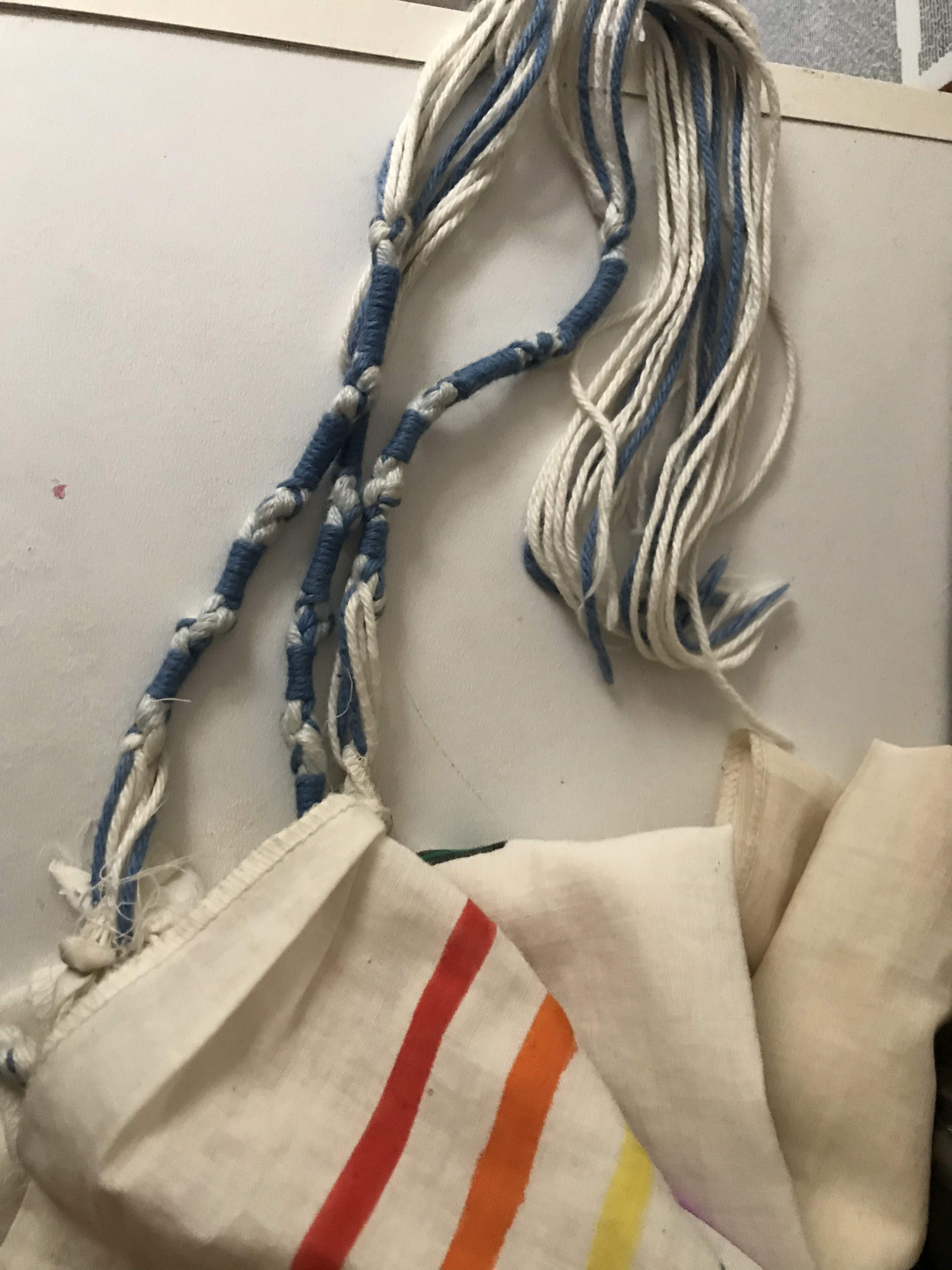
Immediately following the Israelite threat to stone Joshua and Caleb Torah tells: then the Presence of the LORD appeared in the Tent of Meeting to all the Israelites. A covenant of G!d’s forgiveness, and a technique to help us remember our inspiration, instead of fear: the Tzitzit. Firstly, says Rashi, it helps us to see. And perhaps see ourselves more clearly: Rashi likens the tzitzit to the curls of our hair! Nachmanides explains that they help us remember, help us to resist skepticism and idolatry. How? It’s the blue; which reminds us of creation of land, sea and sky. Creation/the natural world is our anchor to sanity! The Ramban explains:and the profit of ‘eretz’ (earth) is ‘bakol’ (in all): “And what is the eretz? It is that from which the heavens were hewn, and it is the Throne of the Holy One, blessed be He, and it is ‘the precious stone,’ and ‘the sea of wisdom,’ and corresponding to it is the blue thread in a garment of Fringes.  The land will tell its own truth, even the grasshoppers will participate in songs of praise.  Rabbi Arthur Waskow explains the fringes as reminders of many web-like  connections: to one another, to the natural world and to the Divine.  Look at the fringes, and feel the connections! Then live guided by creation’s inspirations, rather than fears.

Adon olam asher malach; Shechinah ashar Malka;  Hu echad v’ain sheini (Master of the Universe who reigned, Feminine G!dly presence who reigned, is one and not two!)

From Sefer Yetzirah Ten inscriptions:

For the Creator is one

And has no second

And before one,

What are you counting? (translation Rabbi Jill Hammer)

G!d is one, yet also containing feminine and masculine sephirot , or facets, within! G!d is One, not Two, yet there is much duality in the world.  Until now, the song is all I knew of Age of Aquarius! According to Rabbi Lee Moore, who teaches Jewish Trending into the Age of Aquarius, for two millennia we have been in the age of Pisces, which is a very dualistic time, symbolized by two fish swimming in opposite directions. That this is changing, we are entering a new age, G!d willing a kinder and gentler age. Rabbi Moore teaches that we have a role to play with how this will pan out. What can we do to unify conflict and duality?

The parashah this week, B’haalotcha. Has SO MANY dualities, or twos in it, opposing forces. But if you look there is a pathway to one-ness to redemption to be found each time within the text.  

In Chapter Ten, Numbers, there are to be two silver trumpets made. Why two? One trumpet to summon the leaders, Two are played to summon the kahal, the ordinary folks.  And two ways to play the trumpets – the Short blasts for war, which represent brokenness according to Penine Halakhah, Rabbi Eliezer Melamed, The solution: a Tekiyah, a single long blast for peace, for Shabbat.  See Source Sheet linked here

G!d dwells among the people in the wilderness in two forms the cloud covering the Mishkan/Tabernacle, appearing as fire by night. And as long as the cloud could be seen, we’d rest, if not perceived, we broke camp! When we’d break camp (interesting we use “break”!) Moshe would call out Kumah– arise G!d and scatter our enemies.

The resolution? When Moshe would call : Shuv return. And S’forno explained that Shechinah would once again rest with Yisrael

Two prophets ran out (Numbers 11:27) and told Moses, saying, “Eldad and Medad are acting the prophet in the camp!”  Joshua says “restrain them.” The resolution? Moses answers: Would that all the LORD’s people were prophets, that the LORD put His spirit upon them!”

Moses will take a second wife, and both his siblings will criticize him for it, although only Miriam will pay a price.  El Nah Refah nah is the answer, Moshe’s prayer, “Oh G!d, please heal her!”

My favorite though is the law for a Second Pesach, Pesach Sheni (Numbers, chapter 9) You see this law was not originally in the Torah given to Moshe at Sinai.  A group of people who could not offer the Pesach offering approached Moshe and Aharon at the tent of meeting.  It’s not fair, they complained, we want to draw close to G!d too! (Now, you guessed it, there is actually a second time of complaining – “we don’t want manna, we want meat”! with a different motive, that tale has a very different ending.)

This is an appeal to justice and to the desire to approach G!d, and so Moshe says “Stand by!” literally.

And G!d spoke to Moshe saying: they are right. And here’s the new law, a second chance, a Pesach sheni, and not just for them, they were tamei because of a funeral, but for those who are too far away on a journey. And for the Ger, the stranger who resides in your midst. There shall be one law for the stranger and for the native born.

An amendment to the Torah! Was it imperfect to begin with? 

Rather, perhaps it was a test! G!d was waiting for them to say, “what about justice, what about a chance for me to be a part of the people”, and they passed the test, G!d reached out and included others under the tent. There shall be one law for the stranger and the native born. And right after these words in the text, Shechina rests upon the tent.  Maybe G!d is still waiting for us to take the first steps to unifying the dualities!

 Did you ever feel the need to be like Thoreau living on Walden pond, opting out of the “rat race” for a while?  To ditch the “military industrial complex” (a phrase I learned from my twenty two year old kid) or like Wordsworth to separate from the

“world (that is) too much with us, late and soon,

Getting and spending, we lay waste our powers…”

Not to numb the senses and simply escape, but to find out how to connect to G!d, nature the infinite universe? How would it feel staying apart?  What would be gained and lost? What of the loneliness? And how would others recognize your choice and give you space, and… what would you do about your hair?!

 In this This week’s parashah, Naso, a pathway is given

Bamidbar chapter 6:2: If anyone, man or woman, can make a Nazir’s vow, to set themself apart for G!d,

There are really only three requirements to becoming a Nazirite: 1. No wine or other intoxicants  2. not go near a dead person, not even a close relative 3. To grow your hair wild!

 “Kodesh yihyeh, gadel pera s’ar rosho” For all the term of their vow as nazir, no razor shall pass over their head; it will remain holy for all of their days as a Nazir, Holy to  G!d, the hair of their head being left to grow untrimmed. 

There was a loud party in my neighborhood this past weekend, blasting the silence of the night as I took a walk, with typical dance and DJ songs. Alcohol I’m sure was had, and people celebrated, and I’ve been there. My daughter’s Bat mitzvah was celebrated in the back yard, and I enjoyed sharing food and drink and laughter with family and friends. Sometimes, though,  feeling hollow, hevel, as Ecclesiastes says, I yearn for only the silence, and to step out under the stars. Sometimes I cannot join genuinely in the rejoicing. Requirement #1, if you vow to be a Nazir is not to indulge in alcohol or intoxicants: no celebrations.

The second requirement of the Nazirite is to not attend a funeral, to be unavailable to share in the community’s losses, or even those of your own family. Without the solace of becoming vulnerable in your joy, perhaps the symmetry is not to be vulnerable to the loss of loved ones. It reminds me of  what my yoga teacher, Maria says about the Buddhist masters who respond with equanimity to life’s highs and lows.

So why the long, wild hair?  Rafael Sforno, the renaissance commentator says it means the hair should not be coiffed, not formed into any shape. Perhaps it makes the Nazirite less judgmental of self and others.  I had previously thought that maybe the wisdom was in avoiding the harsh metal razor.  But the holiness of the hair is mentioned too many times:  I recognize now that it’s more of a mountain-man/-woman thing: letting be what will grow. Just as so many haven’t taken haircuts this year!

Rashi explains: “his hair shall be holy, In that he must let it grow freely to let grow the overgrowth, in Hebrew  perah of the hair on his head..  Interestingly the other meaning of the word “Perah” is a leader.

The Zohar pictures the white hair and beard of the Ancient Holy One, Attika Kadisha as rays of shefa and mazal.

And of course there was Shimshon -whose name is related to shemesh , the sun, and who is according to Dr Ely Levine a “a liminal hero, sitting on the edge of what is acceptable and what is not.”  Hair is interestingly a liminal material, between life and death. Formed in the follicle within the dermis by living cells, cells die as they are forced up through the shaft, and all that we see is entirely made of dead cells and materials. Why does a toddler cry during that first haircut? They think it will hurt! But it doesn’t. The other body material made in a similar way are finger and toenails, Klippot. Both are formed from dead cells filled with the tough protein keratin. Fish scales, shark teeth, feathers, fur: all keratin, as is the dead outer protective epidermis of our own skin. Ironically fingernails are considered to have demonic potential, even as the Nazir’s hair is holy. They grow a bit after death, dirt accumulates beneath them, they can be sharp and cutting, and to keep them growing very long will curl them and make using the hands difficult. Traditionally you would cut nails before Shabbat, and either burn them (best choice) or bury them, or they are dangerous according to Tikkunei Zohar! And when we do havdallah, turn nails toward the flame, to ensure that the light holds sway over them during the week.

When your vow is done, a ceremony of cutting the sacred hair, and burning it ends the Nazirite’s separation when he or she rejoins with a drink and celebration. Or perhaps donating to locks of love.

The musical Hair opened on Broadway in 1968. I was ten years old, and I saw a 50 year revival. A time of civil unrest, similar to today, gre w a youth culture of subversive disengagement. Opposition to: the war in Vietnam, racism, to sexism, and to poisoning of the earth, reactions to the assassinations of King and the Kennedy brothers, was expressed by young men by growing their hair “long as I can grow it” In this musical, hair became a symbol of a new culture, The dawning of the age of Aquarius. When violence and war take a friend’s life, they urgently pray to let the sun shine in!

Israeli New Age musician Idan Raichel had beautiful long dreadlocks, which somehow made the cries more plaintiff Mimaamikim karati eilaich- From the depths I call to you! He cut his long dreadlocks recently, and shaved his hair close to the scalp. He explained: he’s a family man now, with two pre-teen daughters.  Perhaps the symbol of his new role in society was to shave his head as the Nazirite does .

All of these are possible answers to the opening question: Why the wild hair? But the most beautiful answer floated to my ears yesterday in the words of poet Elana Klugman spoken in her poem Revelations: The Toratot of  Ruth about Ruth and other tales, and hopes for gentler times, as she imagined G!d as

the infinite

tenderness of All

caressing our wild hair.

That’s why the wild hair.

Getting lost alone can be terrifying, but together, what an adventure it can be! Our parashah and new book of Torah is Bamidbar meaning “in the wilderness”; And almost as soon as arrive we get lost, wandering in a wilderness in space and time. A large roaming community – how does that work? How can we create order in the wilderness? How meet everyone’s needs? How protect children in this mobile community? And how can we protect our values: truth, justice and peace? Three things that the whole world rests on, (Pirke avot 1:18)

 To answer I’ve found one take-away each from Chapters 1,2, and 3 of Numbers:

Chapter one: “Lift up the heads  of the children of Israel by family and house and mispar shemot “count the names” Raphael Sforno, Italian Renaissance, commentator explains it means each name has a story: at that time, the names of the each reflected their specific individuality, virtues. 

So first to create order, to lift up the individual, locate them within a family/tribe, Just as in time we are Counting days of the omer – each day precious, each seed of barley reaching toward the sky.

Chapter 2 is organizing tribes by space

Eastward, facing the rising sun is Judah, Zevulun and Issachar,

Westward, facing the setting sun is the tribe of Ephraim, Menasheh and Benyamin

Facing the North wind is Napthali, Dan and Asher

Facing the Southern sun: Gad, Reuben and Simeon

We know where we belong, within our family and in relation to one another, the sun, earth and wind

And in Chapter three: Levites, who guard and serve the Israelites by caring for the innermost mishkan, a beautiful space to hold the laws and let G!d’s presence enter and dwell among our community: heart, truth, and inspiration!

Surrounded and supported by community, against the unpredictability of the world. This geometric arrangement reminds me of the Angel’s blessing we say at bedtime:

B’shem Hashem Elohai Yisrael

M’mini Michael – (on our right Michael, angel who is like G!d)

M’smoli Gavriel – (on our left Gavriel, angel of Strength)

Um’lfanai Uriel – (in front of us Uriel, angel of Light

Um’achorai R’fael – (behind us R’fael, angel of Healing)

Val roshi v’al roshi Schinat El – (Above us G!d’s feminine facet: Shechinah)

Here are three lovely versions: Carlebach; Elana Brody, and Debbie Friedman

It was then I realized the meaning in my own life: community of friends around me, helping me through wilderness are actually Angels, each one unique! Together we’ve been counting the days of the omer, each day focusing on embodying middot: falling in love,  flexing our courage, practicing gratitude, endurance, listening for harmony, feeling connected, and knowing we are surrounded by majesty.  We can all meet at Sinai now, ready to looking anew at our one another with eyes and hearts open.  We’re almost ready for TORAH! (also blintzes and cheesecake!) May peace reign. Chag Shavuot Sameach!

Behar 2021

Behar means upon the mountain, Mount Sinai that is. t includes the commandments of the Shmita, of letting the land rest every seven years, like a huge exhale, and letting our unceasing work upon it rest as well.  The planet has exhales and inhales during the seasons, and the Holy Days reflect very ancient traditions that accompany this. Our counting of the omer for example, was a holding of the breath, praying that there would be dew, and not too much rain each day so that the seeds of the grain could sprout into tall crops and our families would be fed. Imagine holding our breath each day and watching the grain grow and yearning. We take our food so much for granted, and tradition has many ways to acknowledge our gratitude for the miracle of sustenance. For example the b’rachot before and after eating.  The omer bundles with this our higher aspirations and yearning for understanding and measuring our souls. Today is Netzach she’b Yesod – endurance with our connections with one another and with the earth. The shmita and yovel offer solutions to endure upon the land and with one another, and then this command from verses 23 and 24 to remind us and give us a perspective Lev 25:23, 24

But the land must not be sold beyond reclaim, for the land is Mine;

you are but strangers resident with Me.

The verb Tz’mitut is found only here and in verse 30 in the entire Torah. From the verb Tzamat to end or exterminate, We don’t have the landlord’s permission to destroy our home, even if we should want to, for short term profit! Rashi explains : Your eye shall not be evil towards it  for it is not yours.  Ibn Ezra Explains: The word tzemitut is similar105In meaning. To keritut (divorcement) The 7From the root tzadi, mem, tav. (will cut them off) it is a hyperlink to psalm 94: That G!d  will cut them off

Ramban Explains: By way of the Truth,(Kaballa) the meaning of the expression for the Land is Mine is like and they take ‘unto Me’ an offering.188Exodus 25:2…for the Jubilee will apply in the world – not only in the land of Israel

Throughout the land that you hold, you must provide for the redemption of the land.

In another connection between humans and the land, just as we redeem captives, we must redeem land.

Human ownership of land is an illusion. If we love our children, we will educate ourselves into being stewards of the land: ovdah v’shamra, to serve and to guard Shechinah whose presence is b’chol ha arets.  Because the land is G!d’s, not ours

The land needs to breathe and we need to rest and breathe too on Shabbat, If we ignore these commands, R Arthur Waskow reminds us, that in the Next parashah, Behukotai, we pay the price, the land will simply demand and take her Sabbaths, at our expense.  With the hope that these truths can set us free: keratem Dror b’artzecha: and may we be strong: Chazak Chazak v’nitchazek

Emor 2021

The LORD said to Moses: Speak to the priests, the sons of Aaron, and say

to them: None shall make himself tamei (impure to bring an offering in the

Mishkan) for any nefesh among his people,

Emor, the command to speak, follows vayomer, and G!d spoke, and the v’amarta – you shall tell a three fold repetition of speaking. Rambam explains we must say over and over, and Rashi explains, teach the children, and so the repetition. There is a story of Rav Pinchas of Koretz, whose brother was an eminent scholar, but Pinchas was all fire and emotion, who often was unable to study, because when the paragraph began “And G!d said” he would cry out in wonder, and run outside so moved by that miracle. Here we have G!d speaking, and then the same word AMAR repeated, three times, for Moshe will say and tell them. I can’t even imagine how Pinchas would react. For me, It reflects a beautiful echoing: G!d speaks and Moshe speaks, and then the kohanim must teach. But will our teachings be good enough? G!d’s speach is the pure ideal. Ours will be flawed by the limitations of our understanding and capacities, and perhaps there will be dissonance between them, a paradox.

AND who is this nefesh that will make the Kohen tame? Often used to mean person Nefesh is a level of soul, the life-force of the body, the awareness of the body. enmeshing of the Nefesh with cells and tissues body. Nefesh here is understood to mean a body which has died. I am learning about Jewish concepts of what happens to the soul after death, and merging it with my own understanding from biology, and finding it very enriching. Judaism does not separate mind from body, they are enmeshed. Just as the cells still remain alive, many of them, in the body, so the soul is still partly there

So why would this contact make the Kohen tamei? This is an important question, because there are many kohanim that still will not go to a funeral. My teacher Reb Marcia our teacher, who explained that the Mishkan is no longer here so many Kohanim do not feel that restriction. That’s a good thing because in Ex 19:6 says we should be a nation of kohanim!

This non-separation of life and death, I think, explains why the Kohanim become tamei with contact: this nefesh is a mixture of life and death, a dangerous in between place. The kohen is supposed to radiate an ideal, be symbolic of pure life. Yet he is mortal, human flawed as we all are, and so the paradox. We all exist within this contradiction: harmony and beauty exists and so does dissonance and despair. Mortality collides with our visions of eternity. In perhaps the most challenging verse of Emor, 17 Moshe is to explain to Aharon that any of his chilren

who has a mum/defect shall not draw near and offer nourishment to God.

But we are a nation of Kohanim, and I want to draw near, and bring the offerings of my heartand somehow nourish this world and G!d, AND I, like 26% of Americans, have a mum, a disability. Further I’ve learned that many wounds are invisible, yet disabling. And I pray G!d will accept my prayer, though I am imperfect.

Rabbi Shefa offers this teaching about Emor: Our spiritual challenge is to acknowledge with eyes wide open, our flaws, the harm we cause through them: the suffering, injustice and cruelty that pervade our world…AND at the same time… to see the absolute perfection of it all.

I know R Shefa is right, and the only way through is …through – I am broken, but have known visions of perfections, hear dischord, but know harmony. Am mortal but can conceive of an immortal soul, The paradox is the way home. Maybe that why Torah repeats AMAR 3 times.The first is G!d’s speech, the second is our flawed speech, the third is our speech through the crucible of recognizing of our wounds and defects, the third is our healed speech made holy once again.

Kedoshim/ Earth Day 2021

Microsoft Word – Kedoshim 2021.docx

Kedoshim and Earth Day 25th day of the Counting of the omer Netzach within Netzach.

Kedoshim t’hyu, ki kadosh, ani, Adonai Elohechim. Holy you shall be, for I, Yah, your G!d am holy!

Double parashah this week, and Rabbi Mira spoke of Acharei mot, so I will speak about Kedoshim . In this amazing parashah, G!d tells us to act toward the earth and one another in holy ways. The reason: B/c the creator of life and love, and this wondrous planet is holy! Here is all of Torah, standing on one foot, says the great Hillel: love your near one as yourself, the rest is commentary. And important to see on this earth day, Netzah shb’netzach where we learn again, there is an important connection between our moral behavior and the land. There is karma, there are consequences for our actions and those consequences are played out via the land..

19:29 Do not profane your daughter, using chilul – the same word used a few verses earlier as a as something not to do toward G!D and make her a harlot, and don’t prostitute the land, or the earth will be filled with depravity

First of all, how could a parent do such a thing? Well it seems that in poverty, you could hire your children out as indentured servants, or marry a daughter off for the bride price. Rashi explains that Torah here speaks of one who gives his unmarried daughter away as an illegitimate concubinage. This marrying off of young girls still goes on. I have supported an organization called unchained at last, started by activist Freidy Reiss, survivor of an arranged, forced marriage to an abusive spouse, lobbying for ending child marriage in this country. Gov Murphy signed into law in NJ 2018! New York permits 17-year-olds to marry with court approval

But what do we make of the second half of the verse, and don’t prostitute the earth, or the earth will be filled with depravity. Rashi explains: If you do this to your daughter the soil will become faithless to you in the distribution of its fruits, producing them in other places and not in your land. But perhaps it’s resonance of feminine: Honor your daughter as you honor Shechinah, the feminine indwelling presence of G!d in the land. We prayed twice this morning – m’lo kol ha- artetz k’vodo – the whole earth is filled with G!d’s glory. Shechinah is often understood as inhabiting the beauty and bounty of the earth which nourishes us. Uninhibited as always, Zohar explains that the fertile valleyof Hizon/vision between two mountains are the breasts of Shechina, nourishing the children of israel in the valley between! And El Shaddai means G!d of breasts. I love this image of G!d nursing and nourishing us.

And yet we prostitute the earth. We have destroyed the great forests of the planet in the name of profit. Read the Pulitzer Winner The Overstory by Richard Powers, breathtakingly beautiful and heartbreaking. We are still doing it in the great Amazon, (where the richness of the land is in the forest canopy, burned up into smoke a double whammy toward climate change, chillul/profaning Shechinah) And we pollute the earth, suburban gardens pouring far more pesticides per acre even than farms in ignorance and in homage to the god of green lawns, poisoning the butterflies, birds, bees, fireflies, the groundwater, and our netzach, our ability to remain alive on this planet.

Today’s symbol for Netzach she’bnetzach is the redwood tree, Redwoods have been around for about 240 million years, 300 feet or more, Officially, the oldest living coast redwood is at least 2,200 years old, but foresters believe some coast redwoods may be much older.
They are carbon soakers, climate change heroes, Redwoods live so long because they are extremely resistant to insects, fire and rot.

Be holy, for the love of our daughters and sons through whom we endure, so we can endure on this land G!d has gifted us. Earth Day is a reminder that we are connected to all living creatures, that we only endure together loving one another and the other creatures of this planet earth.

Be like a tree
Eytz chayim hee
Who will remain after you to repair this wondrous world?

NPS

Metzorah 2021

Tazria Metzorah 2021        Netzach sheb’tiferet. 18th day in the counting of the omer, and Israeli Independence day.

Elohai, neshama she’natata bi t’horah hi! Oh G!d, the soul you have given me, she it tahor!

~Morning liturgy

We are stardust, we are golden, and we’ve got to get ourselves back to the garden ~Joni Mitchel

How does beauty endure? As I meditated on this late at night I realized it’s a two step process. First, to seek and recognize beauty, to take the time, and to perhaps look outside the box.  Secondly to commit to protecting beauty. During the past year we’ve lived through difficult times, plagued not just with COVID, but with racism too.  Illness is not beautiful, and despairing of beauty can happen. The Poet John Keats, who died of consumption writes, in Ode to a Nightingale urging the lovely bird to “fade far away, dissolve, and quite forget, what thou amongst the leaves has never known,  the weariness, the fever and the fret; here where men sit and hear each other groan,… where but to think is to be full of sorrow and leaden-eyed despair. Where Beauty cannot keep her lustrous eyes, or new Love pine at them beyond tomorrow. ….but in Jewish tradition my grandma’s eyes are beautiful! Psalm 148 brings our eyes to the wonders of life and creation. In spite of it all there has been beauty In our own time, in rebounding of the natural world. Visits to National Parks have soared during the pandemic, we protect beautiful places so they can endure. In Torah Tazria Metzorah, we read about quarantine, contagion, about encounters that shake us to the core, that poke at the boundary lines between life and death,.  And about how to re-enter the group after the fear. a reentry of the spirit, with rich symbolism.  Torah has never seemed so relevant, I wondered what I could add to the conversation, this is what came together. Metzorah begins

   This shall be the Torah for one who has Tzaarat (a contagious skin ailment) on  the Day of their becoming Tahor (pure). And the Kohen will be brought… Be brought where? It was not unusual to find people cast outside ancient city walls. But the Kohen will go Outside seeking the afflicted one, to make possible a pathway back home.

The Kohen shall go outside and see. Then with the technology available at the time the following materials will be gathered:

The Cohen commands two live pure birds, cedar wood, crimson thread, and hyssop And a bowl of MAYIM CHAYIM:  living waters. Then in two stages death is replaced with life.  And  we see things done in sevens – symbolizing a new genesis.

וְהִזָּ֗ה עַ֧ל הַמִּטַּהֵ֛ר מִן־הַצָּרַ֖עַת שֶׁ֣בַע פְּעָמִ֑ים וְטִ֣הֲר֔וֹ וְשִׁלַּ֛ח אֶת־הַצִּפֹּ֥ר הַֽחַיָּ֖ה עַל־פְּנֵ֥י הַשָּׂדֶֽה׃   One bird will be sacrificed, blood entering the water, which shall then sprinkle it seven times on the one who is to be cleansed.  In the town water can be stagnant in the wilderness it flows freely,…and then a release, the  live bird is set free to fly over the field. A powerful image, if you’ve seen doves or pigeons set free. Death replaced with life

After this, a seven day waiting period separated from his family sacrifices, sin and olah, and the blood on the right ear, thumb and toe to be replaced with delightful oil on the skin in the same spots, you guessed it, seven times. And we re-enter reborn, without fear or guilt of having either deserved getting sick, or having passed it along.

But I wondered about the banishment/ quarantine to the wilderness or field, and what the person cast out was doing during that time. Perhaps gathering the cedar and hyssop. But what exactly is hyssop? I looked it up: it’s a medicinal plant good for many ailments. The wilderness has much to teach us about medicine, and so many new medicines come from forests and wild places. And the wilderness can set our spirits free, as that dove flies free.  As John Muir said, in wildness is the preservation of the world. And the Israelites were forged in the wilderness.  In my studies of Zohar this week we are studying about Rav Metivta – a University in the wilderness that can be accessed by souls who innovate and re-enliven words of Torah. There in the wilderness we are  taught by the teachers of the greatest generation: those who died in the wanderings of the wilderness, and died there. There on the mountains when your mind and heart are most open to you can be taught and inspired by none other than Moses and Aaron, who runs a school of love, and (this is cool!) Miriam. And your soul can fly, it says from one university in to the other ever more elevated. The wilderness was not just where we wandered, it was the pure crucible of revelation and inspiration. This is the Torah of the wilderness There are plants like hyssop, living waters and birds that fly free. And for there to be enduring beauty and we need wild places. We are stardust, we are golden, and we’ve got to get ourselves back to the garden!

If you’re ready to be One, stand strong and surrender, Ready to be One.

Billy Jonas’ song was in my head this morning, in answer to my prayer last night that this Teaching honor the memories of those lost in our lives.

On this Yom HaShoah, Holocaust Memorial day, in this week of Gevurah, courage, in counting the omer we hauntingly read of the deaths of Aaron’s two eldest sons. They were beautiful, spiritual souls lost too young. The rational voice of the Rabbi’s says they were punished for their sins. And the mystical voice of the Rabbi’s says G!d took them to be close. I struggle with both of these interpretations. Rather G!d mourns with us always in our loss, perhaps especially when we can’t find the tears, as Aaron and Moses were silent.

Nadav and Avihu were no ordinary people, these were no ordinary deaths.

In the first verse of Shemini Moses calls Aaron, his sons, and the elders of Israel; This list is the first hyperlink to a previous scene. The verses continue to promise that: “Today G!d will appear to you.”  Wait, we don’t see G!d do we? We the listeners who are not to make images of G!d because nothing we see can come close. But this has happened before, it is the 2nd  hyperlink to Mishpatim – after Sinai, Ex 24: A voice  says to Moshe: Come up to G!d, with Aharon, Nadav and Avihu and the 70 elders” and then outrageously:

 וַיִּרְא֕וּ אֵ֖ת אֱלֹהֵ֣י יִשְׂרָאֵ֑ל וְתַ֣חַת רַגְלָ֗יו כְּמַעֲשֵׂה֙ לִבְנַ֣ת הַסַּפִּ֔יר וּכְעֶ֥צֶם הַשָּׁמַ֖יִם

 לָטֹֽהַר׃  and they saw the God of Israel: under G!d’s feet there was the likeness of a pavement of sapphire, like the essence of sky in purity.

Imagine how inspired these two young men, the only ones chosen in their generation, must have been in this intense, mystical encounter! And now in today’s parasha, this encounter repeats.  The community offers sacrifices, G!d appears, G!d’s fire comes out of the altar, people shout and fall on their faces terrified, all except for the two, who go into the fire with their own incense and fire pans, seeking G!d.

And the Torah continues וַיַּקְרִ֜בוּ לִפְנֵ֤י יְהוָה֙ אֵ֣שׁ זָרָ֔ה אֲשֶׁ֧ר לֹ֦א צִוָּ֖ה אֹתָֽם׃

The trop mark under “lo”not, is rare, a mercha kefula found only 5 times in Torah, a link to aggadic legend.

They drew near before G!d with a strange fire that was not commanded to them.

So what was G!d’s response:  And a fire went out from before G!d and consumed them, and they died before G!d.

And then Moshe says to Aaron: בִּקְרֹבַ֣י אֶקָּדֵ֔שׁ   with those near to me I will show myself holy.

Moses then instructs the boys’ cousins to carry the bodies out, and to grab them by their cloaks. Wait, the cloak was not burned, neither the bodies? The majority opinion of the Rabbis is that they sinned, and were drunk, based upon the warning a few verses later not to enter the tent of meeting with wine or other intoxicant. But it is not the only opinion. Rashi, in his comment on sees Moses as explaining to Aaron: your sons who have died are greater than me and than you!”

What was this strange fire? What was this death?  Whether they chose to  leave this world an effort to unite with G!d, or were careless and ran into danger, it doesn’t matter. To do either is to kindle the strange fire not commanded by G!d! Today’s teaching is clear, no aish zarah (strange fire)  We are to always choose life so that we and our children can live. Perhaps that’s one way we have endured, still persisting, to find the Netzach sheb’gevurah, endurance within strength.

When you’re ready to be One, don’t just surrender, Stand strong and surrender, choose life, because we already are One!  Mystics seek G!d’s spirit not as others chase thrills, but to bring G!d into this world in such need! To stand and sing out the power of G!d’s healing and forgiveness, to teach this love to the lonely, so that the lost will find their way home. Noah Aronson We choose the life!

This is some of the background material for the drash.

Life is the true fire we are commanded to seek, and to seek death is the strange fire, never commanded. So choose life that you and your children may live!

The case can be made that Nadav and Avihu offered themselves up as a misguided attempt of mystical union with G!d  Here are some texts showing the existence of spiritual death-seeking as a mystical pathway. Here are some examples of this death-seeking I have found.

1.     Story as told by Reb Zalman from the  A Heart Afire,  in a story of the Avraham, son of the Dov Bear, the Maggid of Mezerich, pgs 241 and 242. Avraham, was known as “HaMalach” (the angel) He and Reb Shneur Zalman got very deeply involved in a meditation, eventually reaching the place of  atzilut, until they are at the point of being able to leave life itself.  Shneur Zalman saves the Maladkh’s life with a crust of bagel and beer, reminding me of when Eliyahu is in the cave, and suicidal, and the angel saves his life and brings him back to life by feeding him!

In a related story, the Malakh’s wife similarly saves her husband by ascending to a heavenly court in dreams, fighting against her husband’s strong desire to join them.

2.     In Melila Hellner-Eshed’s book, on the Zohar, A River Runs Through It, page 58-62, the deaths of Moses and Rashbi are considered,

a.     Rabbi Shimon said “Moses never died…It is called death from our perspective…whoesoever is in perfection, in who resides the holy faith, death has no sway over him…

b.     In the  Idra Zuta Rashbi experiences his own death as a passage into true life….the occasion of his transformation into …full..union with Schekninah. ..not merely metaphoric but mythical and mystical

c.     The white light on page 273. It is a common expression when someone has a belief in the afterlife of seeing a white light.  “The quest for the white light has another important aspect; the wish to be absorbed and subsumed within the divine – a kind of death wish (bold is mine), perhaps death by divine kiss – arising from the desire to attain the source of all. Melila footnotes this: This desire for white, associated both with the desire for perfection (eros) as well as death (Thanatos), receives expression in Alken Afterman, Kaballah and Consciousness, page 113.

Afterman’s mystical poem “Desire for White”

Everything, its open mouth

Lipless

Its gaze cloudless

Everything, its one desire

Soundless

Desire, or the inner colors of white

-The deaths of Nadav and Avihu has been interpreted in ways that perhaps once represented culture in biblical times portraying a punishing G!d, This image is no longer what is needed in today’s global society to deal with problems requiring intercultural cooperation. Therefore a paradigm shift is needed. R’ Shhulamit Thiede teaches “we worship an interpreted God” R’ Art Green in “Seek My Face” speaks of  G!d as the Oneness that unites all existence, and also in ever changing intimacy that permeates all creation. G!d is found by plumbing the depths of the soul and also, in seeking G!d, R’ Green says, look first to love! “A Jewish path to Oneness can only be the one that leads through (the metaphor) of human intimacy.  The Heart of Being, the Interbreathing of Existence, as R’ Arther Waskow explains, is more true to G!d’s creative nature, and desperately needed as models and mindsets in the healing of the human relationship with the earth, and of cultures with one another. Redemption is described as “the collective effort of all generations” across cultural boundaries

The model of a punishing G!d is part of an interpretation of Torah which models abusive patterns. The psychic trauma manifests or is mirrored in the actions one human to another and to the creatures of the earth.  Life can punish us, and there is karma, where we must pay for the consequences of our own actions. It is by G!d’s grace that we can withstand, persist and support one another.

Ironically Avihu, whose name means “he is my father” would never have descendants, and Nadav, whose name means” giving” gave himself away. The truth/ emet, is that beautiful young men and women and children die. Sometimes it is suicide, or war, or rushing into danger for thrill seeking, or cancer, or….so many other paths.

G!d as the power that feels the hole in the universe made by the death of the righteous and mourns with us, perhaps especially when we are too repressed or shocked or stressed to find the tears. I have lived this in my own experience unable to mourn until I was able to open my heart, following a more spiritual pathway. Then I was able to confront my childhood hurts and call it by name, abuse, and travel the path to healing for myself. Only then was I finally able to shed free tears for the losses in my life.

Consider the tikkun if we shift the narrative of Nadav and Avihu’s deaths as misguided young mystics, running toward death, and that the Torah’s true message of life is the true fire, the one commanded, and death is the strange fire, never commanded. So choose life that you and your children can live.
One of my favorite Scenes from ET is when the children hide ET. The grownups are coming to look for him.

Where do they hide him? Among the other toys, in plain sight!

In the Zohar G!d glory Hiding in plain sight, and each word of the Torah can be a doorway to the divine.

What precious gems are hiding in plain sight in our lives? How can they become revealed? Pekudei offers an answer in 3 parts 1. Prepare – make something new 2. Wait 3. Pay attention esp to the familiar!

Pekudei, the Israelites have finally completed the Mishkan. It is the final book of Exodus, a happy ending, The Israelites are free in the wilderness, and having left Sinai have prepared a place  for G!d to dwell among them. They have given of their hearts their best gifts, and prepared a beautiful portable sanctuary. and are now creating the garments for Aaron and his descendants: Let’s listen to one verse chapter 40 verse 14 from this week’s

וְאֶת־בָּנָ֖יו תַּקְרִ֑יב וְהִלְבַּשְׁתָּ֥ אֹתָ֖ם כֻּתֳּנֹֽת׃

Then bring his sons forward, put tunic (K’tonet) on them,

This reference to K’tonet is a hyperlink to Joseph – same word for his coat of many colors. There is a passage in the Zohar say that with the days of our lives, we create a k’tonet pasim –garment like a coat of many colors for our souls. Each day we add colors or rip out threads. At the end of our lives, we have created from our lives the garment of our soul. R’ Abraham Heschel.Know that every deed counts, that every word is power…Above all, remember that you must build your life as if it were a work of art.” ―

It is gorgeous to think that as our bodies, skin and organs fray with age, that we our soul’s garment can grow more full and dazzling. So each day we can prepare.  What gifts are we bringing in our lives to prepare our dwelling place for the Divine in our hearts? 

Part of the preparation is to make space, to create a hollow space in our heart, devoid of ego, a space for love.  What is the difference between the golden calf, and the arc of the tabernacle covered and lined with gold, with the golden kruvim forming an arc above? The answer  occurred to me this week: The calf is solid, the arc and cruvim create a space! A space for G!d

2ndly we must wait. In Pekudei the Israelites must wait until the first of Nisan for the official dedication of the Mishkan, when Moses knows the time is right.  Waiting can be hard, it requires discipline and trust. Waiting: psalm 5:4  Hear my voice oh G!d, at daybreak I shall prepare for You , and I wait. …. I wait Zohar asks – what does this mean? Surely all the people of the world hope and wait for the goodness of the blessed Holy One, even the animals of the field

 How do you keep the trust and know spring will come?  I discovered shoots of daffodil that had been preparing under the snow. A second Heschel quote “Self-respect is the root of discipline: The sense of dignity grows with the ability to say no to oneself.”

3rd, pay attention. If we look for it, there miracles hiding in plain sight – in the daffodil shoots, in the eyes of a friend, in G!d appearing in a misty cloud. No more will there be a dramatic sound and lights show like Sinai. Though awe inspiring it didn’t work to keep G!d in our hearts. It was too powerfully scary. So we made what was familiar, a golden calf, took the easy way out – and fear was the pathway to the dark side. One of my favorite quotes from R’ AJH “Our goal should be to live life in radical amazement. ….get up in the morning and look at the world in a way that takes nothing for granted. Everything is phenomenal; everything is incredible; never treat life casually. To be spiritual is to be amazed.”

Taking G!d with you, it’s how we carry our dreams through the journey of years.  But how can our dreams survive intact through all of our fears? Cut the cloth with love, measure the seams with care, cast jewels of joy on the breastplate and light that flame eternal.