Torah for now

Posts tagged ‘love’

The Binding of Isaac, cords of love?

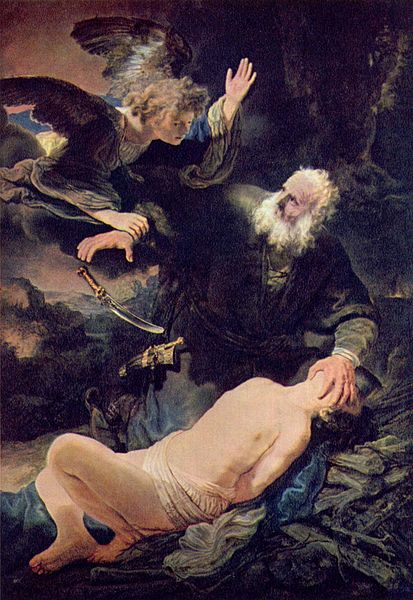
“Take your son, your only one, whom you love, Isaac, and go with him to the land of vision, Moriah, and offer him up as a burnt offering” Gen 22:2 How could a father attempt murder of a longed-for, beloved child at the command of a loving G8d? This is a question many have tried to answer. One tradition sees Virtue in Avraham’s willingness to sacrifice his child in obedience. Another tradition, however, as Rashi quotes in midrash, says this last of ten “tests” that challenge Avraham is Satanic. The accuser, Satan, challenges Avraham’s love of G8d, who enacts the test. According to the Midrash, Satan then descends to earth trying to talk Avraham out of the sacrifice, using all the reasons we would argue today. Avraham in mystical tradition represents the sphirah of “chesed” loving-kindness. Why does Avraham listen to the command to offer up his “only” son as a burnt offering? Was it fear, pure faith?

I propose another interpretation: the binding of Isaac is a parable about the sacrifices we make to honor our parents, in obligations borne of love. This is more consistent with the themes of love and strength in Genesis, and bears powerful wisdom for our lives today. According to Maimonides, Abraham does everything for the love of G8d and humans, who are in the Divine image.

“Scripture says (Deut. 11:13): ‘To love the Lord
your God’-whatever you do, do it only out of love.”…
Abraham our Father achieved this level; he served God out of love. ~Maimonides’ Introduction to Perek Helek Introduction to Chapter ten of Mishna Sanhedrin

Avraham is the model of hospitality, his tent was always open, he interrupts an audience with the Divine to feed and wash the feet of three strangers, who reflect G8d’s image (when he is 90 and recovering from circumcision!) He plants an “eshel”, interpreted to mean an orchard or a hotel, to feed people, and teach them that bounty comes from G8d.

If Avraham is all about love, how can this be harmonized with attempted murder of Isaac? Consider this: love is the rope that binds his son. I have a newborn grandbaby, and it is stirring strong memories of motherhood. When that baby cries, you are bound to respond. A parents’ life is not their own. Mara Benjamin, in her article “The obligated Self: Maternal Subjectivity and Jewish Thought” brilliantly uses the experience of maternal obligation out of love to speak of religious obligation, a concept we are sometimes uncomfortable with. She writes

Maternal obligation, in both its practical and its existential dimensions, offers contemporary Western people’s most substantive experience with the meaning of obligation. …The care for an infant perfectly captures the pairing of command and love at the heart of rabbinic thought. If God is not only loving parent but demanding baby, we may find within ourselves the resolve to meet the demand.

But what of caring for aging parents (or other relatives), is that not also an obligation bound by cords of love? According to tradition, Isaac was 37 at the time of his near sacrifice. (Based on his mother Sara’s age at his conception, 90 and the timing of binding of Isaac immediately preceding her death at 127 years) Avraham was 137 years old. In my mind I halve all the ages in the Avraham saga to make it relatable, still he’s elderly, perhaps disabled. Somehow he makes a three day journey on to mount Moriah and climbs a mountain. Although the donkey may carry him to the foot of the mountain, how does he climb, when the donkey is left behind at the foot of the mountain: Does Isaac carry him? I have recently had to put my life on hold to care for a disabled relative, I did it out of obligation borne of love. It is difficult, and my actual identity at times seemed subsumed by the obligation. I propose that, as many adult children Isaac is a care-giver whose obligation to care for his father is the rope that binds him. This makes sense of the ages of Avraham and Yitzhak, of the love that Avraham is said to embody. What about Yitzhak, named for the laughter of his elderly parents? He represents “gevurah” or strength in tradition, and it takes so much strength to care for aging parents. These obligations bind us but should not slay us. Avrahram responds to G8d’s call, lifts up his eyes to see the miraculous ram, that takes the place of his son so that Isaac can be a link in the chain of generations.

Isaac embodies the fifth of the Ten “Commandments” at Sinai: Kabed et avicha v’et imecha… honor your father and your mother, that you may long endure on land. According to Sefer Hamitzvot command “honor” means to give them to eat and drink, bringing in and taking out” This sounds like being a caregiver to an elderly disabled parent! According to Ramban, to honor parents is to honor G8d.

Sources on Sefaria

The Most often repeated command: Do Not Oppress the Sojourner!

This week’s Torah portion is Mishpatim, meaning “laws”. The narrative of Revelation is interrupted to give a whole bunch of laws, although Moses is still up on Sinai! These laws include some troubling ones, as well as some beautiful laws (Source page Here )There is a flashback to before Revelation as well, where Moshe reads everything that came before Sinai to the Israelite people, and they answer as one All “na-aseh v’nishma” We will do and we will hear. How can you agree to do if you haven’t heard what the deal is. Rashbam explained it means we will do all we’ve been commanded so far and listen to upcoming ones. But the Me’or Einayim hints that the doing will open your heart, and bring so much joy and love, that you will simply be attuned to the Holy One. A voice from Heaven (bat kol) hearing the Israelites say “naaseh v’nishmah, asked “who told you this secret?” for this is how the angels serve the Blessed Holy One. It is a beautiful thing! So what is it we must do? The single most oft repeated command in the Torah stems from our experiences leaving Egyptian slavery. It is this: Do not oppress the stranger, for you know his nefesh soul, for you were strangers/sojourners in the land of Egypt. According to the Talmud, Rabbi Eliezer stated that “the Torah warns 36 times, and some say 46 times, not to oppress the stranger” (Babylonian Talmud, Bava M’tzia 59b) Twice in this Torah portion alone. By the time we get to Leviticus, it has morphed into a command to actually love the stranger as we love ourselves! Leviticus 19:33–34 and Deuteronomy 10:19

Once again, our neighbors and friends are being rounded up in churches and schools without any regard to being deserving or not. They are undocumented, they are vulnerable and sojourners. Our command is clear

HEAR THEIR CRIES, by Miryam Margo Wolfson December 30, 2018

You already know how it goes 

To be so far from safety, from home

To be alone, to be a stranger in a narrow zone

Love the stranger, you were strangers too

Love the stranger, you know their soul

Hear their cries and know

You can be part of the healing, 

make things whole

A little girl cries in the nlght

Though they hear her no one comes to hold her tight

No one makes it right, or reunites

The world seems far too big and too cold

Without Momma beside her to hold  

Bridge

Naaseh v’nishma, We will help and then truly hear

When we comfort and dry the tears 

It can open pathway so we

Can be free, to live in dignity

Naaseh v’nishma,  

Let us open our hearts and our ears

Cause there will always be mountains to climb

We can truly be there,*

even gather a glimpse of Divine

if we..

Love the stranger, we were strangers too

Love the stranger, we know their soul

We Hear their cries and know

we  must be part of the healing, 

make ourselves whole

* Moses is told to climb the mounain and be there!

Pulitzer prize winning photo by John Moore

Just Breathe for Qohelet/ Ecclesiastes

I  spent a day last week with one who was dying, body failing, spirit hovering. The hospital machines whirring and spinning, some would soon be removed. “Breathe” urged the loved one to the dying one, when every breath was painful effort. “Breathe” and for him she did for a few more days.

Hevel, merest breath”, is our life, says Qohelet, (Q1:2) Biblical book of wisdom. Yet merest breath is a Divine gift, and cannot be forced.    “It sucks, said the loved one” “Yes” I replied, validating his sorrow and anger.  “Only love is as strong as death,” (shir ha’shirim 8:6 )I suggested, but his need/desire was too great to let go.

  We seek insights on what it means to be alive and in relationship with others. In the ancient Biblical words of Qohelet we find  wisdom to help us gain perspective and understanding of the enormous issues of where G8d is in the passage of time and mortality, and why bad things happen to good people in the presence of a loving G8d. This gift of wisdom is not unique to Jewish literature and also appears in the ancient Chinese wisdom of Lau Tzu’s Tao te Ching. Of the beloved’s strong need for his wife’s breath “…free from desire, you realize the mystery, caught in desire, you see only the manifestations, Yet mystery and manifestations arise from the same source. This source is called darkness. Darkness within darkness, gateway to all understanding” (TTC 1).

The fact that we are here, as unlikely as that is, is a miracle, as are love, and beauty and goodness. These we attribute to a loving G8d.  However, coming to terms with mortality, the inhumanity of some human behavior, illness and suffering can powerfully challenge us. “no amount of effort can make right something truly perverse, and things that are lacking almost never manage to come into existence in a real enough way to count” (Q1:15) says Kohelot, in the gorgeous melody of a trope that paradoxically lifts our spirits. These words validate our fears, acknowledging their weight and their shared human concerns. All people in various cultures who have sought wisdom must deal with such questions. We perhaps reject, as I do, a G8d that micromanages, and can make our team win with supplications or animal sacrifices. Just having lived to pursue goodness may have to be enough. In trying to control and fix the world, we have separated ourselves from it, and created ecological ruin. The technology that protects us, uses resources, creates waste, destroying the natural environment, which we are meant to be a part of, Just as the technology that prolongs death destroys dignity, and we must let go in the end.

In this week’s parashah, Yaakov, who has been the heel-grabber, tries to manipulate things to “win” at life, will finally wrestle with his demons and his intense desires to dominate his brother. He will let his family and wealth  cross over to offer them up to his brother, and there see the face of G8d. Perhaps this can only happen wrestling with the Source  in the darkness. In the mystery he will be blessed with disability and re-Named, yet the Tau warns us. …the Name that can be named is not the eternal Name (TTC:1)

  Qohelet, much like the Tao te Ching, says the world can’t be tampered with, or “you’ll ruin it”,  that the Master sees things as they are without trying to control them (TTC 29)…lets them go their own way. Our technology is “shaping clay into a pot, but it is the emptiness inside that holds what we want.”  (TTC 11)  Qohelet recognizes the  “helvel/emptiness inside”. The river of time and events “flows into the sea, yet the sea is never filled” (Q 1:7). It cannot be stopped, we cannot fight it. The spectre of death is also a(n) hevel/emptiness, but one which gives life infinite meaning. The value of humans is not what we can get out of one other, but is in their bonding. Qohelet says “two are better than one…if the one should fall down, the other one can at least help him up…if someone attacks two can fight (them) off (Q4:9-12).  It is brothers that we need!

 In Jewish tradition, Qohelet is read during Sukkot, our week-long festival spent outside, in a fragile hut, unprotected, and open enough to see the stars, and find our perspective in the larger world. We read Qohelet to know that life is ephemeral, and precious: “Do whatever you can manage to accomplish in this life, because in Sheol you fill find no activity, no reckoning, no knowledge and no wisdom, and that is precisely where you are going!”(Q9:10) 

Similarly, the wisdom of the Tao is reflected in Chinese paintings which offer a different perspective, of human beings as a small part of a much larger creation. We can be liberated by giving up control of things beyond our strength to the heavens, in the words of Qohelet: banish worry from your heart, and regret from your flesh, for childhood (life) lasts as long as a breath. Then when we return to our dwellings, perhaps our roof will be unable to separate us from G8d. Our gratitude will be richer for our blessings, and a full harvest, or even death will not harden our hearts. If he can let her go, their love can survive beyond her body.  Perhaps the harmful dramas will abate as we relinquish control. Rather we can be generous with ourselves and others, to “send our bread out onto the water….(and) sow (all) our seeds and not desist even in evening” And emerge into the day and declare “how sweet the light and how good for the eyes to see the sun!” (Qohelet 11:1,6, 10, 7) .

If I can let you go as trees let go
Their leaves, so casually, one by one;
If I can come to know what they do know,
That fall is the release, the consummation,
Lose what I lose to keep what I can keep,
The strong root still alive under the snow,
Love will endure – if I can let you go.