Torah for now

Posts tagged ‘faith’

Joy is required: Who are these?

The setting is Ancient Egypt. Father Yaakov (Jacob) has come to Egypt and spent the past 17 years finally “settling” down. He was denied this peace for the prior 20 years while he was in mourning for his beloved son, Yoseph (Joseph) Midrash says that G8d’s presence left him, and he had no power of prophecy during this time. Only when father and son are reunited does the presence return: in other words when joy returns, so does G8d’s presence. How important is joy? Psalm 100 describes the joy of gratitude, as Yaakov must have felt

“A psalm of gratitude; Rejoice for G8D, all the earth;(2) serve the Holy in gladness;come into the Divine presence with shouts of joy!”

This week’s reading happens on Yaakov’s death bed. Joseph is coming to see him. Joseph his favorite son, now looks and acts Egyptian. One Midrash tells that it is Yoseph’s Egyptian wife, Poti Phera, that sends him to his father to bless the sons. Yaakov is told his sons and grandsons are visiting, and the elderly prophet sits up in his bed. He recaps some of his inspirations (G8d speaks to him) and heartbreaks (Rachel died on me!). Then the surprising question when his grandsons are brought close: “Who are these?” Tradition is that Yaakov’s been hanging out with his grandsons studying Torah for the past 17 years. Is it possible he doesn’t recognize them?

Rashi says he’s balking due to evil kings that will come from their descendants,

Or haChayim adds that he asks to arouse feelings of love in his son before the blessing.

I recognize the heartache of Dementia in conversations with my Mom who hasn’t knows her grandchildren in awhile. The text does say that Yaakov was ill. Midrash says it was the first time an illness preceeded death in the Torah, and that Yaakov actually asks for this to prime his death bed speech.

In last week’s reading both Yehudah (Judah) and Yoseph define who they were.”Anochi E’er’venu “I will be his pledge” says Yehuda, Ani Yoseph “I am Yoseph!” exclaims the Egyptian vizeir! and (See Vayigash) and everything changes. In Genesis G8d asks Adam “Where are you?” Ayecha in Hebrew. G8d asks Kayin, “Where is your Brother?” Perhaps Yaakov is asking to see how his son will define his grandsons. The prelude to blessing the grandsons mentions G8d, and a homeland now abandoned, not just by Yoseph, but by the entire family saying: (Gen 48:3) God Shaddai was seen by me in Luz, in the land of Canaan; he blessed me” Perhaps this is a test of the bond between Father, son and G8d. If it’s a test, Joseph passes, because grandfather does bestow the blessing, gifting them his angels of protection, and a sense of family rootedness (Gen 48:16) What is Yoseph’s response? In Genesis 48:9 “Yosef said to his father: They are my sons, whom God has given me here.” In this land there is G8d too. In this land the blessing of children.

“Then Yaakov called his sons and said:
Gather round, that I may tell you
what will befall you in the aftertime of days.”

Rashi: He wanted to reveal the end of days and the Divine Presence left him, so he began saying other matters

Thirteen very different sons. How can they make a unity, a family? Mi Eileh? Who are these – plural, this is not one-ness? Do I recognize the people my children have grown up to be? Can family unity be restored? It must be hard, when Yaakov looks at his sons and sees the violence and betrayal of his older sons, he can no longer be joyful. There is a happy ending (even though Yaakov dies in this week’s reading) As we move from genesis 49: 7-8, curses become blessings. and by verse

28: All these are the tribes of Israel, twelve,
and this is what their father spoke to them;
he blessed them,
according to what belonged to each as blessing, he blessed them.

Yaakov’s sons are mythical, they have animal logos, they are the 12 signs of the zodiac in many ancient synagogues. Together the 12 zodiac signs make a complete year, as together the 12 tribes make a nation. Out of many One? E pluribus unim “out of many one” Where is it written? On the capital rotunda .. Opposite George Washington is the banner E Pluribus Unum, Latin for “out of many, one”… Where else? Never has the American or Jewish world been so fractured in my lifetime. Parents and children are at odds: conflicts over Israel are tearing families apart. I pray we can look beyond theses obstacles to the good heart and soul of our family. May joy and blessing return. They are what will get us through to difficult times, to the future.

Source page on Sefaria

Speaking Truth to Power

A New calendar new year approaches. Perhaps we think about New Years resolutions, What are some of yours? Can we really change? What must the foundation be for our change? Perhaps theses 3 steps: Admit our truth, our imperfections, learn from experience, speak: redefining who we are out loud.

What about bigger changes of making the world a more just and kind place?

That also requires recognizing our common errors, and speaking truth to power. This week’s news saw truth under attack. A news story by 60 minutes was pulled that was so painful to watch. Climate change science is being removed from government websites. Everything is not ok. To the voice in me that says “People don’t change, and the powers that be are too strong: why should we even try?” Torah comes at this time of year to show us, yes, people, can and do change. And when they present their truth from the heart, everything can change.

This week we read the climax of the Joseph saga in Parashat Vayigash in Hebrew, meaning “and he drew close”. It is the face off between two brothers: Yehuda in one corner, and Yoseph/ tzaphenat in the other

Yoseph

In Gen 41:45, last week’s parasha:

And Pharaoh called Yosef’s name: Tzafenat Pane’ah/The God Speaks and He Lives,
and he gave him Asenat, daughter of Poti Fera, priest of On, as a wife.
And Yosef’s [influence] went out over the land of Egypt (Gen 41:45)

Pharoah gives him a name and makes a match-a wife, things a parent does

Tzaphenat dresses like Pharoah, speaks Egyptian, pretends not to understand Hebrew, has a divining cup, He names his firstborn Menashe/He-Who-Makes-me Forget,
meaning: God has made-me-forget all my hardships, all my father’s house. (Gen 41:51) Joseph even enslaves people, they are forced to give up everything, becoming serfs in exchange for the rations he has saved in preparation for the famine. He enslaves one of his own brothers, Simeon, until they return with beloved Benjamin. Even in power, he does not send a messenger to his father!

What about brother Judah? He’s the one who said “let’s sell him as a slave” He is not the firstborn, Reuben is, Yet it is he that steps forward in this, the climax of the Joseph story. This approach was not something the old Yehudah could do! The one who guarded his terrible secret, and had no empathy for either his brother, or his father, who was inconsolable thinking Yoseph had died. Yehudah contains the letters of G8d in his name יְהוּדָה YHUDH. He is the one tribe of Israelites whose kingdom survived, named the Lion by his father’s blessing.

Yehuda approaches Yoseph who he believes Is the grand vizier of Egypt, akin Pharoah: he draws near. Proverbs 27:19

(19)As face answers to face in water,So does one’s heart to another’s.

Emmanuel Levinas teaches us that only by recognizing the face of the other can humanity survive. I always thought it was a drawing near in love, by appealing to love to reunite a family. But the commentators knew differently. This is a chutzpadick approach, this took courage, this was war!

See Rashi 44:18:3, S’forno and Or haChayim 44:18:1

Yehuda’s speech is found Here

Here is my aha moment, reading the comments this time around:

Judah’s approach to Pharoah foreshadows Moses’ approach to a different Pharoah 400 years later, a Pharoah who did not know Yoseph. That Judah’s redefining himself accroding to his personal truth is what leads to Yoseph defining himself: I am Yoseph! Od avinu Chai: does my father live?

Judah has shown us that change is indeed possible. But for his internal change to change outside conditions, he must reveal his truth, and have the courage to go Face to Face with the powers that be. Those powers happen to be his brother Joseph in a deep masquerade. Judah’s truth reaches down to pull the truth from Joseph’s deep well. Each brother defines himself by his words. May we define ourselves according to our deepest truths, and bring about the change needed in our fractured world

Vayetzei: A Ladder BETWEEN Heaven and Earth

There is a concept of Torah being written in black fire upon white fire. The black letters are limited, but in the spaces between the letters, there is unlimited meaning in connecting words and concepts to one another. An example of this white fire can be found in making meaning from Jacob’s ladder as a relationship between heaven and earth, and in the words, finding the relationship between twin brothers. In Genesis, Chapter 28, Jacob, in fleeing Canaan, finds G8d in a geographic place between Canaan and Haran. There is a ladder between Heaven and earth, and Jacob realizes G8d is in this liminal space. He later sees G8d in the face of his brother, and in re-establishing this relationship is able to return home to his fate and calling. Even his new name Yisrael is a relational one: Yisrael, meaning to wrestle with beings Divine and Human

SONG: BETWEEN, 2011

Linked on sound cloud above.

Written as commentary to the Biblical portion including Jacob’s Ladder: Between, 2013.

Take my hand and help me climb

I’ve been in the depths below

Why am I here among all these broken hearts

OK, it’s my own heart,

Has been so hollow, I’ll admit

How can I climb,

Help me see beyond

My own four walls

Chorus:

Life happens in the space between;

And there are Angels going up and going down.

You are that angel;

Helping me to see the way to climb free.

Every rung is made of love and gravity;

Helps me to return the favor done me;

Jacob, he ran to the wilderness

Leaving behind security

In the quest for superiority

He made his brother his enemy

But Jacob don’t you know, that it’s brothers that we need

 Maybe between is all we ever have:

Between heaven and earth, between death and birth;

Between you and me, G8d’s presence rests;

Helping us find our way in the wilderness.

Jacob never climbs the ladder in between

So did he miss the point of his great dream?

G8d was in this place though it did not seem

It would take struggling so supreme

To help him realize that dream

If this is true, Why Do I Exist?

My favorite question asked by anyone in the Torah happens in this week’s Torah reading, and it’s asked by a woman, the matriarch Rivkah (Rebecca). Source page: Here In Genesis chapter 25, although Yitzhak (Isaac) truly loved Rivkah, she was barren. They pray together, and Rivkah conceives twins, amazing. The word for prayer in this verse is וַיֵּעָ֤תֶר Vayeatar meaning to plead. And then, trouble. Vayitrotzetzu, the babies were struggling, even crushing one another in the womb. On her own, without Yitzhak, perhaps because he can’t handle the truth due to the residue of the Akedah, she goes “lidrosh” et Havayah, to seek G8d. She asks the question: im kein, lama zeh anochi “if it’s like this, why do I exist?” The word “lidrosh” or seek, is the same as in Drash, or midrash, a true seeking. Because she is a woman, the biblical commentators suggest she is simply in pain, and it’s her first pregnancy, and she seeks an oracle. But Rivkah is the spiritual descendant of Avraham, choosing her pathway to follow Avraham’s G8d. The patriarchs are thought to have spoken to G8d directly. We now have Torah, the age of prophecy is supposedly dead.

Midrash b’reishit Rabba asks a similar question. G8d says “let us create humans in our image” speaking to the angels. They are arguing about it, and G8d hurls truth to the ground, and behind their backs creates humans in love and longing, but with free will. Around 2000 years ago, Hillel and Shamai debate whether humans should have been created. After three years of debate, their answer is no, but we’re here, so let’s do what we can. It was a brutal time, violence was pervasive, and human inhumanity gives makes us question whether.

I propose that Rivkah’s question is exactly what the plain sense says: If it’s like this, If I am to bring violence into the world, two brothers already trying to crush one another, what’s the purpose of my life? And also in the plain sense, that she directly sought out the Holy One, no intermediaries.

But what of G8d’s answer: “two nations are in your womb” and it’s unclear whether the older twin will serve or be served! That’s not answering the question! As Jack Nicholson’s character says in the movie “a Few Good Men” “my existence, while grotesque and incomprehensible to you, saves lives” and of course, “you can’t handle the truth”

I am studying Maimonides, preface to the Guide to the perplexed, where he says that G8d and truth are like a golden apple surrounded by a silver filigree. G8d and truth are so far beyond us, so powerful that we cannot view or understand it directly. Even in the Biblical times when humans talked directly to G8d, the Holy One answered in terms we could handle. For Maimonides, and many observant Jews, Torah and halachah are the silver filigree. For scientists, the process of experimentation is the silver filigree. If you are not spiritually inclined what’s your structure for finding the most important truths? What question would you ask? Is it possible to talk to G8d directly today? How do we receive answers? Shabbos blessings!

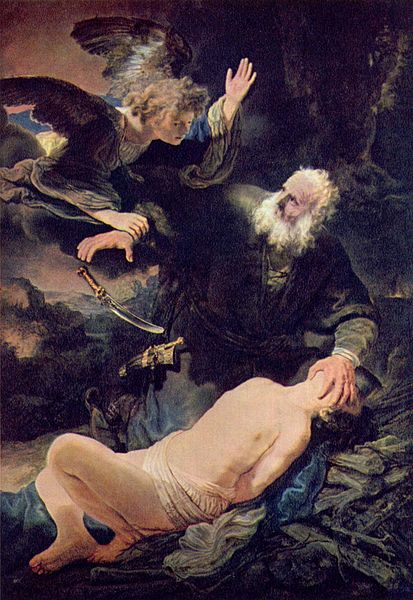
The Binding of Isaac, cords of love?

“Take your son, your only one, whom you love, Isaac, and go with him to the land of vision, Moriah, and offer him up as a burnt offering” Gen 22:2 How could a father attempt murder of a longed-for, beloved child at the command of a loving G8d? This is a question many have tried to answer. One tradition sees Virtue in Avraham’s willingness to sacrifice his child in obedience. Another tradition, however, as Rashi quotes in midrash, says this last of ten “tests” that challenge Avraham is Satanic. The accuser, Satan, challenges Avraham’s love of G8d, who enacts the test. According to the Midrash, Satan then descends to earth trying to talk Avraham out of the sacrifice, using all the reasons we would argue today. Avraham in mystical tradition represents the sphirah of “chesed” loving-kindness. Why does Avraham listen to the command to offer up his “only” son as a burnt offering? Was it fear, pure faith?

I propose another interpretation: the binding of Isaac is a parable about the sacrifices we make to honor our parents, in obligations borne of love. This is more consistent with the themes of love and strength in Genesis, and bears powerful wisdom for our lives today. According to Maimonides, Abraham does everything for the love of G8d and humans, who are in the Divine image.

“Scripture says (Deut. 11:13): ‘To love the Lord
your God’-whatever you do, do it only out of love.”…
Abraham our Father achieved this level; he served God out of love. ~Maimonides’ Introduction to Perek Helek Introduction to Chapter ten of Mishna Sanhedrin

Avraham is the model of hospitality, his tent was always open, he interrupts an audience with the Divine to feed and wash the feet of three strangers, who reflect G8d’s image (when he is 90 and recovering from circumcision!) He plants an “eshel”, interpreted to mean an orchard or a hotel, to feed people, and teach them that bounty comes from G8d.

If Avraham is all about love, how can this be harmonized with attempted murder of Isaac? Consider this: love is the rope that binds his son. I have a newborn grandbaby, and it is stirring strong memories of motherhood. When that baby cries, you are bound to respond. A parents’ life is not their own. Mara Benjamin, in her article “The obligated Self: Maternal Subjectivity and Jewish Thought” brilliantly uses the experience of maternal obligation out of love to speak of religious obligation, a concept we are sometimes uncomfortable with. She writes

Maternal obligation, in both its practical and its existential dimensions, offers contemporary Western people’s most substantive experience with the meaning of obligation. …The care for an infant perfectly captures the pairing of command and love at the heart of rabbinic thought. If God is not only loving parent but demanding baby, we may find within ourselves the resolve to meet the demand.

But what of caring for aging parents (or other relatives), is that not also an obligation bound by cords of love? According to tradition, Isaac was 37 at the time of his near sacrifice. (Based on his mother Sara’s age at his conception, 90 and the timing of binding of Isaac immediately preceding her death at 127 years) Avraham was 137 years old. In my mind I halve all the ages in the Avraham saga to make it relatable, still he’s elderly, perhaps disabled. Somehow he makes a three day journey on to mount Moriah and climbs a mountain. Although the donkey may carry him to the foot of the mountain, how does he climb, when the donkey is left behind at the foot of the mountain: Does Isaac carry him? I have recently had to put my life on hold to care for a disabled relative, I did it out of obligation borne of love. It is difficult, and my actual identity at times seemed subsumed by the obligation. I propose that, as many adult children Isaac is a care-giver whose obligation to care for his father is the rope that binds him. This makes sense of the ages of Avraham and Yitzhak, of the love that Avraham is said to embody. What about Yitzhak, named for the laughter of his elderly parents? He represents “gevurah” or strength in tradition, and it takes so much strength to care for aging parents. These obligations bind us but should not slay us. Avrahram responds to G8d’s call, lifts up his eyes to see the miraculous ram, that takes the place of his son so that Isaac can be a link in the chain of generations.

Isaac embodies the fifth of the Ten “Commandments” at Sinai: Kabed et avicha v’et imecha… honor your father and your mother, that you may long endure on land. According to Sefer Hamitzvot command “honor” means to give them to eat and drink, bringing in and taking out” This sounds like being a caregiver to an elderly disabled parent! According to Ramban, to honor parents is to honor G8d.

Sources on Sefaria

Be a Song, on a Shofar

For the 15th day of Elul.

The 15th day of any Hebrew month is a full moon: it’s a lunar calendar. Each letter in the Hebrew alef-bet is also a number, and yud=10 and hey=5, so yud-hey would logically be used for the number 15. Yud-Hey (Yah) is also a name for G8d, (as in Hallel-ulYah (praise yah). so often 9+6 is used instead. Rabbi Arthur Waskow urges us to re-embrace G8d in the full moon, and full moon Holy Days. That is a powerful call! This is not just any month, it is Elul, whose hebrew letters are an acrostict for “Ani L’dodi v’dodi li (I am my beloved’s and my beloved is mine) in which we seek G8d’s nearness, and the forgiveness of other humans.

The moon will begin to wane now, negating her “ego” becoming hollow, bittul (empty of herself) like the shofar. It is, according to the Zohar, the day in which, in the full moon, David sees Bathsheva bathing on the roof (did she know the king could see her?!) and summons and takes her. She becomes pregnant with Solomon, and in Second Samuel, David sends her husband, Uriah, whose name is linked with Ohr, light, to die on the front lines of a battle. Samuel approaches David, and David admits he was wrong, and he writes psalm 51 in his quest for forgiveness. King David was given credit for writing all the psalms. He was a musician, whose music calmed Saul’s troubled heart, and had a magical harp. In preparing for my High Holy Day pulpit, I am steeped in the melodies of these days, which are unique.

Rabbi Jill Hammer in her “Book of Days” ends this day with a blessing, that I adore:

As the High Holy Days approach, we find ourselves at a crossroads.

Carried by the music of the penitential season, we set off down the road,

following songs that will lead us to better lives

During these very difficult and heart-wrenching times, may we become hollow, and BECOME a song, and a shofar, to alert ourselves and others to the changes that must happen, for the sake of our children. “Hashkeit, ushema Yisrael” hush up and LISTEN commands Moses in this week’s Torah reading.

Elul, the month before Rosh Hashanah is here!

Elul 1: Happy New Year!

Wait, what?

Let me explain: In the Mishna, which is the book of writings compiled in the year 200 of the common era, after the destruction and expulsion of the Jews in the year 70, in which the Rabbis both remembered, and adapted the traditions (oral law) to the exile, there are FOUR New Years in Jewish tradition: The New Year of Kings: the first of Nissan the first; The First of Tishrei: Rosh Hashanah, when the years were counted; TuB’Sh’vat – the new year of the Trees, and Today, Elul the first – new year of the Animals. The New Year of the trees was reconstituted by the Kabbalists in the 15 and 16th centuries, and again in modern times to become a Jewish “Earth day”. Let’s revive the New Year of the Animals, and celebrated and vow to protect animal life on this planet. If you were a (non-human) animal, what would you be?

Elul 2 – Two. Not only are there two stone tablets that Moshe (Moses) brings down from Mount Sinai, there are two sets of tablets. After seeing the golden calm, Moshe smashes them on the ground and they shatter. I was, for a long time angry at Moshe for doing this: how could you break such a precious gift? I thought, who are you to do that?! But the Israelites had made an idol of Moshe, this covenant needed rewriting. Kudos, says the midrash. G8d forbid our faith should become inflexible as stone. Famously the broken shards of the first set of tablets are placed in the ark.

Elul 3 -Three. On the third of Elul, we recognize the “threes” of the shofar sounds. There are three different kinds of blasts: Tekiyah, one log blast, which is three times the duration of the “sh’varim”/ three short blasts, and each of those are three times as longs at the staccato blasts of the “Teruah”! And there are at least three symbolic interpretations of the sounds of the shofar: 1. they are the sobs of Sarah when she found out that her husband was attempting to sacrifice their only child, or of Sisera’s mother when she found her son was dead. 2. They are an alarm clock waking us up to return to our core values and to G8d. 3. They can be our voices when we exhale, so that we can be a shofar, singing and calling out injustices.

Elul 4- Four: there are four matriarchs, four corners of the earth, Four elements, four worlds. We need to be out in nature and nourishing, like the mothers, grounded in the four directions, among the earth, air, fire and water. It is said that during Elul, the king is in the field, ie closer. Let us go out into nature and commit ourselves to healing our mother earth/Shechinah.

Join me for ten minutes a day on zoom, message me for the link

The power of Words: Emor

Language is one of the very few features that defines being Human. Certainly other creatures have language: Trees in the forest speak to one another chemically beneath the soil, (would that be amazing to hear and speak that language!), bees dance to tell one another where the good flowers are. Other great apes can be taught sign Language. But the brain space devoted to the motor and sensory parts of language in humans is enormous! (shaded in this diagram) When I was four years old, I learned about lying, from Michael, the four-year-old little boy next door, who just made up a lie in answer to my question. When I asked him why, he just shrugged. We have the full range of words and the power to abuse them or write poetry so true it makes the heart soar. What could it mean for the troubling times we’re in?

In Genesis, G8d speaks, and the world comes to be. This week’s reading Emor, begins “speak”(emor) to the Priests (Aaron’s sons, Kohanim), speaking…. Emor begins with the silent letter “Aleph”. Moses is instructing the Priests to avoid contact with the dead, except for their immediate relatives. The Hasidic masterpiece Mei Hashiloach explains this: A Kohen will see every harsh thing in the world as a purposeful act of the Holy One, and become really angry, so upset is he with the suffering. “as discussed in the holy Zohar. Therefore God commanded, “Emor el haKohanim – say to the Kohanim.” “Emor – say,” means speaking softly. God enjoins us to whisper into the ears of the servants of God that they should not hold grudges (against G8d) Source page linked Here (for Torah nerds!)

The end of the reading contains a narrative teaching more on the power of words: What does it mean to curse G8d’s name, and why does it matter? After all, it’s just words: sticks and stones can break my bones…. In the narrative, a fight breaks out when a man with an Egyptian father tries to camp in the area reserved for the tribe of Dan, which was his Israelite mother’s tribe. Apparently, you only get to camp according to Dad’s tribe. The midrash identifies the Egyptian father as the task master who was beating the slaves so severely, that Moses slew him, and had to flee Egypt. His mother was an Israelite woman (likely the child was born of rape, his mother being a slave at the time). During the scuffle, the man screams out the ineffable name of G8d (in Hebrew YHVH) whose meaning is existence itself, and curses it. This is the only form of “cursing G8d” which earns the death penalty! (Rash 24:16:1)

This seems harsh to a man in pain, ostracized, trying to defend his mother and his parentage, not to mention the fact that Moses killed his father. Like the Kohen he gets super angry. Moses is at a loss: it is one of the four times in Torah that G8d’s help is sought for judgment. (Moses’ kids do not have an Israelite Mother either) What sense can be made of it all?

The book of Job also has a dramatic discussion about using words to curse G8d. When he loses everything, Job still blesses G8d. When he’s covered in painful sores, he curses the day he’s born, but refuses to curse the Source of life itself. An angry response is understandable, but “mad” is a synonym for angry, and there can be psychological and physical chaos if we release our anger. The idea that words can create worlds has a corollary: words can destroy worlds.

There are two different words for “cursing” or blaspheming used here in Hebrew. The words used here are לקלל l’kallel and ונקב V’nikav, which mean both mean to puncture, to put a hole in something. I am reminded of a balloon suddenly pierced, it flies away and collapses as the air is released. The name for G8d YHVH is a mashup of past, present and future tenses of the verb “to be” and the “breath of life” according to Rabbi Arthur Waskow which, if it were to be pronounced, would sound like breathing. This reminds me of the ‘whispering” that is spoken to the Kohanim. To scream this name in anger and curse it is to curse existence itself . To mess with it is to question that there is meaning and goodness at the heart of life. All those who heard the curse were to place their hands upon his head and witness the punishment. In Hearing the curse, there is danger. Quoting Mei HaShiloach again “Zohar says (Vayikra, 106a), “He took the final Hei in God’s holy name and cursed him, in order to defend his mother.” This is because the final Hei hints at the world of Asiyah, the world of action. Though God desires that we fulfill His mitzvot with our actions, still He wanted to create an opening whereby He would bring about salvation even without the actions of man” This is a fascinating comment: there are no shortcuts, only by partnering with the Holy One of Blessing can we perfect the brokenness. For more on the blasphemer, see Aviva Gottleib Zornberg’s book on Leviticus: The Hidden order of Intimacy, Chapter Emor. Through her books on Torah, she has been a powerful teacher!

The air waves and print are full of screams, and lies. The Name of G8d is being used, as it has been during the Crusades and pogroms, to hurt people. Chaos, hatred and anger are being used for the power they bring. These are dangerous times. To witness all that we hold sacred, ideals such as “love the stranger” “love your neighbor as yourself” the imperative to care for the gift of creation, and that we should pursue justice, truth and peace upon which the world rests (Mishnah Avot) being threatened is profoundly disturbing. What life raft will keep us afloat? I am reminded of a story of a king who is told that his country’s wheat fields are almost completely contaminated by a fungus which causes insanity. They have enough of the old flour left to support one man – “shall it be for you, Majesty”? Ask the king’s advisors. The King thinks for a bit, and decides, “no, it must be reserved for my wisest, trusted advisor. That way when everyone has gone mad, I will have someone to look to whisper the truth in my ear and to guide me.” Can you hear the whispers, because it seems to me the world has gone made, from the abuse of words. What do you think?

Deflating balloon flies away flat cartoon vector illustration isolated on white background. Air balloon deflates with puffs of air. Kids rubber toy and decoration element.

Tetzaveh: will you still love me tomorrow?

One of the most beautiful Jewish traditions, is the canopy which covers a couple during their wedding ceremony this gauzy, open canopy, a chuppah, a symbol of a couple of things. Firstly, it is a symbol of the home the couple will now share. Chuppah is also a symbol of the Mishkan, or portable sanctuary that was built to take the inspiration of Sinai with us. Two weeks ago, we read of revelation at Sinai. According to the legends/ midrash, Revelation at Sinai was actually a wedding between The Holy One of Blessing and the people. In fact the entire erotic song of songs is taken to be the love song between Israel and the Holy One!

One week ago, we read of the instructions for making the portable sanctuary, the mishkah, which will allow G8d to dwell amongst the people. Folks give lots of beautiful gifts, a starburst of color, and materials from gold to wool. This week’s reading begins with a flame that must be continually renewed. now you, command the chilldren of Israel that they may take for you oil of olives, clear, beaten for the light,, draw up a lampwick regularly.

Every morning, every night. This is the container to shine back a light to the one who freed us from slavery, like saying “I love you” to your partner, spouse, child, and showing that light is going back and forth. Starlight, moonlight,Fire on Sinai, and that pillar of light are answered by our humble olives, who get their energy from sunlight, and contain oil / light hidden within them if you clarify them.

This week is Mardi gras, and next week is the Jewish equivalent in Purim, a bawdy tale of lust, power and palace intrigue. This holiday always comes as the winter turns to spring. We hide our identity in masks, as the king’s wife Esther (whose name means hidden) hides her identity as a Jewess. The book of Esther does not mention the name of G8d, not even once, as this week’s Torah reading does not mention Moses. The only portion in the final 4 books of Torah – Moses is hidden in the “and you” in the commands quoted above.

It is so interesting given the season of early spring that is arriving with  Purim. Seeds are hidden within the ground, within their seed cases, and there is magic in them. That’s why we say in the blessing for bread, not that G8d makes bread, but hamotzi, the one who sends the wheat out of hiding. Life is hidden when a woman is pregnant. Esther’s Jewishness, is of course hidden, but so is her courage. And of course if Shechinah’s (The feminine, immanent facet of G8d) presence fills the earth, (The whole earth is filled with G8d’s kavod)! it is the encouragement of the blessed Holy one who pushes the truth hidden from the earth into view, and to nourish us and other creatures, as it says in psalm 85: Truth with spring up from the earth, and righteousness will gaze down from the sky, and G8d will provide the good, and the earth will nourish body and soul” My Setting of Psalm 85 inked here

I think joy comes, not just in the morning (psalm 30) but in springtime and its anticipation! As the words in this Jerome Kern song “You are the promised kiss of springtime, that makes the lonely winter seem long – what if that song were about Sh’chinah, the presence of the Holy One?!

Sometimes ugliness is brought out of hiding, which seems to be the state of the world today. This is the story of Purim too. An advisor to the king seems innocuous enough, until his ego is challenged by the one guy in the kingdom who wouldn’t bow to him. The king’s advisor proposes genocide, and, lied to, the king, hiding in a glass of alcohol agrees. The advisor’s name is Haman, and he is a descendant of Amalek, a warfaring tribe who attacks the most vulnerable of the wandering Israelites.

Kedushat Levi interprets Amalek as being a hidden part of each of us deep within ourself! A colleague, Josh Jeffries writes in his capstone on how we need an Amalek in order to make the hidden destructive powers within and without visible, to take it out of hiding!

So this week we light a lamp, and show our loved ones and creation that we love them. May it help us find what is hidden in ourselves.

Adelina ’and Josh’s beautiful wedding ceremony at St Lucia, captured by Alex Dali Weddings

Singing at the Shores of Release & Black History month (and psalm 13)

Sometimes things feel so bleak, you feel squeezed on all sides between a “Rock and a hard place”. But you are here today you made it: the baby was born, you recovered from that breakup, disease, accident: you were redeemed, and life felt suddenly new and shiny again. (I ‘m a big fan of the Pixar movie Soul, which acts out such a scenario!) Remember that feeling, the inspiration? One of the names for G8d is Rock, “tzur” in Hebrew. And the word for Egypt, “Mitzrayim” has the same root as Tsures – squeezed, troubles all around. (Funny, I never noticed the homonym there!) This week’s Torah reading, named Beshalach, referring to Pharoah sending the Israelites out of Egypt. This is the first climactic moment of the Passover story, of the Exodus. What is the response of the Israelites to freedom after 400 years of slavery? It is to sing! Does that seem likely to you? One day this past year, after I had been holding in frustrations, I rode my bike to an abandoned field. I tried to scream, but what actually emerged from my body was song. Maybe not so weird! This beautiful poem, the Singing by Rick Barot speaks of the power of a woman’s song. I wonder what the black woman in the poem saw on her phone that brought on the song? Announcement of a birth? a death? the daily news? a memory? A woman’s voice, in mourning, in lullaby, in despair, it seems like her song has all of these. She sings. she sings. she sings. she sings.

This is also Black History month in the US. There are many powerful songs that emerged from African slavery here in America, including “Swing low, sweet Chariot” The Chariot is code for the Underground Railroad! Many of these songs are still sung in churches today. They help deal with being overwhelmed and oppressed: squeezed with tzurus.

The first sound the Biblical slaves made in Exodus was groaning or crying out. They had been silenced, to repressed to make any sound until now, taking their condition as “the way it was” It was this primal cry that brought G8d into their midst. But their second was song. When did they sing and what did their song sound like? The answer in the text is that there were two times of singing: First Moses and the sons of Israel sang aspirationally: I will sing. Then Miryam, whose name I share, sang with the instruments brought along for just such a miracle and sang, dancing a circle dance. Many commentators put the women second, but the chasidic S’fat Emet explains that Moses song is aspirational in the world of our dreams, but Miryam sings for all both men and women in the now, dancing the circle, in which all are equal in their relationship to G8d who is in the center.

Miryam my biblical namesake, is derived from Mar (bitter) and yam, meaning sea. From the bitterness of slavery her song brought sweetness to the Israelites. Directly after freedom the Israelites become bitter again, concluding that G8d hates them. A living well of water follows them through the wilderness, which according to midrash is Miryam’s well – a rock that yields water! Connecting all those places and stories in the wilderness, creating a song which lasts all of Miryam’s life. The Israelite people now read the song of songs as an emotional description of the Exodus, and of G8d’s love. Perhaps the song was a love song. There is disagreement on whether the song began while crossing or after, but according to Chizkuni, Miryam began her song while the Israelites were still crossing! (source 7) This song is the moment of awareness of the immanent presence of the Holy one – the moment of falling in love. Song is the most appropriate sound!

Remembering: a postscript

For a long time the stories of enslaved people were not told. Here in Florida, it recently became illegal to teach those stories again in the public schools, and a young professor who happens to share my last name lost her post from a public college because she taught the history of slavery. As Isabel Wilkerson teaches so powerfully in her Pulitzer prize winning book Caste to deny this history is like denying your family history of disease when you go to the doctor, or to deny old damage in a house. It doesn’t work. The Biblical psalms are a study in Crying out to G8d, Here is a setting of psalm 13. In this psalm the poet despairs of G8d forgetting them – lets go all those emotions. But then remembers: Oh yeah, remember that time I was redeemed, you were there G8d and can be there again for me in love.