Torah for now

Archive for March, 2026

Shabbat HaGadol, Passover is coming!

Bonnie asked her “burning question” and it was brilliant! Why do we read about the crossing of the Sea of Reeds in the Torah reading cycle in February, rather than April when Passover actually occurs?

We read a lot of Torah on Passover (Pesach in Hebrew), there are special readings EVERY SINGLE DAY of the seven (or eight) day festival and a special Haftarah on the Shabbat before Pesach, called Shabbat HaGadol (the Great!) Many of the Passover daily readings do indeed tell the story of the Exodus (Ex. chapter 12) The crossing of the sea, including the song of the sea, led by Miryam and the women, are read on the last two days. If Shabbat falls on the in between days, Exodus 33-34 . Exodus 33 is the aftermath of the egel hazahav– the golden calf. We read about G8d’s forgiveness. When we had freedom, the first thing we did was to be “stiff necked” to go back to worshiping idols of gold, and Aaron was involved: the frightened people asked him to build one, and he did. To be free, means free to make mistakes. Perhaps you have been a teenager, newly freed from parental oversight, or know one, or have parented one? My daughters have shared with me some sad stories of overprotected youngsters suddenly free to do anything they wish at college for the first time, who made terrible decisions. We are not just freed from Egypt, we are free to serve the Holy One of Blessing!

So what is the Torah reading this week in the yearly cycle and what does it have to do with Pesach? It is Tzav, meaning command. Moshe (Moses) is told to command his brother and nephews about how to become the kohanim the “priests” officiating at the sacrificial offerings of the Mishkan. But first they had to be “purified” to be open enough to become channels of holiness, and to be forgiven for Aaron’s making of the Golden calf/egel hazahav. See source 4 (Sifra, Midrash from school of Rabbi Akiva). Aharon (Aaron) needs to know his heart has been accepted, just as the wandering generation of Israelites needs to know. To accomplish this transformation to become kohanim, Aaron and his sons are washed (by Moshe!) and are locked in the Tent of meeting for seven full days, to emerge on the eighth day, and then anointed with oil. They would then emerge, be installed and wait to see if G8d would accept their offerings, as fire or pillar of cloud. Those seven days of waiting must be rough – would G8d accept the work of their hands – the art and architecture of the mishkan? (tabernacle) And would G8d then be with them, and travel with them through the wilderness? And what did the soon-to-be priests do locked up in the tent of meeting for seven days? During my ordination, 16 of the 17 candidates were secluded in a room for an hour or two. We also had worked together for the past four months to craft our transition ceremony and prepare for our new roles in life. Would the world and the Holy One of blessing accept the offerings of our hearts? The responses would not be visible as a pillar of cloud, but in the fire in the hearts of the people we served.We sang, laughed. There was bonding, there was palpable tension. We sang in our ceremony from psalm 91, asking G8d to accept the work of our hands and hearts (source 1). In a similar way, Moshe “fills their palms”. Your hands and hearts must be open to be filled and receive gifts. Pregnancy seems like such a waiting as well, much longer than a week! Then your hands are filled with a tiny miracle. And transformation follows – oh the mystery!

Like the kohanim waiting in the Tent of Meeting the Exodus itself has a period of watching and keeping in Exodus 12: In the waiting period between the tenth plague, death of the first born and the leaving. לֵ֣יל שִׁמֻּרִ֥ים הוּא֙ לַֽיהֹוָ֔ה לְהוֹצִיאָ֖ם מֵאֶ֣רֶץ מִצְרָ֑יִם leil shimurim – a night of watching/guarding to G8d, toward leaving the “tight place” – Egypt. I’m guessing there was not much sleep during that midnight watch. Rashi (source 2) says it was much longer than a night, that they were waiting to see if G8d would fulfill a promise of redemption many hundreds of years old!

Seven days, and then the eight day will tell. That should ring a bell! We are about to enter a festival for seven days, and then an eighth day in the diaspora. In addition the fall and winter festivals, Sukkot and Hanukkah are eight day festivals. Seven days of creation – Sheva in Hebrew, represents completion. The eighth, one day beyond. There is both getting together on Pesach, and isolation if you observe the dietary laws, from the non-Jewish community. Rabbeinu Bahya (source 3) references the seven layers of clothing of the kohen, and cites from the zohar This is also the reason that these days of inauguration were described (in the Zohar) as “days of שלמות, “days of perfection, or perfecting.or wholeness. The Haftarah for Shabbat HaGadol is the very last book of the last prophet Micah, envisions a messianic time, a time transformed, where Elijah the prophet will turn the hearts of parents and children to one another.

May your family or friendship circle find wholeness this Pesach, as Moshe anointed his brother and nephews. And when Elijah comes to your seder, may the generations turn their hearts to one another. Pesach and springtime can be magical!

Related: Passover 5785

Be Holy and … Sacrifice Animals?

Short answer: no -sacrifice ego. Carve a space, fill with song and G8d and rise!

We have reached in our weekly readings, the third, central book of the Torah called Leviticus in English, because much the book consists of instructions to the Levites on how to perform the specifics of animal, oil, meal and wine sacrifices. In Hebrew it’s named “Vayira” meaning “and He called”

Leviticus is an amazing book, containing the command to “Be Holy” and to “Love your neighbor as yourself”, not to hold grudges, to “love the immigrant” and many aspects of how to live our lives in just and holy ways (as well as some problematic ones!). In very traditional communities, it is the first book taught to young boys. Yet, the very first thing Moshe (alone) hears are instructions for the technology to draw close to G8d – in the Mishkan (portable sanctuary) as well as in the Ancient Biblical Temple. It is called a Korban, which comes from the room ק ר ב K R V meaning to draw close.This first sacrifice described is burnt up completely – it is an “olah” – an unblemished animal of the herd which is used to kaper/atone for unintentional transgressions. I don’t know about you, but I just assume in the course of any day or week, I will unintentionally hurt someone’s feelings, or create pollution that harms the earth, or forget about G8d when I’m in an argument. The question of “how do I live with myself” is more than just hypothetical. I am currently reading the writings of Rabbi Nachman of Bretzlov, whose quote about the imperative of finding joy graces the home page of Shaarei Simcha’s website. He was the great grandson of the Ba’al Shem Tov, a towering figure, and had very high expectations of himself. Yet he struggled every day to find just a spark of good in his “black soul”, so dark was his self image and so exacting was he of himself. From sparks of brightness from the deeds and commandments he followed, he found bright spots. Yet in these bright spots he still found his motives to be less that pure, but deep within this inner darkness were some G8dly sparks and from those he connected the dots to make a melody ( a nikkud is a dot, a spark of G8d in Hebrew, and also means a musical note) This melody lifted his spirit and allowed him to sing songs of praise. There were no medications for the depression Reb Nachman experienced, and he recognized the danger of being swallowed up by its darkness. Reb Nachman lived in the 1700s, and there also were no animal sacrifices to assuage his guilt. Instead he sacrificed his his ego! From this low place of humility he was able then to ascend to experience great joy (expansive consciousness) and to sing. He worked hard at this each day of his (short) life

All of that being said, the verses found in this week’s reading describing the butchering of animals are hard for many folks to stomach. I do not eat meat (except fish) and usually I avoid these verses, choosing other verses to read instead. However, there is merit in approaching what makes me uncomfortable – and facing it. For Biblical omnivores, sacrifices were the only source of meat. This meant recognizing the loss of life, ensuring a painless slaughter, and prayers to sanctify this transfer of energy. Most of the sacrifices were not burned up, as the olah was, but shared with family and friends, given to the Levites, or the poor, no leftovers allowed. The factory farms that produce most of the meat on this planet for us are ethical and environmental nightmares. The callous consumption of the bodies of once living creatures, reducing them to the point where we never have to think of, or experience where our food comes from results in the increasingly common practice of calling meat “protein” as if it were created as a disembodied nutrient for our benefit! And this all happens on an unimaginably large scale. Compared to the “sacrifice” of a creature, which one seems barbaric to you? Still, I wish there were sacrifices in the Bible that did not involve taking a life. So consider – this system was replaced by sacrificing our words and time and egos almost 2000 years ago. What remained was for Biblical adherents to take these verses metaphorically as most verses should be -taken beyond the simplest meaning all the way to the lessons they teach and the mysteries they contain. As the Medieval commentator Ibn Ezra says:

Far be it from God to require a burnt offering. Scripture clearly states, If I were hungry, I would not tell thee…(Ps. 50:12). On the contrary, it has a secret meaning.

Click here for sources

The (maybe) Happy Ending of Exodus

This past fall I saw the show “Maybe Happy Ending” (mini concert of show) Like the Robots, the Israelites began as slaves and their happy ending is love.

The Book of Exodus ends with the completion of the Mishkan (tabernacle) being in flame at night and covered with a cloud to shade it during the day, meaning that the Divine presence will be with us in these forms. Fire is the terror of Sinai, the inspiration at the burning bush, the manufacture method of the Golden calf, and the instructions to B’tzalel on how to build the Mishkan (sources on Sefaria Here) My Grandfather’s Hebrew name was B’tzalel and one of my children are named for him. The name means “in G8d’s shadow.” There is only an outline in a shadow, and shelter from the blazing sun. I suggest that the fire is the intuition and passion of the artist – The ability to be inspired is certainly a gift. G8d chooses B’tzalel because of this gift. The Holy One then provides a general outline, a material list – just as a shadow casts a general outline of the One who casts it. It is a combination of fire and cloud – of inspiration and of protection from constant demand of creating this beautiful artwork. That protection from demands is introduced at the beginning of this week’s reading Vayakhel meaning “and you shall gather them in community” It specifies, commands you shall not kindle a fire. In contrast to slave labor, we are to have the opportunity to unwind, to refresh.
I tend to do too much. I know this because one of my kids gave me a book as a gift called “The Art of Doing Nothing” But make no mistake, I believe in Shabbos – that palace in time described by Rabbi Heschel. First to just be, then to glimpse beyond myself, and to be “Vayakhel” gathered in a community. To inhale deeply , in medical talk inhale is inspire. It means to be able to lift our heads from the grindstone to see the sparks, the fire cast in the heavens and create things from those patterns using our intuition. In Shaarei simchah, I am yearning to find kindred spirits with whom to sing, and play and imagine.

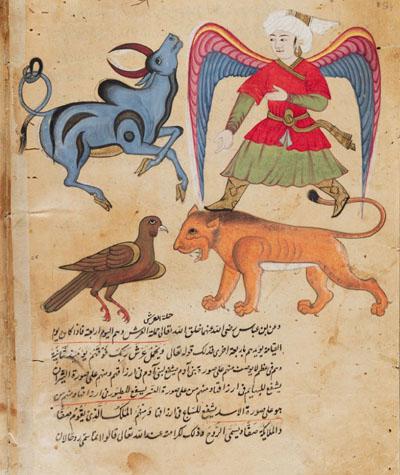
Intuition and imagination what we can gain from a combination of inspiration and time to do “nothing” B’tzalel creates tapestries of weaving that should be impossible. Talmud Yoma describes the tapestry, with its weave going through to the other side making two images. B’tzalel somehow made a weave so that on the other side appears the image of a different animal: a lion on one side, and a condor on the other. Interestingly, those are 2 of the 3 chimeric animals in Ezekiel’s vision of G8d’s chariot. The ox, oh so similar to the calf is the third. That ability – to hold different ideas together and come up with something new is genius, and not robotic.

So the enslaved Israelites, like robots, first live only to work, that is their only purpose. In the show, when the Robot’s work is done, they are left to die. Instead they connect and find love. This is the purpose of the Mishkan – for People and the Divine to live in a loving relationship, the Mishkan is symbolic of a G8d coming “home’ to us. What is my evidence that the Mishkan is built like us- by and for love? Believe it or not, it’s the copper mirrors donated by the women to build the washbasins for the Levites to wash. In Exodus 38:8 Rashi cites a Midrash (see the Rashi on source page) where Moses doesn’t want to accept the mirrors, as instruments of vanity and sexuality. The Holy One replies that the mirrors are the most precious gifts of all. G8d explains that when Pharaoh command brutal workloads, the women would go to their husbands in the fields, bringing refreshments and their mirrors. Each would tease their husband about who was better looking, until the husband’s passion was aroused. This is how a generation was conceived: in play, in leisure carved impossibly by love. The song of songs is then cited by Rashi here (Song 8:5) “I awakened thy love under the apple-tree”, (referring to the fields where the men worked) This is why we make apple charoset on Passover. And that’s why the book of Exodus has a “Happy Ending”, maybe..

Below: the image of the creatures (they will be chimerized together) of Ezekiel’s vision. The golden calf was a tiny piece of reality that was owned to manipulate. Betzalel’s tapestry had woven a lion on one side and a “nesher” r tcondor on the other from the same weave! complex and unlimited.

.

To Teach is the Thing!

Nation shall not lift up sword against nation, neither shall they learn war any more ~Isaiah 2:4 I look at scenes of war helplessly this week, from a distance, and wonder “when we will ever learn”?

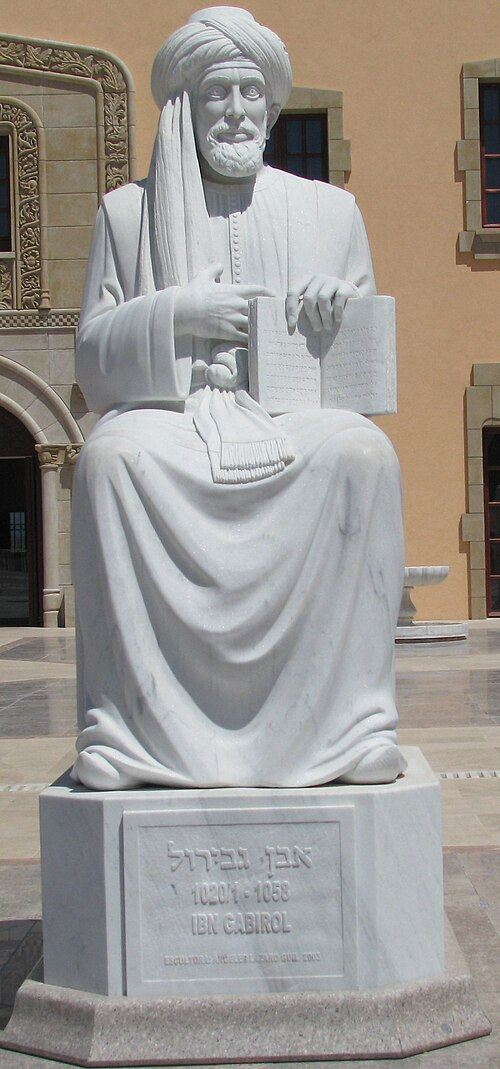
Have you heard this saying: “Those who can do, and those who can’t teach” I have been teaching most of my life, It is a whole bunch of doing: not everybody can or should teach. In fact, Solomon Ibn Gabirol (11th century Anadalusia, pictured below) indicates five steps toward wisdom: In seeking wisdom: the first step is silence, the second listening, the third remembering, the fourth practicing, the final, the ultimate act of wisdom is only acquired by teaching others! I suggest that Moses (Moshe) is going through these steps to become Moshe Rabbeinu, our great teacher

A quick recap in the action: Just a few chapters ago, the world meets G8d at a mountain called Sinai, which was volcanic and terrifying. The people ask Moshe (Moses) to go up and get the remainder of teachings from G8d. He went. He’s a little late coming back, and the folks make a golden calf. G8d sees this, calls the people “stiff necked”, and offers to start over, wiping the folks out and beginning again with Moshe. Moshe protests, to the point making himself sick (“fever in the bones”) G8d relents, agrees to stick around! Happy ending no? No, everyone’s still upset. The first of many things to happen is the first set of tablets, inscribed by the finger of G8d, are smashed. Moshe leaves the camp. He is alone separated from the community. How do you think he feels? The tablets are smashed on the 17th of Tammuz, in the heat of summer, and Moshe goes up the mountain again on Elul 1st- about 2 weeks later.

What must Moshe have felt like as a leader, a teacher? As soon as he’s (perhaps) a few hours late coming down the mountain the Israelites make a solid gold idol, bow to it and announce “this is your G8d” and dance around it! Ok, Moses went up for a long time without food and water, and satan (the adversary) besets them with an image of Moses death, But still, they are eager to replace Moses, they are scared of “that man” and feel they’re being pious by building an object they have made, own and use to tame the Untame-able, and their fear. They dance!

Often I feel a failure as a teacher, like Moshe. I have taught that the life on earth is precious for most of my life, and feel the world slipping into chaos. And people dance and behave like everything’s ok. What a dissonance! How lonely must Moshe feel! What have you expended your heart and soul into that people just didn’t get? What did you do?

Something that struck me is that this scene on the mountain, where the hero is in despair hidden in a cave on the mountain of G8d happens again in Kings, with a different prophet, this time it’s Elijah. Elijah is so despondent, he asks G8d to take his life. Moshe (Moses) is so despondent, he asks to see G8d’s kavod. In the scene with Elijah on the mountain, he experiences a storm wind that shatters rock (!) and an earthquake and a fire. And G8d is not in these dramatic, powerful things! Where is G8d to be found? In the kol d’mamma daka the voice of soft murmuring – the still, small voice. Eliyahu (Elijah) fails to listen to G8d’s advice, and instead stages a dramatic mountain top contest with, you guessed it, fire! But Moses will evolve to greatness and “gets it” and becomes the consummate teacher taking those steps of Gabirol

  1. Silence – in his loneliness Moshe can know silence. The loneliness functions to arouse desire.
  2. Listening – in his despair, Moshe has the audacity to ask to see G8d’s kavod– honor or glory, or Presence. G8d replies “I will make all my goodness (emphasis mine) pass before you” What he hears is a new covenant to replace the fiery one at Sinai – the 13 Attributes of G8d. Forgiveness and love become an essential part of our experience of G8d. He hears the still small voice and brings this as the gift of words back to the people.
  3. Remembering – midrash says Moshe was instructed by day, and studied at night, filling in the white fire, the oral law and interpretations. Unlike the first set of tablets inscribed by G8d, Moshe must learn and interpret. He would not just parrot what he understood, but teach a method of extrapolating for changing times, first passed down as oral law.
  4. Practice- Moshe returns and his face is radiant with “keren or” horns of light. He veils his face but removes it to teach and to learn from the Holy One
  5. Teach – Moshe Rabbeinu becomes our ultimate teacher. His radiant face reflects his Teacher, and he removes the veil to speak heart to heart/ face to face with the People..

To teach is Holy, but wisdom begins in silence, longing and listening. To love is Divine. Moshe takes one step further. Although G8d says “no one can see my face and live” and the Holy One shields Moshe in the cleft of the rock from seeing the “face”, At the end of the Torah it will say that Moshe saw G8d face to face. “From the fire to the limit to the wall” sang Chaka Khan to love, the redemptive force that holds the world together. watch scenes of war on my television helplessly and pray that we remember that golden rule. May this be G8d’s will.

Much honor to Rabbi Aviva Gotlieb Zornberg, for her book on Exodus The Particulars of Desire (the whole series of books is wonderful), and from whom I deepened my understanding of this parashah.