Torah for now

Posts tagged ‘moses’

To Teach is the Thing!

Nation shall not lift up sword against nation, neither shall they learn war any more ~Isaiah 2:4 I look at scenes of war helplessly this week, from a distance, and wonder “when we will ever learn”?

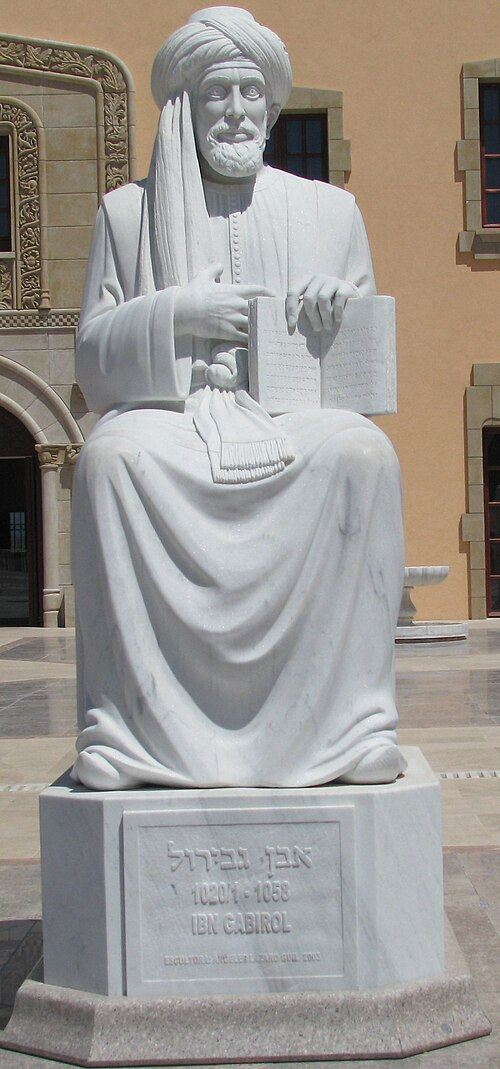
Have you heard this saying: “Those who can do, and those who can’t teach” I have been teaching most of my life, It is a whole bunch of doing: not everybody can or should teach. In fact, Solomon Ibn Gabirol (11th century Anadalusia, pictured below) indicates five steps toward wisdom: In seeking wisdom: the first step is silence, the second listening, the third remembering, the fourth practicing, the final, the ultimate act of wisdom is only acquired by teaching others! I suggest that Moses (Moshe) is going through these steps to become Moshe Rabbeinu, our great teacher

A quick recap in the action: Just a few chapters ago, the world meets G8d at a mountain called Sinai, which was volcanic and terrifying. The people ask Moshe (Moses) to go up and get the remainder of teachings from G8d. He went. He’s a little late coming back, and the folks make a golden calf. G8d sees this, calls the people “stiff necked”, and offers to start over, wiping the folks out and beginning again with Moshe. Moshe protests, to the point making himself sick (“fever in the bones”) G8d relents, agrees to stick around! Happy ending no? No, everyone’s still upset. The first of many things to happen is the first set of tablets, inscribed by the finger of G8d, are smashed. Moshe leaves the camp. He is alone separated from the community. How do you think he feels? The tablets are smashed on the 17th of Tammuz, in the heat of summer, and Moshe goes up the mountain again on Elul 1st- about 2 weeks later.

What must Moshe have felt like as a leader, a teacher? As soon as he’s (perhaps) a few hours late coming down the mountain the Israelites make a solid gold idol, bow to it and announce “this is your G8d” and dance around it! Ok, Moses went up for a long time without food and water, and satan (the adversary) besets them with an image of Moses death, But still, they are eager to replace Moses, they are scared of “that man” and feel they’re being pious by building an object they have made, own and use to tame the Untame-able, and their fear. They dance!

Often I feel a failure as a teacher, like Moshe. I have taught that the life on earth is precious for most of my life, and feel the world slipping into chaos. And people dance and behave like everything’s ok. What a dissonance! How lonely must Moshe feel! What have you expended your heart and soul into that people just didn’t get? What did you do?

Something that struck me is that this scene on the mountain, where the hero is in despair hidden in a cave on the mountain of G8d happens again in Kings, with a different prophet, this time it’s Elijah. Elijah is so despondent, he asks G8d to take his life. Moshe (Moses) is so despondent, he asks to see G8d’s kavod. In the scene with Elijah on the mountain, he experiences a storm wind that shatters rock (!) and an earthquake and a fire. And G8d is not in these dramatic, powerful things! Where is G8d to be found? In the kol d’mamma daka the voice of soft murmuring – the still, small voice. Eliyahu (Elijah) fails to listen to G8d’s advice, and instead stages a dramatic mountain top contest with, you guessed it, fire! But Moses will evolve to greatness and “gets it” and becomes the consummate teacher taking those steps of Gabirol

  1. Silence – in his loneliness Moshe can know silence. The loneliness functions to arouse desire.
  2. Listening – in his despair, Moshe has the audacity to ask to see G8d’s kavod– honor or glory, or Presence. G8d replies “I will make all my goodness (emphasis mine) pass before you” What he hears is a new covenant to replace the fiery one at Sinai – the 13 Attributes of G8d. Forgiveness and love become an essential part of our experience of G8d. He hears the still small voice and brings this as the gift of words back to the people.
  3. Remembering – midrash says Moshe was instructed by day, and studied at night, filling in the white fire, the oral law and interpretations. Unlike the first set of tablets inscribed by G8d, Moshe must learn and interpret. He would not just parrot what he understood, but teach a method of extrapolating for changing times, first passed down as oral law.
  4. Practice- Moshe returns and his face is radiant with “keren or” horns of light. He veils his face but removes it to teach and to learn from the Holy One
  5. Teach – Moshe Rabbeinu becomes our ultimate teacher. His radiant face reflects his Teacher, and he removes the veil to speak heart to heart/ face to face with the People..

To teach is Holy, but wisdom begins in silence, longing and listening. To love is Divine. Moshe takes one step further. Although G8d says “no one can see my face and live” and the Holy One shields Moshe in the cleft of the rock from seeing the “face”, At the end of the Torah it will say that Moshe saw G8d face to face. “From the fire to the limit to the wall” sang Chaka Khan to love, the redemptive force that holds the world together. watch scenes of war on my television helplessly and pray that we remember that golden rule. May this be G8d’s will.

Much honor to Rabbi Aviva Gotlieb Zornberg, for her book on Exodus The Particulars of Desire (the whole series of books is wonderful), and from whom I deepened my understanding of this parashah.

Bring a little awe and love down! Terumah

In the reading from the Torah this week are the detailed instructions Moses receives to make the portable sanctuary by which the community who stood at Sinai can take inspiration with them, and to have the Holy One of blessing living in their midst. Most of the rest of Exodus is concerned with this, with one notable exception: the sin of the golden calf. Perhaps the sin of greed and insecurity which led to the golden calf. But how can the Holy One convey this to Moses, and why the detail? A midrash/legend from Bamidbar Rabba ” Moses said before the Holy One blessed be He: ‘My God, am I able to craft like these?’ He said to him: ‘Like the form “that I [am showining you]”’ (Exodus 25:9), “with the sky-blue, the purple, and the crimson wool, and with the fine linen” (Exodus 38:23). And G8d inscribes the pattern in fire on Moses’ palm.
The Midrash goes on to say, if you do this I will dwell in your midst, constricting/ focusing energy in this place you build. The same source places the reason for those colors of the sanctuary to reflect places on earth rather the heavens: “Its cushioning of gold” (Song of Songs 3:10) – this is the earth, which produces the fruit of the land and the fruit of the trees, which are similar to gold. Just as gold, there are different types and different shades, so too the fruits of the land; some of them are green and some of them are red.
“Its seat [merkavo] of purple wool [argaman]” (Song of Songs 3:10) – this is the sun, which is placed above, rides on a chariot [bemerkava], and illuminates the world, just as it says: “It is like a bridegroom leaving his bridal chamber…” (Psalms 19:6). By the power of the sun rain falls, and by the power of the sun the land produces fruit.

Finally, ““Its interior is inlaid with love” (Song of Songs 3:10) – as after all the act of Creation, He created Adam and Eve…”

In other words the travelling artwork/ sanctuary is the inspiration of the fire in the sky and the miracles of earth created in architecture and art.

We look to the heavens and the forests and fields for inspiration, they have a design which is far beyond our capacity to understand and imagine. If we can open our hearts to the awe and love they inspire, and bring the awe via music and art into our midst, gratitude and humility and joy can happen

It is written in psalm 16: 8 “I have set G8d before me continually” This can become a powerful practice, in Hebrew “Shiviti Adonai L’negd tamid”

SHIVITI (Miryam Margo Wolfson)

Advice from a Father in Law: no kings

This week’s Biblical reading is called “Yitro” it is named after Moses father-in-law Jethro, who we meet for the second time in chapter 18 of Exodus. The first time is in the Wilderness. This great song in the Prince of Egypt gives Yitro a voice (the stunning voice of Brian Stokes Mitchell!) This part of the Torah is famous for the 10 Commandments and revelation at Sinai in Exodus 20. Even though Jethro is heard two chapters prior, the medieval commentator Rashi convincingly argues that his encounter with Moses comes after revelation at Sinai. (Number 5 on the source page) Jethro has heard about the redemption at the Sea And revelation at the mountain top and seeks out his son-in-law with Moses’s wife and two sons in tow. He then gives up any status that he had a Midianite priest and reunites this broken family, as he joins the Israelite faith.

The advice that Jethro gives Moses is excellent. Jethro says that people are standing in long lines to see Moses and ask him questions. He tells his son-in-law Moses to delegate, and to appoint leaders over the thousands, the hundreds and the tens of people. This is supposedly so that Moses doesn’t get tired out. But I suggest that it is a redistribution of purpose, authority and power down to the level of families rather than a concentration of purpose, authority, and power in one man. The Israelites were so frightened after receiving the 10 Commandments, that they told Moses to go up for them, or they would die. Thus, they removed their own honor, authority, purpose In fear. My first Jewish teacher as an adult was Rabbi Henry Weiner of Blessed memory. He explained that every person who was present at Sinai and all of us from future generations, each have a place on the slope of the mountain. Each has a place that is unique and contributes to the whole In a way that no one else can. As Jethro restores Moses’ family, So he restores our place. Israelite people are standing in lines all day long waiting to talk to the great Moses, as if to the Wizard of Oz or some billionaire politician. They are not being honored physically, emotionally or intellectually. The Bible subversively warns against setting kings over themselves (Deuteromy 17:15-20) and if they insist God will choose for them, but “he must not keep many horses or send people back to Egypt and not have many wives. He should not let his heart go, astray or amass silver, and gold to excess… So that he may not raise his heart over his brothers” Even the great Moses was not meant to be king. Perhaps it is why his brother Aaron was chosen rather than he to be the spiritual leader, and he was not permitted into the Promised land. Jethro returns, whether of his own volition or fate, or the hand of God, to bring Moshe down to earth where God’s kavod dwells, after Sinai. Returning the feminine in the guise of Moses’ wife and the feminine aspect of God in the Earth herself. 

(*God’s kavod is the honor, or glory, indwelling immanent feminine aspect in mystical teachings)

King Solomon and the Queen of Sheba in the palace. You shall not set a king above you. (from ‘Hutchinson’s History of the Nations’, early 1900s ) Painting by Edward John Poynter

CONSTRICTED THROATS: Moses, me and Esther

– Did you ever get emotional, so that there was a lump, a constriction in your throat, and you were temporarily unable to speak? When The Holy One asks Moses to go to Pharoah and demand “Let my people go” Moshe responds “NO, they won’t listen to me! I have a kabed peh, a heavy mouth u’chvad lashon What does it mean to have, like Moses, a heavy tongue?

G8d’s answer: Who but I give a mouth (and speech) to humans, and who makes those who are mute?

But G8d creates all through acts of speech (in what language I’m not sure: math, physics, music, love?) and creates we humans who are partly defined by speech and are Btzelem Elohim In the Divine Image, in that way. Is G8d also the power who creates those who are mute? Many things can make a person mute: being born without hearing, for example. With therapy sign language can be taught. The mind can make you mute: my eldest daughter, so brilliant and super sensitive would lose her voice whenever she became sick! But trauma can make a person mute as well, as the heart wrenching literature of the Shoah attests.  The Slonimer Rebbe speaks of slavery in Egypt as so crushing, that their minds were enslaved, not just their bodies. He explains when finally the slaves were able to get out a geshrei, a good primal cry, it was the first step in their deliverance. That was when G8d heard their voice, their cry and sends Moshe. He speaks of the tightness or constriction in the throat where the soul cannot get out or express itself.  Moshe, the Slonimer continues was actually as an avatar of the Israelite people. Therefore he was unable to speak fluently! The word ּכְבַ֥ד  The shoresh/root also means “honor” Perhaps “k’vad peh uchvod lashon” means a mouth and tongue that honors the people that Moshe serves. There are times when it is inappropriate to be verbose, such as entering a house of mourning.  Until the Israelites could move from the Narrow place of tzuros, Mitzrayim and be free and to SING at the sea, Moshe could not be the orator who would be the channel of Torah from Heaven to earth. I personally found my voice first through teaching, then through singing. I am still finding my voice.  Moshe’s life begins in a similar way. He is born into danger. Zipporah, his mother keeps him hidden and safely for three months. When he is no longer able to be silenced, she trusts him to G8d, fate and the Nile. Now he can cry and win the heart of the Pharoah’s daughter..

In the land of Shushan, Persia, many years following was a beautiful Jewish girl named Haddassah. But when the kings men came to uncle Mordechai’s house looking for the most lovely to be queen, she was silenced, not to reveal her true identity, and given a new name, Esther, from the same root as nistar, hidden.  She hasn’t been paying attention to the happenings of the kingdom when she is told of Mordie in sack cloth and ashes – send him some new clothes. She wants to remain deaf and mute to trouble, hard to blame her, who wants trouble?!  Mordechai then delivers my favorite line of the whole Megillah

Chapter 4:6 “If you keep silent in this crisis, relief and deliverance will come to the Jews from another place, while you and your father’s house will perish. And who knows, perhaps you have risen royal position for just such a crisis.”

And our unlikely heroine is born. She does not fight hatred with fists, but with seduction and revelation.

What is it in our lives that we’d like to ignore, issues we’d rather not think about. And what is your position of influence, what can YOU do? Moshe’s heavy mouth was a sign of his complete entanglement in the people he served. Esther’s hiddenness, the secret of her success. Perhaps it is your deepest flaw or disability which can actually be your superpower.