Torah for now

Archive for the ‘Uncategorized’ Category

A Psalm in Praise of Tears.

I am teaching a brief series about psalms. Psalms address their voice to the Holy One of blessing, they are rhythmic and use parallel repeats. They are perhaps the most widely read, and beloved book of the Tanach (Bible). I have challenged (optional) the learners to create a personal psalm to use in prayer. One of the events of this double reading, is that Miriam Moses and Aaron’s sister dies- in the wilderness. The very next thing that happens is that the community is out of water! SOURCES HERE

The water that is missing are the tears. There is no public ceremony, no tears recorded shed by her Brothers, or the community. Rashi writes that a magic well of water followed the Israelites during their wanderings. With her gone, so was the well. Torah is akin to water, and tears are healing. My experience is that you can’t go around grief, only through it. In the ancient Temple in Jerusalem there were bottles for tears – a lacrimatory The more tears, the more the respect and affection for the departed. These bottles were placed in the grave. We are mostly made of water, that weird and wonderful chemical, whose “stickiness” (think wet) makes life possible. Water is life! Even the name “Miryam” (spelled as the Hebrew sounds and is spelled) contains the word “yam” meaning sea. Miryam rescues her brother from the Nile, leads in song as the free crossed the sea of reeds – her life is linked with water. In this week’s reading, Chukat/Balak, Miriam dies, and the light that shone when she announced Moshe’s (Moses’) birth was dark. Yet no tears are shed- his heart is hard. This leads to the disaster of Moshe hitting a rock to bring water for the thirsty people, and calling them Marim-rebels. Moshe was supposed to speaking to the rock. As a result, he dies by the “kiss of the Holy One” at age 120 before reaching the promised land. I suggested that his inability to properly mourn Miryam’s loss led to his anger

I am learning with students about psalms. I have rewritten a poem about my own blocked tears and tears rediscovered. to fit the psalms, I share it here

A Psalm, dedicated to my students

Yah, my God, you filled me with life force

I am filled and strong against life’s storms

You brought me to this world and I am grateful for my life

But when the music of my small world

turned to screams, smacks and strife

This little girl you made built a wall so tall

And pretended that All was ok.

But the funny thing was,

Tears would stream down her face.

In a sad story or tale

Yet In the face of her own losses, tears refused to fall

The wall refused to come undone.

Until choice and challenge opened a path of grace

Bringing her face to face with the hurt child inside

Then she finally shed tears for those long gone from her side

And finally reach out for those souls who no longer did abide

who left a hole within her life.

Healing me with the beauty of their presence

After a lifetime my heart broke and was made whole.

Oh Holy One, now I can praise you with all my soul,

Tears have freed me

I am grateful overflowing for my wonderful, mixed life bowl.

Truth, justice, kindness, and peace: Korach

Which is the most fundamentally important of these values, in your life, in our world: Truth, justice, loving kindness and peace or faith? Choose one, for the sake of this exercise. To help you – answer this question -What would the world look like if this were lacking in your life?

If you say peace, can you remember a times many of us give up our dignity for the sake of peace, especially women, I know I did – conflict avoidance. There are times to approach a conflict with courage. There are times to make good trouble, to challenge authority. These may be such times?.

Perhaps you chose justice, for without justice there can be no peace. How I wish for justices on our courts as of old – Bader Ginsburg for example. And without the truth, can there be justice? so maybe truth is the greatest? But what is the absolute truth, and are there times when the whole truth is hurtful? When Sarah says how can I become pregnant with my husband so old, even G8d tempers the truth. Every bride is beautiful at the wedding. says Talmud ketubot, in the opinion of Hillel. Shamai disagreed, you should be 100% truthful. But what is the truth about beauty?

Truth must the always be tempered with loving kindness. Loving kindness alone however is not great by itself, it can lead to spoiled kids and abusive spouses, who take the gift of the love they are given for granted.

What about emunah? Think of a time when you knew G8d was with you, immanent, not transcendent – palpable and in the room.

The Torah of Korach teaches us that the greatest of these is emunah – faith. Not that You believe in G8d, but that you know G8d believes in you. The challenge was not about leadership – but about whether we will follow G8d up – to the spiritual heights of Siinai, or go back to what’s familiar.

An insight that I received as a gift, is that the pit that opens to swallow Korach is the grave/kever that receives us all. The people are terrified by the fate they have gleaned by not knowing that G8d was with them in the debacle of the spies. You have brought us here for G8d to kill us in the wilderness.

We are all mortal, but we can choose to die in the wilderness or to know that G8d is with us in life, and even facing death. It is possible to fully experience the precious quality of each minute of life in our very mortality. But it can be terrifying; The ground opens to receive us all, What’s the difference in the case of Korach ? The ground receives his family, l’dor vador disappears. For the rest of the wilderness generation, We may not get there, but our children may – and that has to be enough. Our tradition is not happy with the fate of Korach’s children – Midrash tanchuma says that when Jonah was in the belly of the fish the fish traveled way down to the foundation stone upon which the world was founded. And what are they doing – Singing!

There is a story of a Kingdom where the ruling Queen loved her subjects so that she invited all her subjects to the palace who desired, an audience with her. On that special day the Palace was opened, and the subjects flocked in! They first experienced the amazing palace gardens, with scents and color patterns to delight and dazzle the senses. Many subjects were so intoxicated, they lingered here and did not move on. Next were art galleries that filled the eyes with such insights and delights to enlighten the mind. Many people stayed in this part of the palace. Then a concert hall replete that bathed the ears and soul with moving and beautiful sounds. Heavenly choruses, and instruments of all types in perfect harmony. Many more souls lingered here. The Queen remained alone at the center of the palace. Visit the Queen, she is so lonely for our love.

Psalm 85, a psalm of the sons of Korach:

Chesed v’Emet yifgashu – loving kindness and truth have met – balancing one another

Tzedek v’Shalom nakashu – Righteousness and peace have kissed – balancing one another

And truth shall spring up from the earth

And righteousness shall rain down from the sky

And G8d will provide the good

And the earth will nourish body and soul, the earth will nourish us whole!

Sh’lach, 5786 The Danger is not how big the enemy is…

…it’s how small we tell ourselves we are in comparison. We live in challenging times, the truth is for sale – Lies are peddled today for profit or power. And fear is the emotion that sells. And fear becomes hate.

This week’s portion is Sh’lach, meaning “send” and begins with the choosing and sending of scouts to tour the Promised land. This venture will end in catastrophe. The scouts famously bring back giant fruit, they have to carry it between poles it’s so big, and explain that there be giants there and even mythical creatures, Nephilim who fell from the sky. 10 of the 12 scouts send out words -slanders Yotziu dibat ha-aretz some are true, some false, to intentionally create terror. They lie to try to convince the people they have only one option”, they explain – to go back to Egypt, the real land of milk and honey., the land will eat us!

וַיֹּצִ֜יאוּ דִּבַּ֤ת הָאָ֙רֶץ֙ … אֶ֣רֶץ אֹכֶ֤לֶת יוֹשְׁבֶ֙יהָ֙ הִ֔וא

וַנְּהִ֤י בְעֵינֵ֙ינוּ֙ כַּֽחֲגָבִ֔ים וְכֵ֥ן הָיִ֖ינוּ בְּעֵינֵיהֶֽם׃

we were in our eyes like grasshoppers,
and thus were we in their eyes!

What’s so wrong with feeling overwhelmed, feeling inadequate, or like a grasshopper in your own eyes? And what’s the a subtle lie in the verse –we cannot know how we appear in someone else’s eyes! Perhaps these are the most damaging lies -the ones we tell to ourselves -about ourselves! “I’m not good enough, I am worthless” . According to Sforno, the Israelites thought G8d hated them for their sins, and so were bringing them to die. Perhaps these former slaves have internalized the hateful words of their brutal slave masters.

So how can we counter these feelings? How remember we are children of the Divine, and how hold on to the moments of clarity and inspiration?

A song from proverbs 3 Ira Levin

When you need more than your own understanding, lean on the power of love

The wisdom you’ll hold is worth ten times the gold that some sell their souls for in vain

and a Peace that surpasses every thrill on this plane

is heard when your soul calls your name.

When you experience a calling, when you’re true to that – your soul calls your name – To abandon that calling is another thing the spies were guilty of. The Israelites should have known that G8d was with them: they lived the miracles: redemption at the sea and revelation at Sinai. What a gift!. What do you do with that inspiration? You want to hold it, to let it guide your life. In Sh’lach instead, words inspire fear, and fear leads to violence. Soon the whole community threatened to pelt Joshua and Caleb with stones (Numbers 14:10)

a. acting from fear

b. by mixing lies with truth

c. by forgetting that God had been with them, redeeming them against all the odds

d. by belittling themselves

violence and chaos errupt. A few verses later, the scouts have worked the people up to a mob that plans to stone Joshua and Caleb.

June is Pride month, where the LGBTQ+ community declare, we are in the Divine image, God is with us, we have heard our soul call our names. Before covid, while I was still teaching full time at Brookdale, the campus one night went on full security alert – a suicide had occurred and the person trans.n I had another trans student who was homeless when their parents kicked them out on the street. The suicide ideation rate is upwards of 50%-80%, it is a matter of life and death.

U’vacharta b’chayim, choose Life, Deuteronomy pleads.

How can we remember in this crazy world that G8d is with us?

Perhaps. That’s what our tradition is for (show talit)

A story: Tainted wheat

There once was a Queen, beloved by her people. One day her chief advisor, Menachem approached her with a very worried expression.

What’s wrong, the Queen asked? Your majesty, it’s the wheat. It has been infected with a mold – it has spread to every field in the kingdom.

The subjects will have no choice to eat bread made from this wheat or they will starve, but when they eat it, they will lose their minds, they will see visions, they will not what is real and what is imagined.

Don’t we have an emergency reserve stored up” asked the Queen. Yes, replied Menachem, enough to feed one person.

What should the Queen do? Feed herself, and watch all her subjects go insane?

Menachem, You shall eat the wheat. But your majesty, you will not know what is right or wrong. Ah yes, but I will look to you Menachem, and you shall give me a sign, and I will know when I am veering from the right path.

What is that symbol, you ask.

When the whole world’s gone insane, our tradition brings us back to center.

The tzitzit reminds us like a string around our fingers. The last verses of this weeks reading is about these reminders.  When we see them we are reminded we live in a crazy world, and there is a deeper truth.

And don’t mess with grasshoppers, when they face drought the transform into….locusts – together they are a force to contend with!

Lighting the Candle of Inspiration. & God and Moses as nursing Mothers.

Have you had mentors who energized and inspired you? I have been fortunate to have teachers, Rabbis and Hazzanim who inspired me. My dearest hope is to touch others in this way – if you touch the two flames together, they shine more brightly.

Moses was the greatest teacher the Israelites have had. Very soon, by the end of this week’s Torah reading, B’haalot’cha, we will see the foundation for insurrection. A rejection of Sinai, a desire to return to slavery and the old ways. A rejection of Manna which was heaven sent for cucumbers, leeks, and most of all meat. But at the beginning of the Torah portion, there is also much joy!

B’Ha’alotcha means raising up (the menora) to light the light. Moshe is like that light. Chapter 9 of Numbers begins so hopefully and positively. In some of the most dramatic trope I’ve read, the wandering Israelites “make the Pesach” festival. I imagine, since they took their flocks with them, they had meat offerings, and a feast. Followed by a “complaint” or question, by a few that who were tamei (ritually impure) because someone near them had died, or they were traveling and could not partake in the festival, and could not draw near to G8d with an offering as the other Israelites could. Unlike the complainers or the insurrectionists to come, these folks only wish to draw close to Sinai. Moshe treats them with absolute respect, taking their question right to the Holy One of Blessing, and getting the very first amendment to the Torah – they could participate in a Pesach sheni – a second chance to offer the sacrifices. !

Sources here Rashi interprets this questioning like a star student asking a great question, and says this is akin to prophecy!

Happy, indeed, is a human being (lit., one born of woman) who may so confidently rely that at any time when he wishes to do so he may speak with the Shechinah! — This section, in fact, ought to have been said by Moses, just as all the other sections of the Torah, only that these men were privileged that it should be promulgated through their intervention, because “meritorious deeds are brought about by worthy men”

By the time we get to Chapter 11 of Numbers, the situation of the complainers is so difficult for Moshe, he asks G8d for help, or, if not, for death! In Moses’ frustration with leadership challenges, G8d answers him by using Moses as a candle to light the flames of others. 70 elders, Eldad and Medad become prophets, to taste what it’s like to be so inspired. -“speaking with the Shechinah” as the midrash and Talmud allude to above. When Joshua sees Eldad and Medad ecstatic and running around prophecy-making, he tries to protect his boss (Moses) but Moshe (Moses) say – “would that all the people were prophets” The prophecy that Eldad and Medad were telling was that Moshe would not lead them across the Jordan, rather Joshua would! Just as my fondest wish – to pave the way for my replacement(s) by inspiring others!

Also, for fun, some gender bending commentaries about Moses and G8d being nursing mothers, for Pride month. This first Rashi is about the Manna. Perhaps God is the nursing mother, and the rebellion of the people is like the toddlers (Israel is a fledgling nation) being weaned. About the taste and texture of Manna:

Our Rabbis (Sifrei Bamidbar 89) explained it as meaning “breasts’ (i. e. just as the suckling imbibes, so to speak, every possible flavor with the mother-milk. so the Israelites found all flavors in the manna;

And about Moses: He imagines himself as a nursing mother, and then rejects that image for himself – but first he, and all of us, get to imagine it. Sources here

Channels for Blessing

This week’s reading in “The Torah of our Lives” is Naso. I spoke about Hair on Thursday morning. HERE is a post I wrote about Hair, the mystery of why a Nazarite is not to cut their hair.

My middle child was born with a shock of black infant hair. So was her baby! In both cases it wore/ is wearing off, and new, somewhat lighter hair will grow in. This child was the smallest of the three, and I used to recite a stanza of a William Blake poem to her each afternoon as I gave her a sponge bath on the countertop in her carrier.

Years later, remembering these scenes from her infancy, I blended these words into the Priestly Blessinng, the Birkat haCohanim, which is also from this week’s Torah reading, immediately following the laws of the Nazir: Numbers 6:24 Sources here

(22) יהוה spoke to Moses:(23) Speak to Aaron and his sons: Thus shall you bless the people of Israel. Say to them: (24) יהוה bless you and protect you! (25) יהוה deal kindly and graciously with you! (26) יהוה bestow [divine] favor upon you and grant you peace! (27) Thus they shall link My name with the people of Israel, and I will bless them.

When my children were little and growing, I would channel these blessings, as a parent is entitled to do, even if you’re not a kohen, a descendant of Aaron. Notice in verse 27, it is not YOU blessing children, nor even the children of Aaron, but you become a conduit for G8d’s blessings. People do not receive enough blessings. I have learned from Rabbinic Pastor Leon Olenick (pic and bio below) how to give people blessings, at a class he presented at the Renewal conference Ohalah. What an amazing feeling to be a blessing channel. I just really listen intently to what folks say when I ask them what they need most from the universe right now, close my eyes, and open my heart.

I dedicate this to my child, and the child in us all

PRIESTLY BLESSING by William Blake and Miryam Wolfson and Numbers 22

To see the world in a grain of sand

and Heaven in a Wildflower

to hold infinity in the palm of your hand, eternity in an hour

when I look at you, my child, I vow to try to keep you safe

I pray that G8d will be with you always

Y’varech’cha Ad*nai v’yish’merecha, May G8d bless you and keep you

Ya’er Ad*nai panav eilecha v’chunecha May G8d face you and grace you

Yisa Ad*nai panav eilecha, v’yasem l’chah Shalom

May the light of G8d shine down upon you ____name____

May you be blessed with wholeness, with peace

May you be blessed and bless others!

Leon Olenick

Leon Olenick

Leon Olenick is a Board Certified Chaplain, Rabbinic Chaplain, Author and Spiritual Counselor. He coordinates Adat Ha’araphel, Congregation of the Cloud, a Jewish Renewal Community, which meets on-line the second and forth Shabbat morning of each month. Ordained by Reb Zalman z’l, Leon’s wish is to create a ruach ha kodesh, a holy experience for all. He is married to Judaic artist Jackie Olenick, has 3 children and nine grandchildren. (as of 2 years ago)

Leon and I co-lead services with other renewal voices live-streaming on the second and fourth Shabbat mornings of each month.

Bamidbar/Numbers a Generation of Fear and Love

Kol ha-Olam kulo Gesher tzar m’od, v’haikar lo hit’pached klal ~Rebbe Nachman of Bratzlov. There are times in our lives when “all the world is a narrow bridge, and the essence is not to en-fear ourselves”

These are difficult times. The ikar the essence is not to make ourselves crazy with fear. In our cycle of readings, we begin the book of Nsumbers this week. This book is called BaMidbar in Hebrew, meaning “in the wilderness”, which is where we will be wandering for next 40 years. These years are a time of love as well as conflict between God and the Redeemed formerly enslaved ones – Yisrael, a crucible in which a people emerge, but only a new generation. The conflict is born of fear in this new book of the Torah – fear of the wilderness full of snakes, fear of thirst and hunger, and fear that they were too small, as small as “grasshoppers”. And out of fear came all the woes of the generation of the wilderness –Beloved by G8d, yet doomed to die there. As Yoda said “fear is the pathway to the dark side” (the rood yada in Hebrew means to know) There are several links from Bamidbar to the upcoming Festival of Shavuot, which celebrates Revelation at Sinai -which is in the wilderness! Even with all the complaining and dangers, it was also the place of love between the Holy One and the nascent people of Yisrael – the G8d wrestlers, dancers and singers. That connection is seen in Song of Songs, with the echo of a “banner of love”

Source page linked Here

It was a particularly harsh wilderness, there would be great strife, and great love in this wilderness. There is no worship of the blessed Holy One except from darkness, and there is no good except from evil. When a person enters on knowing an evil way and then abandons it, the blessed Holy One is exalted in His glory. Therefore the perfection of all is good and evil together, ascending subsequently as good;…This is perfect worship.~Zohar

Jeremiah (31:2-3) tells that although they too flawed for a covenant with the land the Israelites are beloved as does Rashi (1:1) explains the counting of the Israelites. But perhaps there was no way of becoming who we are without the challenge of the wilderness

The circular arrangement of tribes around the mishkan/tabernacle following the counting is the shape of aspiration – for all to be equal in the circle dance, with G8d at the center of their lives. The banners arranged by their father’s house – many have animal logos, perhaps reflecting the zodiac. The four directions are mentioned, with Shechinah/ Malchut (see zohar) and G8d centered aspiration. These echo many of the shapes in the ancient mystical Book of Formation/ Sefer Yetzirah and represent the ideals of forming a new people.

In addition, the circular arrangement of tribes under their banners is an attempt to take control of the unknown and the wilderness. By numbering each man of fighting age we can seem formidable, by this beautiful arrangement take down some of the fear provoked by a wilderness.

Governments today, just as the ancient Israelites did are responding to fear, stress and doubt, causing them tostray very far from those ideals. In our time as in Biblical times, we hold out hope that a new generation is better prepared to approach and fulfill those ideals. If we don’t let our fears of the other, the unknown wilderness get the best of us.

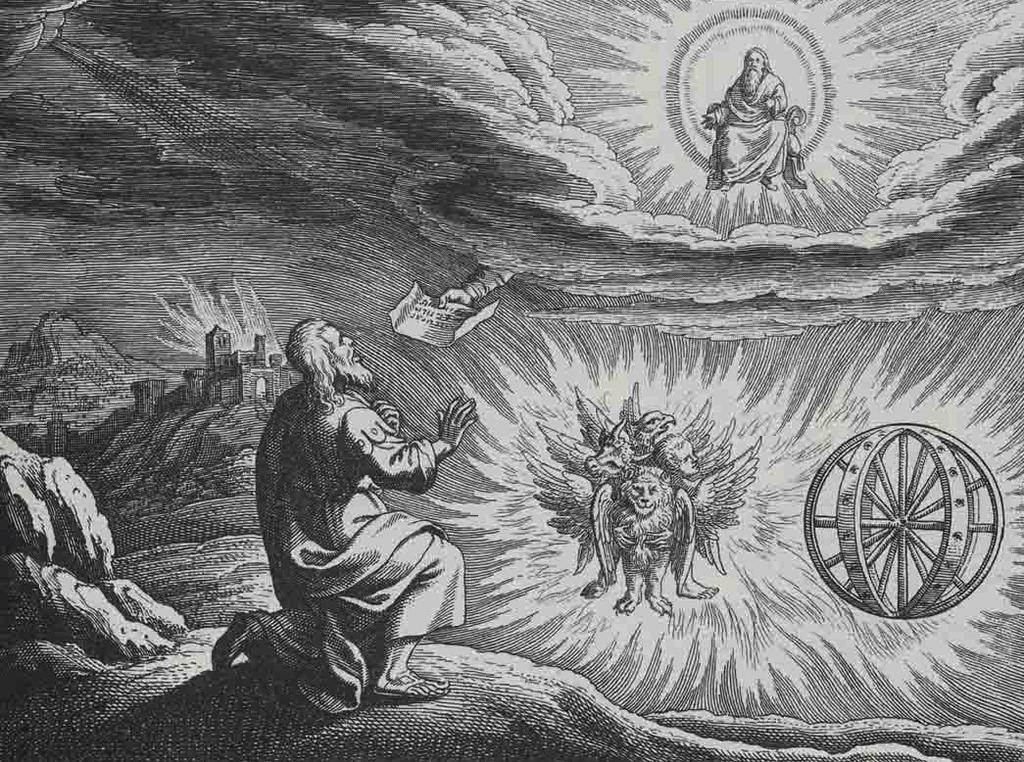
On Shavuot we also read from Ezekiel’s psychedelic vision of G8d. Ezekiel’s chariot –merchavah in a hyperlink from Shavuot to the banners in this week’s reading.Below: Ezekiel’s Vision according to Matthaeus (Matthäus) Merian (1593-1650) –

User uploaded media

WP-en. There attributed to site http://www.biblical-art.com/., Public Domain, https://commons.wikimedia.org/w/index.php?curid=4164018

A Solution to Entitlement?

The Shmitta (letting enslaved go home, letting the land lie fallow every 7 years) year and the Yovel, Jubilee year -each of theses is supposedly a chok – a mitzvah without rational explanation. The second of the double weekly reading -B’Chukotai – with my “chok”(plural) tells of the blessings and curses which result from following or disregarding these Mitzvot (commandments)

Leviticus 25:10 includes the words on the liberty bell: Keratem dror b’artzechah – Proclaim release/homecoming throughout the land. This is a spiritual homecoming. I disagree that the laws of Shmitta and Yovel are without explanation. They certainly are among the most radical and difficult and laws, particularly for the wealthy and powerful, to observe. It requires them to abandon free their slaves, to open their fields for the poor, and the wild beasts (!) and to become equal in status to other human beings. To give up the idea that they are entitled to what they or their ancestors have wrested from the earth and from others because (variously in the text): “G8d said so”, or because it is what the eretz or earth requires, or because it’s right. Here is one verse, and the Rashi Text that is interestingly an encapsulation of these laws (Sources Here)

(5) You shall not reap the aftergrowth of your harvest or gather the grapes of your untrimmed vines; it shall be a year of complete rest for the land. Here are Rashi’s comments on this one verse

(1) את ספיח קצירך THAT WHICH GROW OF ITS OWN ACCORD OF THY HARVEST — i. e. even if you have not sown it but it grew from the seed which fell into it (into the ground) at the time of the last harvest — and that is what the term ספיח denotes. (2) לא תקצור THOU SHALT NOT REAP [IT] — to take it as your exclusive property as you do with other harvests (with the harvest in another year) but it shall be owner-less (הפקר) to all and then thou also may reap of it. (3) נזירך [AND THE GRAPES OF THY VINE] WHICH ARE נזירים — i. e. those from which you barred people (שהנזרת) and from which you have kept them away, not having made them free to everybody. (4) לא תבצר THOU SHALT NOT GATHER — them thou must not gather, but you may gather from that which has been declared free to everybody (Sifra, Behar, Chapter 1 3).

The word “hefker” means owner-less – like a $20 bill you find on the street and nobody claims it. And the word “s’fiyah” means “with a mind of its own” This isn’t just about grapes, it’s about us, about wildlife. “In wildness is the preservation of the world, said Thoreau, We are meant to belong only to the One who formed us, and to have a mind of our own, at least every seven years, and to sound the shofar of freedom on the 50th year. Otherwise the wealthy and powerful feel they are entitled to own land, to own humans, to despoil the earth. Every 7 and then 50 years sounds about right to me, how about you?

There is a crack in democracy, that’s how the light gets in…

Whisper to us our limitations.

From “Defying Gravity” from the show “Wicked”

I’m through accepting limits

‘Cause someone says they’re so

Some things I cannot change

But ’til I try, I’ll never know…

But what about the limitations of someone with a physical disability, or the ultimate limitation of mortality?

This week’s Torah Reading, is “Emor” meaning “speak”. The root of the word is repeated three times in very short order. The word is not the only way to command “speak!” and its repetition has drawn commentary. For me the most interesting is from Mei HaShiloach (Rabbi Mordechai Leiner, 1800s) that “emor” means to whisper to the Kohanim who have these limitations put upon them.

“Emor – say,” means speaking softly.. G8d enjoins us to whisper into the ears of the servants of G8d that they should not hold grudges when it comes to G8d’s stern judgment, for the intentions of G8d are always in order to improve (sources here)

I love the chesed in this interpretation of how a person should speak limitations to another, and how G8d does!

This reading, like much of Leviticus, contains many laws that only pertain to the Kohanim, the Priests who offer other folk’s offerings to the Holy One of Blessing. So, why read them? Perhaps because we are meant to be a “nation of priests and a holy people”. Also, there are still descendants of Aaron, who will not go to a cemetery. The reading begins by telling the Kohanim not to approach the body of one who has died unless it’s a very close relative – it turns the Kohen tamei –ritually unprepared. Life is the the most magical thing we have, it is the gift that ties us to our Creator. On an emotional level, this law makes sense. Some illnesses also makes a priest tamei. However, does this taboo keep us from mitzvot of comforting the dying and honoring the dead? More importantly does it make the death of loved ones something that we see as unnatural, and make us unable to deal with it? In my childhood, I was shielded from death and dying. My grandpa left me in the car to visit his mother in the nursing home, and when she died, I was not taken to the funeral (or any funerals!) Many years later, I was pregnant and told not to come to the cemetery for his funeral. I was rarely taken to a shiva, memorial in the home of the bereaved. Mortality is the ultimate blow to our aspiration of being “unlimited”

Chapter 21 of Leviticus goes on to say to those who have a moom –a blemish on the symmetry of their body, or a birth defect or a broken limb. As Chapter 21 of Leviticus continues, it tells the Kohen that he is never to approach the Altar with offerings – in other words -not to be allowed do the job he was born into. These verses deeply trouble me, They imply that these men were less worthy. Does this come from the idea that beauty is gifted to those worthy, and that “ugliness, disability, deformity” are reflections of being less worthy intrinsically? I once saw a version of Cinderella on a kid’s show on Reading Rainbow, which showed the “ugly stepsisters” as being beautiful in the beginning. With each cruel act, their faces and bodies would twist until they appeared “ugly” toward the end of the play. The tale of Cinderella is problematic in so many ways, (a discussion for another time) but this move was brilliant! The real test of “beauty” is kindness, nothing else really matters. We are all of us in the Divine image, in all our fabulous diversity, all of our abilities. (See “Twilight Zone” episode “Eye of the Beholder”) In a discussion of politics with a cousin today, he revealed that selects his candidate in part based upon “are they attractive enough to win?” According to Maimonides, Guide to the Perplexed –Sources here –

The multitude does not estimate man by his true form but by the perfection of his bodily limbs and the beauty of his garments.

This is as true today as it was for Maimonides a thousand years ago, and in Biblical Times a couple of thousand years before that. When will we ever learn?

Rabbi Julia Beltzer, in her book “Loving Your Own Bones”, is disabled, and very troubled by these verses as well. When challenged to explain this verse says “I don’t justify it”. She explains, that it is a reflection of the deep prejudice against disabled individuals, and an attempt to assign these values to G8d.

Speaking from personal experience as someone who is at times, medically disabled, I did defy those limitations/gravity. It took me some time, but I overcame the limits that my situation said were true, and I took the leap to apply to, and complete Rabbinic and Cantorial school. I trusted my instincts, trusted in my faith, and leaped. Yet I know there will be limits, that I am not unlimited. When I am afraid, I lean upon my faith, pray for G8d to give me the wisdom to define and respect those limits. I hope these limits are whispered with kindness, but clearly enough to understand. I respect my limits enough to have stopped driving (no, I don’t miss it). But in offering songs of Praise to the One, and being a channel of the wisdom of our tradition to others, for now, I’m unlimited!

What are your limits? How do you know until you’ve tried “defying gravity?” If they are offerings to holiness, to kindness, to truth, may you defy gravity!

AI is not used to create any of my writings ~MW

What does it Mean to Aspire to Holiness?

This week’s Torah reading is a double one, Acharei Mot/ Kedoshim: After the Death/Holiness. After the death refers to the deaths of Aaron’s two eldest sons, Nadav and Avihu. As discussed previously I disagree with the interpretation that they were punished for some minor deviation from the rules. Rather they were holy men who died before their time. Their alien fire, aish zarah, was not choosing life, but choosing a pathway of union with G8d that led to their death. Sometimes these two Torah portions are read separately, sometimes together, depending upon the year (if there’s a leap month they are separated) This year they are read together. When I worked my clinical Pastoral work in hospice and when my mother recently passed, I wondered if there is any connection between “after the death” of someone and Holiness. There is an intense and mind-raising awareness about accompanying someone on the brink of life. We are more aware, of time and mortality and what lies beyond. The work for Holy in Hebrew is Kadosh, what what does “Holy” mean? and what does it mean to aspire to become holy? Leviticus 19 urges us to do exactly this: Kedoshim t’hyu ki kadosh ani YHVH You shall be holy because I, G8d am holy. There are many uses of this word in the Bible, including in the deaths of Aaron’s two sons (Sources here) Leviticus 10:3 Then Moses said to Aaron, “This is what G8D meant by saying: Through those near to Me I show Myself holy, And gain glory before all the people. What can that mean – is it possible that the deaths of these two makes G8d holy! Spoiler alert: this is a pathway that is not endorsed, so their passion is termed an aish zara an “alien fire”.

The word Kadosh is used for the dedication of spouses during a wedding – Kiddushin, a blessing to do a mitzvah asher kiddishanu b’mitzvotav, and even for Temple cult prostitutes k’deshah (which is forbidden in Deuteronomy) We are in the period between Passover and Shavuot when we count the days of the omer, Each day can be used for self reflection, for self improvement. But in the mystical tradition it’s far more intense than this. I discovered a text by Hayyim Vital, a student of R’ Isaac Luria in the 17th century called “Sha’arei Kedushah” meaning Gates of Holiness. Each of these days he spent in isolation, just him and G8d, each was a gateway to connection or union with the One if he were repentant enough, denied his ego enough. In mystical tradition only Moses was able to enter all 50 gates. (there are 7 weeks of 7 days, and then the Holiday of Shavuot). When you are on the verge of fainting, wrote Vital, you then offer this prayer:

“Master of all worlds, to you it is revealed and known that I am not engaged in this for my own glory, but rather for the glory of Your name, for the glory of the oneness of your being, so that I will know You, how to serve You and bless Your name. Enlighten my eyes lest I sleep the sleep of death. Create a pure heart within me”

…Sanctify your limbs and adorn them with Mitzvot (good deeds) making yourself into a throne for the Divine Presence, your body an ark for the Shechinah! (from p 122-3 Essential Kabbalah by Daniel Matt)

After this section of Aspiring to be Holy the text details many of these deeds to adorn yourself “into a throne for the Divine Presence” including the great Golden Rule of the Torah, “Love your near one as you love yourself” This is the core around which all Torah hinges. These things are what it means to be holy.

This is the fourth level – the sod or mystery – the ultimate aim of aspiring for holiness is those flashes of inspiration and knowledge that all is one, it’s all G8d. This is why kedoshim t’hyu is the same as v’ahavta l’re-acha kamocha in being central pillars around which the rest of Torah and our lives can be arranged and given direction! I suggest that the “ani Adonai which follows some of these commands are to, on this level dissolve the barriers between Ani and Adonai

From William Wordsworth (great name!) Tinturn Abby, quoted in Rabbi Aviva Gottleib Zornberg’s Hidden Order of Intimacy commentary on Leviticus

-with an eye made quiet by the power

of harmony, and the deep power of joy

we see into the life of things

note the synesthesia of the “eye” quieted by “harmony” reminiscent of seeing Sinai’s thunder!

April 22nd is Earth Day this year. This Archive Post for more on Earth Day and Kedoshim from 2021

Photo by Marcello Socket on Pexels.com

Empathy: Not just “Nice”, Crucial!

This week’s Torah saga is about empathy for the outcast, when you delve past the surface. On the surface it seems to be a medical handbook, perhaps about microbial control. Tamei is a word that has been translated as “impure” but actually means prohibited from offering sacrifices at the Temple. Giving birth, contact with a dead body, skin ailments that spread, and bodily discharges make a person tamei. Houses and garments can be infected too. It is not the doctor, but the kohen (priest) who inspects and decides whether or not the person’s skin ailment has progressed or regressed enough to perform the ritual to re-enter society. I have written about the contagion before, check it out here; returning following childbirth; and about how this is no ordinary illness, but one of the spirit which becomes visible on the skin. Psoriasis, for example as well as alopecia, lupus are all autoimmune diseases very much affected by anxiety, and stress. The Hebrew word for this skin disease, falsely translated as leprosy is metzorah. Midrash interprets this as evil talk, or gossip. “Therefore, Moses cautions Israel and says: “This shall be the law of the metzorah” the law of the defamer [hamotzi shem ra].” There is a famous Hassidic tale of a town gossip whose tales ruin the reputation and therefore the business of a new arrival in town. When he learns that his words have so wounded, he feels remorse, and goes to the town Rabbi. “How can I set things right?”, he asks. The Rabbi instructs the man to bring him his feather pillow. When he does, the Rabbi opens the window, opens and shakes the feathers loose. “Now go and gather every last feather back”, he instructs. “It’s impossible!” replies the gossip! “Just as your words, true or not, are out of your control once you let them loose.” is the lesson. (sources here)

There is a disturbing verse which snagged my attention. Leviticus 13:45

As for the person with tzaarat (scaly skin infection): their clothes shall be rent, their head shall be left bare, and their upper lip shall be covered over; and they shall call out, “tamei, tamei!”

It sounds pretty awful, I can’t imagine it being me – how humiliating! I would much rather be silent, to hide. If I had a scaly skin infection, that was thought to be contagious, would my crying out keep them away more than my wanting to hide under a rock? I don’t think so! The call of “tamei, tamei” however, can arouse empathy, and prayers for my healing, according to Talmud

On the other hand, what if I am outcast for the sin of gossip? Perhaps now, the public outcry is for the purpose of apology! I learned from Talmud (sources here) overcoming the silence and hiding just might be the reason for this calling out. Calling out in the night can arouse tears of empathy. We are commanded in Leviticus to love your near one as yourself. Silent suffering or silent apologies can both get in the way of that connection between people that is needed in community.

When I walk through the streets of Manhattan, I see forgotten folks. The unhoused are treated as invisible. Their hair is unkempt, their clothes are torn, they are banished from normal activities of life, and unlike in the biblical verses, there is no prescribed way back in to society. Their skin may be broken, or unsightly and people are repelled, perhaps afraid of contagion, or of irrational behavior. And if they cry out in their pain, the police are called. I make it a point to see, to give, to honor them as human beings, each with a spark of the Divine. It’s required in Torah – it’s the foundation of empathy and community. Empathy simply is our hope for a better world.

Recently “Empathy” has been in the news in a way that shocked me. Some were calling it a sin, a weakness Emanuel Levinas wrote in 1934 about ‘Hittlerism” and was inspired to write his argument: that seeing the face of another must arouse within us a sense of responsibility to care for them, no matter what. (source 1) He predicted what would become the Holocaust from an inability to respond with caring and apologies when we err. It is interesting that the crying of the defamer serves both as an apology and a plea to not be left alone forever. When we silence our own or others suffering, we are denied the mitzvah of praying for another, of crying with them, of the possibility of healing.